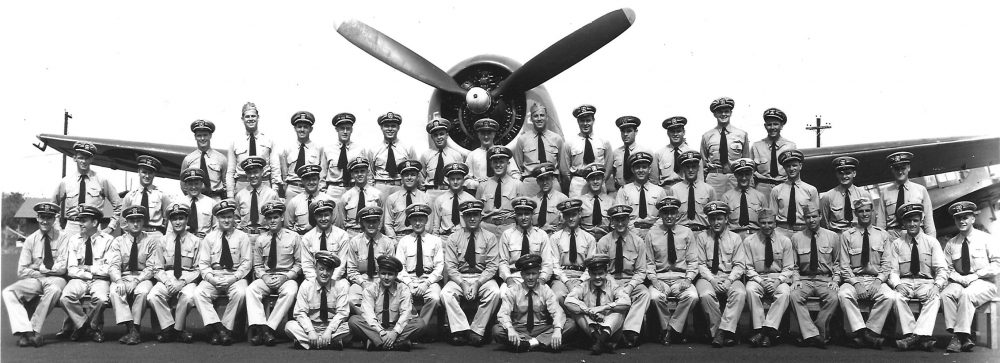
‘Your selection as a naval aviator would deprive others more fitted to the task.’
That was essentially the message Frank Foltz received from Admiral Nimitz’s office in 1942. He was twice turned down for shipboard duty, but Frank was persistent – after all, he wouldn’t let ¼” determine his fate. His sheer size was the problem. At 6’4”-and-change, 275lbs., the Navy thought Frank was just too big for a life that would consist of swinging through tiny hatches and cramming himself into the cockpit of a Hellcat.
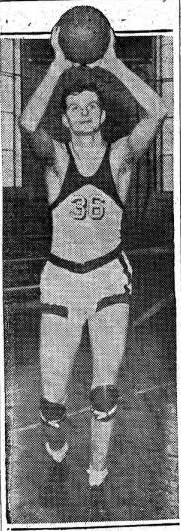
His height hadn’t always been a drawback. Foltz, who picked up the nicknames “Biggie,” “Spider” and “Duke” during his naval service, used his formidable frame to great advantage as part of the Stetson University “Hatters” basketball team. He lettered his freshman year, helping the Hatters finish their season with a 9-1 record and AAU state co-champion title. Fortunately for Frank, basketball turned out to be an integral part of life aboard Intrepid. Per the Air Group 18 official War History,
The only thing that could pass for organized sport was basketball, played on the forward elevator. Pop Thune and his five usually trimmed the highly touted ships-company team, even when Burley and Newsome were on our side.
Perhaps there was something about basketball that suited players to fighter pilot duty. Hal Thune played Big 10 ball for the University of Minnesota; VF-18 commanding officer Edward Murphy prowled the court for Marquette. Whatever the wellspring of his talent, the Navy was fortunate to have Frank flying. He always seemed to come out on top even when the odds were stacked against him.
On 29 October 1944, the odds were about as long as they come.
According to the War History, by late October the men were “depleted and exhausted”. Months of continuous operation were starting to take their toll. The Japanese were also getting wise to strike procedure. Lt. Comdr. Murphy complained that when strikes joined up at the same coordinates throughout the day, enemy aircraft learned exactly where to intercept incoming planes. The Americans were too predictable.
Even worse, Murphy felt that his fighters were not being used to their maximum advantage. Sometimes the Hellcats were loaded with bombs on escort missions. How were they supposed to protect the Avengers and Helldivers with heavy ordnance reducing their planes’ rate of climb and agility?
None of these issues were resolved by 29 October. Though the first full strike of the day, Strike 2A, ran into almost 40 enemy planes in the air over Clark Field, no significant changes were made to the day’s second strike (2B). That didn’t bode well for Frank. He lifted off Intrepid as part of Strike 2B a little before noon. Climbing into the air with a bomb-loaded Hellcat, he must have wondered how he was supposed to simultaneously function as a fighter-bomber and an escort.
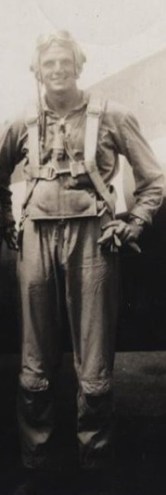
Clark Field spread out below him, pockmarked and blackened in places by the morning’s bombing raid. Frank watched as the Helldivers and Avengers of Strike 2B contributed to the devastation, wrecking parked planes and buildings alike. Once the bombers had lightened their loads, Frank picked out his target: a large hangar. He flew through a curtain of anti-aircraft fire to drop his bomb, and…he couldn’t tell if he scored a hit! There was no time to take a closer look, either. Japanese fighters were waiting in the wings for the Hellcats to descend. As soon as the coast was clear, they pounced on the unescorted men of Bombing and Torpedo 18. Frank poured on the coal. He urged his lightened plane up after the gaggle of Intrepid bombers.
They were already fighting for their lives up there. The Helldiver pilots managed to down a couple enemy planes, and tail and turret gunners in Avengers accounted for two more. But there were once again 40 or so Japanese fighters swarming above Clark Field. The exact problem noted by Ed Murphy – the inability of his fighters to provide consistent escort while themselves dropping bombs – was rearing its ugly head.
Frank was undeterred. Despite the disadvantage in altitude and numbers, he and a dozen or so Fighting 18 pilots flew right into the teeth of the enemy. They weren’t about to let their bomber brethren take it on the chin. The U.S. carrier fighters were superior pilots, flying superior planes, and they knew it. The results speak for themselves. While their Hellcats returned to Intrepid with considerable combat damage, they returned. VF-18 didn’t lose a single pilot; one bomber, an Avenger piloted by Nick Roccaforte, was lost over Luzon. In exchange, they destroyed 11 Japanese planes and claimed another 10 as probably destroyed or damaged.
Frank shot down two Zeros himself. He tagged a third plane as well, but its pilot wisely fled the scene while his plane was still airworthy. It was a virtuoso’s performance. Like a basketball player, Frank had been asked to play offense and defense virtually simultaneously.
It was later confirmed that Frank scored a direct hit on the hangar. Between his successful bombing run and the part he played fending off a force of enemy fighters twice as big as his own, Frank Foltz was awarded the Distinguished Flying Cross. October was really Frank’s month: on the 14th he shot down an enemy when the odds were 3-1 (awarded the Air Medal), and during the Battle of Leyte Gulf, Frank was credited with strafing an enemy cruiser and scoring a direct bomb hit on the #3 turret of the Yamato (awarded the Navy Cross).
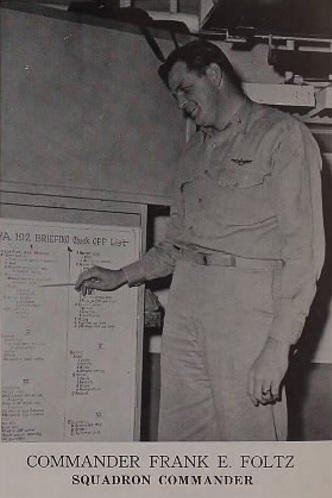
After the war, Frank transferred from the Reserves to career Navy, rising through the ranks until his retirement as a Captain. He served as skipper of a carrier fighter squadron – the “World Famous Golden Dragons” of The Bridges at Toko-Ri fame – as well as commanding officer of VFP-62, based at Cecil Field.
‘Your selection as a naval aviator would deprive others more fitted to the task.’ Well, nobody is right 100% of the time. We’ll give Admiral Nimitz a pass on this one.
 Two-a-Day 18
Pingback: Two-a-Day Tales: Brothers in Arms | Two-a-Day 18
They only gave him a squadron as an O-6?
LikeLike
Hi Jim! His first squadron CO job with VF- (later VA-) 192 was in October 1955, at which time he was a LCDR, or O-4. He then went to photo school and came out the other side of that to command VFP-62 as an O-5. At the end of his Navy tenure that was his post and he retired as an O-6. Thanks for asking!
LikeLike