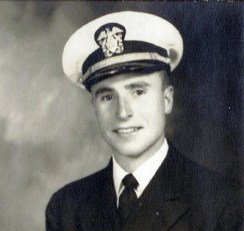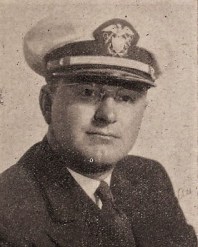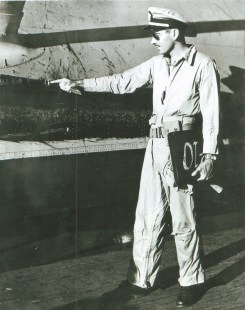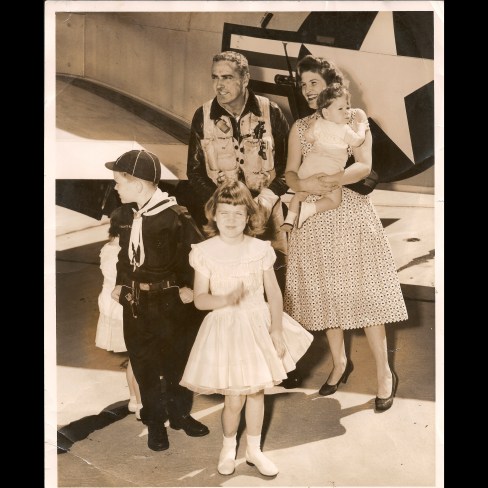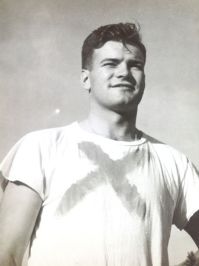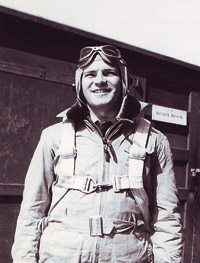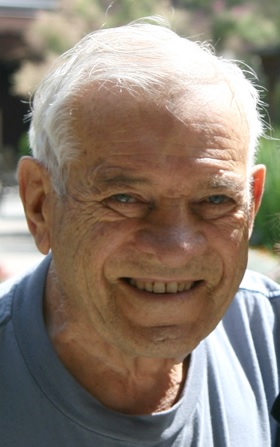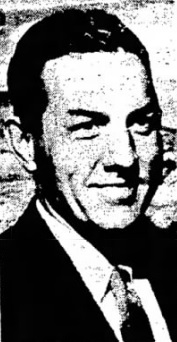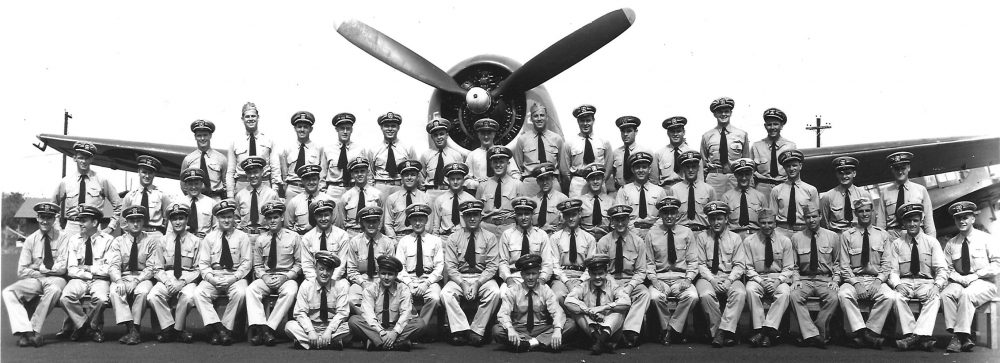
Two-a-Day Tales: Cecil Harris Pt. 1

“Cecil is not the kind to talk about himself…It was easier getting Cecil to tell about his family, and how proud he was of his brothers, Gerald, 24, a captain in the army; and Cpl. Calvin, 28, whom he last heard was in England.

-Morrie Landsberg, Associated Press reporter, Pearl Harbor, 1945
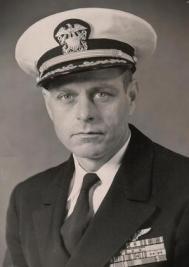
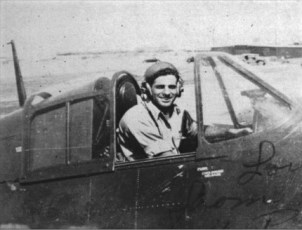
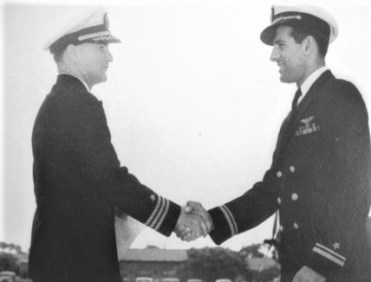
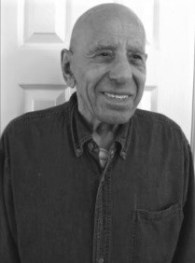
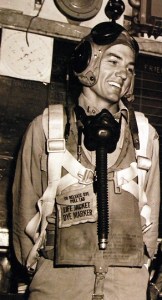
ceharrisShy, quiet, modest, reserved. Cecil Harris was a hard man to pin down with a spotlight. If he couldn’t outright avoid reporters, Harris would redirect them to his squad mates for the “real dope.” When that failed and he had to say something, Harris kept it brief. “I was lucky—and I had the best wingman in the world.” Unbelievable. How was the press supposed to dramatize that?

It made sense for war correspondents to circle Harris like hungry sharks. All they had to do was look at the numbers. 82 days of combat; 44 missions; 24 Japanese planes shot down; the Navy’s 2nd-highest scoring ace of WWII; and finally, 0: the number of bullet holes ever found in his planes. So forget “lucky.” The press—and by extension their public back home—wanted to hear about action.

Though demure on the ground, in the air he was as aggressive as they came. “You have to kick hell out of your plane,” Harris said in a rare 1945 interview, alluding to the kind of full-throttle flying that became his hallmark. He wasn’t exaggerating, either. Harris flew so hard and fast that fellow fighter pilots nicknamed him “Speedball.”

So who was the Navy’s “24-kill mystery ace?” Was he quiet Cecil Harris, or was he Speedball?

Cecil Elwood Harris was born December 2, 1916 in rural Cresbard, South Dakota. He grew up on a sprawling plot of farmland surrounded by fields of waving wheat and dozens of horses. Unfortunately, his coming of age coincided with devastating times for America’s agricultural community. Cecil was 13 years old when the United States plunged headlong into the Great Depression, and 17 when Dust Bowl storms ravaged his home state. Crops were destroyed and farmers lost their livelihood. Bankrupt families fled South Dakota in droves. The Harris farm survived these natural and man-made disasters, but Cecil, preparing to graduate high school, was already thinking about striking out into the larger world.

It was the mid-1930s. “Times were pretty hard then,” Harris recalled in a 1968 interview. So hard in fact that many farm families couldn’t afford to send their children off for a proper education. Harris, lucky to even attend high school in the first place, wanted to do his part to solve this problem. He enrolled at Northern State Teachers’ College (NSTC) in 1936 and in a year’s time was out in the vast countryside, armed with a teaching certificate and textbooks. He taught seventh grade in rural Onaka, SD for a few years before ultimately returning to NSTC to finish out his bachelor’s degree.

His timing couldn’t have been better. In June 1939, President Roosevelt signed the Civilian Pilot Training Act. Though ‘civilian’ is there in the title, the goal of the Civilian Pilot Training Program (CPTP) was to prepare a recalcitrant nation for war in the era of air power. Cecil had showed an interest in joining the Army Air Corps in high school but his parents overruled him. Now he was old enough to sign on the dotted line and his alma mater, NSTC, was participating in the CPTP. He enrolled in the fall of 1940 and secured his private pilot’s license by the end of the year. With war looming, the program ran full speed ahead. Cecil Harris was 1 of almost 10,000 Americans to graduate CPTP in 1940.

Cecil enlisted in the Naval Reserve in March 1941. As he moved closer to earning his Wings of Gold, America unknowingly headed toward “a date which will live in infamy.” The Japanese attack on Pearl Harbor came five days after Harris’s birthday, roughly halfway through his intermediate training course at NAS Corpus Christi. He earned his wings on March 12th, 1942 and completed Advanced Carrier Training in May within days of the first carrier-versus-carrier battle in history. Everything was falling into place.

The Navy put Harris in squadron VGF-27. The unit had 4 months to prepare for deployment. Given the recent battles of the Coral Sea, Midway and the Eastern Solomons, it seemed likely that his squadron was soon to be fighting the Japanese. But Cecil wasn’t going to the Pacific. At least not yet.
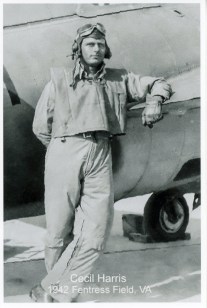
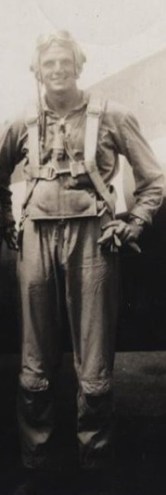
Harris Fentress 1942

He was headed for Africa aboard a recently-converted oiler. His ship, the escort carrier USS Suwannee, was called upon to provide air support during “Operation Torch,” the Allied invasion of French North Africa. Suwannee was slower, smaller and held fewer aircraft than a ship like Intrepid. Its pilots also got more prosaic duty. While fleet carrier fighter squadrons attacked enemies in the air, escort carrier fighter squadrons (that’s what ‘VGF’ stood for) performed supporting roles: patrolling the skies above U.S. ships or strafing enemy antiaircraft guns on the ground. Theirs was thankless but vital work, less glamorous than dogfighting but just as deadly.

On the day of the invasion, November 8th, 1942, Harris was circling protectively above the fleet on Combat Air Patrol (CAP). He and his commanding officer anticipated hours of boredom. Vichy French pilots refused to bring the fight to the carriers, so there was no chance for air-to-air combat. On the bright side, the lack of enemy planes gave Harris and his CO a chance to hunt bigger game: the largest battleship in the French Navy, the Jean Bart, which was sitting stationary at the nearby port of Morocco. Harris got his fill that day diving on the behemoth warship with his guns blazing. He couldn’t possibly have imagined that in two years’ time, he’d be taking on an even bigger ship halfway around the world.

With its job off the African coast complete, Suwannee headed out for duty in the South Pacific. The bloody campaign for Guadalcanal had just wound down and the flight duty that was left was frankly boring. Day after day, Harris and company flew convoy escort missions through waters seemingly abandoned by the Japanese. Then, on March 6th, 1943, the squadron got exciting news. A detachment of pilots and crew from VGF-27 was needed on Guadalcanal to reinforce the island’s slender defenses. Practically everyone volunteered given the monotony of the past months. Cecil Harris was one of 22 men chosen for the assignment. He was about to get a taste of life in the “Cactus Air Force.”

The Chief Yeoman of VF-27 (the squadron dropped the ‘G’ when they moved ashore) kept a log of his experience on Guadalcanal with Harris and the other flyboys. Reading excerpts from that journal, one wonders why anybody would volunteer for such duty. The men probably asked themselves the same thing while they sat in their soggy, mosquito-infested tents, listening for the drone of Japanese bombers. One colorful incident paints a vivid picture of life on Guadalcanal. “We made fudge – took it off fire and put in tent to cool. Charlie came. Dropped a bomb on bomber strip – got a couple B17s and 1 bomb hit ammunition dump – caused plenty ammunition to go off. Big fire…he came back. Got some more good hits…Shrapnel flew in center of us – very lucky no one was hit…would have killed anyone it hit. T’was serious but comical the way everyone fell into their [fox] hole. I went in on my back. Plenty muddy – not much fudge ate.”
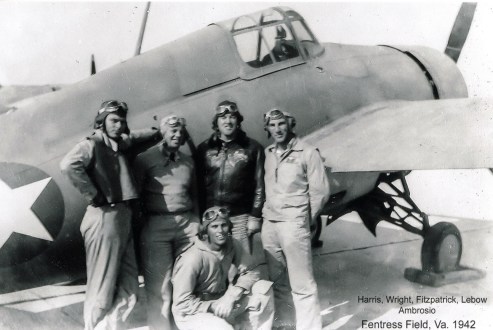
harrisfentress

A week after this incident, on Thursday, April 1st, eight men from VF-27 were chosen for flight duty as part of a larger force of 40 planes sent to attack targets on the Russell Islands. Harris was in one of his squadron’s divisions along with his buddies Frazier, Sweetman and Lebow. After months of flying, Harris had not yet engaged a single enemy aircraft. Well, April fools! 40 Japanese Zeros were waiting over the target to intercept the Allied strike.

In the wild air battle that ensued, Cecil accounted for 2 of 6 enemy planes shot down by VF-27 and returned to Guadalcanal without incident. What happened to the other men in his division better illustrates the carnage of the fight. Frazier was forced to crash-land his F4F Wildcat. His plane was so shot up that it looked like a sieve. Sweetman made a pretty landing—then fainted due to blood loss. His whole cockpit was mangled by enemy cannon fire. Worst of all, Lebow was forced to bail out far from base. He’d been close with Harris since the squadron first came together back in Virginia in 1942. His condition was unknown.

It’s hard to imagine a tougher introduction to war. VGF-27 was out almost continuously from September 1942 to September 1943 and by the end of its prolonged combat tour, suffered 66.7% casualties. Harris thus came to VF-18 as the squadron’s most experienced combat veteran.
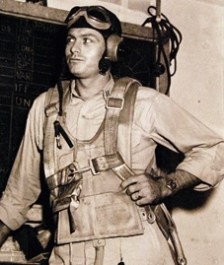
Harris IntrepidFighting 18 is the squadron Cecil Harris made it. Harold Thune, another VF-18 pilot, said that Harris “was very much responsible for training our squadron. Our skipper…was wise enough to recognize Harris’s ability. When we first formed the squadron he made Harris the Flight Officer, who was responsible then for training.” Cecil inculcated his fellow fighters with that “kick hell out of your plane” philosophy. He was a teacher by trade, so he taught.

The Grumman Hellcat flew differently than its predecessor, the more sluggish Wildcat, so a change in fighter tactics was due. Dogfighting and turning inside the enemy was old hat. The Zero excelled in this kind of engagement. The Hellcat, on the other hand, was made to fight on the vertical: diving in, climbing hard, hit-and-run-and-hit over and over again. Fighting 18’s record is proof enough that Harris’s system worked like a charm.
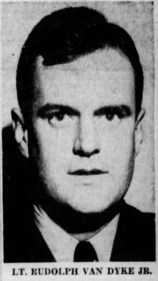
Two-a-Day Tales: Rudolph Van Dyke

Van Dyke Journal Herald 1945In the early 1950s, Rudolph Van Dyke’s employer wanted to find out if “Rudy” still retained the air-to-air gunnery skills that made him a World War II fighter ace. To measure him against the best of the best, they sent Rudy to Nellis Air Force Base in Nevada to duke it out with pilots from the 3525th Aircraft Gunnery Squadron. According to the results, Rudy, “…rated above average when compared with experienced U.S. Air Force fighter pilots.” If the Air Force fighter jocks knew who they were flying against, it might have taken away some of the sting of losing to a Navy boy. After all, Rudy Van Dyke was not only one of America’s leading test pilots, he was also one of the fastest men on planet Earth.
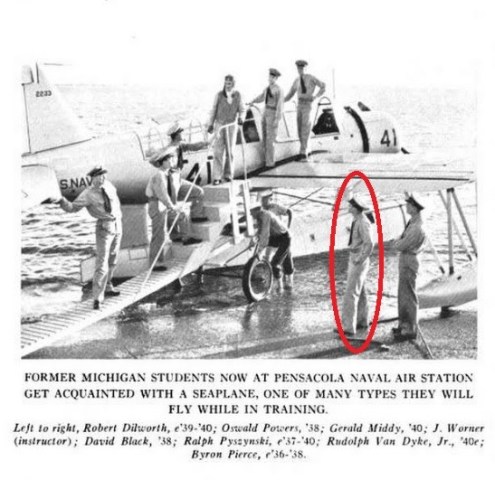
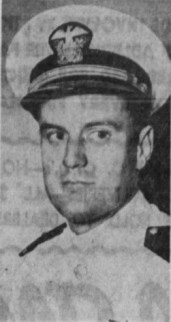
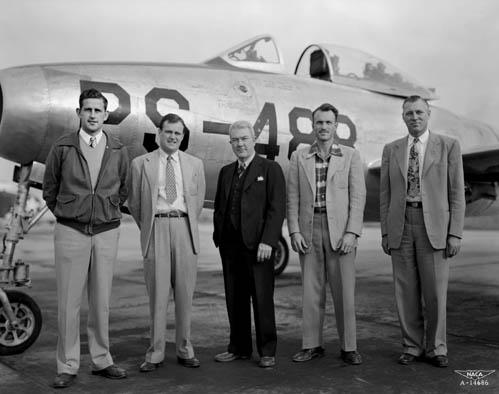
Rudolph Daniel Van Dyke, Jr. was born September 28, 1918 in Berkeley, California, but he grew up in Dayton, Ohio. He built model aircraft as a child and “guessed he always had been interested in flying.” He had a need for speed as well. In 1937, while enrolled at the University of Michigan for aeronautical engineering, Rudy got busted for “speeding 70 miles an hour and reckless driving.” He was fined $20 and his license was suspended for 30 days. However, this incident didn’t prevent Rudy from graduating with the class of 1940, nor did it make a difference when he signed up for the Navy’s aviation cadet program that July. Soon, the idea of “speeding” at 70mph would seem ludicrous.

In training, Rudy flew everything from Stearmans to seaplanes. He earned a place in “the Caterpillar Club” when he was forced to jump from a training plane, but that didn’t stop or even slow him down. He earned his commission as a naval aviator in late June 1941. As his plane-handling skills improved, his natural gunnery proficiency and penchant for speed led him to fighter duty. Rudy bounced around between temporary assignments close to home, at NAS Grosse Ile, Michigan, and as a recruiter in Cincinnati, but these were just pit stops on the way to Intrepid’s VF-18.

UMich Rudy

Like many other ace pilots in Fighting 18, Rudy scored the majority of his victories over Formosa (Taiwan). His mission on the morning of October 12, 1944, stands out not just because of his success in combat, but because it demonstrates how fiercely fighter pilots protected their bomber brethren.

Rudy was assigned to Strike 2A, the first full carrier strike launched against the island. Intrepid’s contribution was 12 Helldiver dive bombers, 9 Avenger torpedo planes and 5 Hellcat fighters. When the weather closed in on the primary target, Kirun (Keelung) Harbor, the majority of the strike proceeded to the alternate site at Tansui (Tamsui), a nearby seaplane base.

Kirun was bristling with antiaircraft guns and bustled with fighters overhead. Tansui was a different story entirely. Antiaircraft fire was meager and no airborne opposition was encountered. As a result, the Avenger pilots and crew “took their time and made the bombs count.” The dockyard, seaplane ramps, bunkers, a freight yard, freight cars and a gunship were seriously damaged or destroyed. Tansui was in flames in a matter of minutes.

In reality, the Japanese hadn’t abandoned Tansui at all—their pilots were just biding time until they had speed, altitude and the element of surprise on their side. As soon as Intrepid’s spent bombers started heading out of the strike zone, a dozen Japanese Army Air Force fighters streamed out of the overcast with guns blazing. Rudy and his quintet of Hellcats peeled off to engage, luring Japanese pilots away from the bombers and into aerobatic dog fights, but there were only five of them, and as many as fourteen of the enemy.

Rudy was not about to let these interlopers have their way. His first opponent flew a ‘Tony,’ a Kawasaki Ki-61 single-seat fighter. Rudy’s opponent pushed his stick down in an attempt to shake him, but it was too late. The Hellcat’s bullets tore through the engine from above. One down! With superior skill and technology at his disposal, Rudy got on the tail of yet another Tony, raking it from stern to stem as it attempted to dive away. A third followed. It was shaping up to be a banner day. The other Hellcat pilots tallied four between them and a handful more probably destroyed or at least damaged. The first wave was driven off without incident, but the fight was far from over.

Van Dyke Dayton Daily News 1941

Rudy in the Dayton Daily News circa 1941

An additional group of 10 – 12 Japanese fighters appeared on the scene. Intrepid’s fighter jocks were back in the hot-seat and running low on ammunition. The bombers pushed ahead while the fighters had it out, but in short order another fourteen enemy planes pounced on the now-unescorted planes. The sky was thick with them. Helldiver gunners, the last line of defense, let roar with their twin 20mm guns as Intrepid pilots pushed their planes to the limits. The running fight covered 70 miles, but the determination of pilots and their crew prevented any losses. In fact, a Helldiver gunner was credited with shooting a Japanese fighter off another plane’s tail.

The Avengers were having an equally tough time of it. A separate group of 12 – 16 Japanese fighters attacked while Rudy and company were preoccupied. Like the Helldivers, the Avenger pilots pulled in tight together and let their guns do the talking; .30 and .50 caliber gunfire kept the lightly armored Japanese planes at bay.

On the horizon, Rudy saw the Avengers circled by a couple remaining Japanese fighters carefully testing the formation for an opening. He pushed his plane to catch up as he watched the formation disappear into the clouds, the Japanese in hot pursuit. Two more planes to his name would make Rudy Van Dyke and ace-in-a-day.

He closed the distance swiftly, buzzing between the formation and the enemy aircraft, making run after run on the Japanese planes. The enemy pilots turned tail and ran now that they had a Hellcat to contend with. The pilots of Fighting 18 had done their job: not a single bomber was lost to enemy aircraft.

Rudy may not have made ace-in-a-day, but the back-thumping and outpouring of thanks he received from the ‘Torpeckers’ aboard Intrepid no doubt made up for it. In any event, he couldn’t have shot those planes down no matter how good his aim had been. Rudy’s gun were empty either before he engaged the enemy or shortly thereafter. Even when his ammunition ran out, he kept attacking, determined to protect the Avengers at any cost.

He ended the war an ace after scoring again on October 14 and October 29. In 1946, Lieutenant Commander Van Dyke retired from the Navy after five and a half years of service. He was awarded the Silver Star, Distinguished Flying Cross and three Air Medals.

Returning to civilian life did not mean leaving the cockpit. Rudy signed on with NASA’s forebear, NACA, as one of its premier test pilots at Ames Research Center in California. Though he married Helen Joy Pestell in 1948 and became a father a few years later, he never did slow down. If anything, he sped up.

Ames Pilots Rudy 2nd Left 1949

Ames research pilots circa 1949. Rudy Van Dyke pictured second from left.

Rudy Van Dyke became one of the unsung heroes of aeronautical research during his time at Ames. He was one of three principal test pilots for Ames’ first Variable Stability Aircraft. Such aircraft are still used today, such as the NF-16 VISTA operated by the USAF Test Pilot School at Edwards Air Force Base and have contributed to advanced fighter and V/STOL aircraft design. He also served as the primary pilot of an F6F-5 Hellcat from which an SB2C Helldiver was flown remotely, the first demonstration of this kind at Ames.

NASA’s official histories of Ames remembers Rudy for something much more fitting, though: speed. Specifically, his pioneering efforts pushing the sound barrier. It is worth quoting one of these histories in full to give Rudy his fair shake:

“George Cooper and Rudy Van Dyke began flight tests of the Air Force’s new F-86A Sabre in 1949. They made prolonged dives, starting from 46,000 feet, in which the F-86A reached very high speeds. These flights opened up the aircraft’s supersonic envelope and preceded North American and Air Force tests of the aircraft at these speeds. At about the same time, people in the general area began to hear explosions that occurred without any apparent reason. Eventually, these “explosions were correlated with the dive tests of the F-86 Sabre; they occurred when the aircraft reached supersonic speeds. This was the first time the “sonic boom” phenomenon had been associated with the supersonic flight of an aircraft. It is also noteworthy that these two pilots were routinely breaking the sound barrier at a time when only a small number of others, based primarily at Muroc Dry Lake, had done the same thing.”

These were dangerous pursuits to be sure, but any test flight could be dangerous. On June 1, 1953, Rudy climbed into the cockpit of an F8F Bearcat—a piston-engine propeller plane nowhere near as fast as a Sabre—and rolled down the runway into California skies. As he climbed upward, he put his plane through maneuvers, testing its response until he gradually leveled off. Nobody knows exactly why, but from that point on Rudy’s plane went into a steep dive until it slammed directly into San Francisco Bay. He did not survive the crash.

Rudy was just 35 years old at the time of his death. He was an accomplished pilot and a father of two infant children. Rudy’s bravery and sacrifice advancing the science of aviation came from somewhere deep inside of him; from the same wellspring that made him fight unarmed against two enemy planes in order to protect his fellow pilots.

As a fitting end note, I want to point out that Rudy’s contribution to aviation science and his pioneering spirit are alive and well at NASA’s Ames Research Center, Rudy’s old employer. Ames is currently responsible for configuration and systems engineering for the X-59, a low-boom flight demonstration aircraft that’s paving the way for the next generation of commercial supersonic planes. They’re working off a legacy that’s over 70 years old, one which traces its roots back to Rudy Van Dyke.

Two-a-Day Tales: George Naff

Naff in Cockpit

George in the cockpit, from a 2012 veteran’s profile by Sandra Powers (hereafter Powers 2012)

There are a number of men who served in Fighting 18 whose stories may never be told. The material traces of history needed to understand their personalities and lived experience—newspaper clippings, photographs, personal accounts and correspondence—may never make it into wider circulation. This is especially true for men who went missing or were killed in action, and for replacement pilots who played supporting roles alongside original members of the squadron.

George Naff, up until recently, was an edge case. Some biographical information and photographs exist on the web thanks to his retirement community’s newsletter, but that didn’t constitute enough to write something substantial about George’s character and wartime contribution. Then I stumbled on the the World War II History Project, a non-profit whose mission is to find, record, save and preserve the stories of World War II participants. They conducted an interview with George that I was fortunate enough to transcribe[1]. All of a sudden, another “Two-a-Day” pilot loomed out at me from the shadows of the past.

George Naff was born in Springfield, Ill. on June 13th, 1923, only a year after his parents emigrated from Lebanon to the United States. George’s large family (he was 1 of 7 children) was forced by the Depression to pack up shop and head to Detroit, MI, where his father opened a family-run grocery store.

George was in the middle of his undergraduate education at the University of Detroit when Japan attacked Pearl Harbor. He feared being drafted into the Army—not simply out of a personal aversion to foxholes, but because his loss would put a serious economic burden on the family-run business back home. He solved the problem by heading into the nearest Navy recruiting station and enlisting in February 1942.

Becoming an aviator was a no-brainer for George. He had a fascination with aircraft dating back to childhood bicycle rides past Detroit Municipal Airport, where he’d stop to watch planes take off and land. After completing Navy pre-flight training in early 1943, he was sent to nearby Naval Air Station (NAS) Glenview, just outside of Chicago, for primary flight training. A further trip to NAS Corpus Christi in Texas brought him to the end of his training regimen. He was awarded his coveted Wings of Gold on July 7th, 1943.

George earned himself a prized billet as a fighter pilot, but as the Navy reorganized the fleet and shuffled carrier pilots between units, he found himself tossed hither and yon as a replacement. He was pulled from training with a fleet carrier air group to perform escort carrier duty, then was detached from that ship to fly off land bases in the Admiralty Islands. It was only after this carousel of deployment that George finally landed with Fighting Squadron 18 (VF-18) aboard USS Intrepid.

Because he was not an original squadron member, George felt like something of an outsider. He was close with Charles DeMoss—another “Two-a-Day” pilot we’ll soon meet—but he didn’t feel like he was one of commanding officer Ed Murphy’s favorites. These feelings didn’t seem to have an effect on George’s ability as a fighter pilot, though: he shot down 4 Japanese planes, narrowly missing confirmation of a 5th that was recorded as damaged.

George Naff DFC

George (right) receiving the Distinguished Flying Cross, from Powers 2012

His first 3 victories came during the Formosa Air Battle, a period of extreme peril for Intrepid. On the evening of October 12th, 1944, enemy bombers sent torpedoes churning through the water around the carrier. A shock felt amidships near the No. 2 elevator was suspected to be a dud torpedo. Attacks against the carrier task force continued through the 13th and 14th as Japanese desperation mounted. Cruisers Canberra and Houston took torpedoes, and these were no duds. George was flying Combat Air Patrol (CAP) on the 14th when a large raid was spotted heading for Intrepid.

The enemy arrived in waves with more than 20 bombers spread out in small groups of 2 and 3 aircraft, forcing Intrepid’s 12 CAP pilots to split up to cover as much sky as possible. George dove down on his first target, closing from the side to shoot at the wing root and fuselage of the plane. It splashed down well shy of the vulnerable flattops. George repeated this a second time: climb for altitude, dive for speed, rake another enemy plane with his .50cals until it careened into the ocean. George was getting closer and closer to Intrepid when a third threat came into view.

One last dive bomber was making headway, zooming up off the ocean’s surface in a huge arc as it entered the first phase of its bombing run. The ships’ guns opened up in a cacophony of noise, throwing up as much flak as possible to drive the invader off. George was undeterred—he knew that if even a single bomber made it to the carriers, it could prove fatal. He closed the distance as the bomber nosed over. His machine guns blazed down over the enemy’s wing until it was practically sawed off by bullets, causing the Japanese plane to spiral out of control towards the water below. Out of over 20 Japanese planes participating in this attack, only 1 broke through the CAP; it didn’t manage to score a hit.

Naff at Home

George in his later years, from Powers 2012

George Naff was awarded his second Distinguished Flying Cross for fighting off these attackers. His first was awarded for participation in the Battle of Leyte Gulf. Though he may have been a replacement pilot who felt like an outsider, George’s combat record marks him as a central figure in the saga of Fighting 18.

After the war, George finished out a degree in aeronautical engineering so he could continue to work in the field of flight. To that end, he moved out west with his wife Delphine to start a career with the Hughes Aircraft Company. George and his growing family remained on the west coast where he worked his way up into a management position within Hughes.

Following his retirement in 1997, George attended regular meetings of the “Old Bold Pilots Association,” a group of combat aviators and test pilots from around the world who, like George, maintain a lifelong love of flying. Their name pokes fun at the old adage that, “There are old pilots and bold pilots, but no old, bold pilots.” George died on March 23rd, 2017; in his nineties, having participated in some of the largest sea and air battles in the Pacific: an old, bold pilot.


[1] I want to call attention to and thank all those Intrepid volunteers who transcribe the Museum’s oral histories. Speaking as both a volunteer and employee, these documents are critical to the interpretation of the ship’s history, as well as the Museum’s collections and exhibits.

Two-a-Day Tales: Richard Cevoli

Quite a few members of Fighting 18—including some of those previously chronicled in these tales, like Clarence Blouin, Frank Foltz and Cecil Harris—made the Navy their career. They served with distinction in the post-war era as squadron commanders and even carrier skippers. Richard Cevoli was another Two-a-Day alumnus who went on to an illustrious career, albeit one cut tragically short. During his time aboard Intrepid, Cevoli destroyed planes on the ground and in the air, scored hits on enemy ships and generally made life difficult for his Japanese adversaries. But that’s only the beginning of a Navy odyssey that took him from Japanese territory in the 1940s, to Korea in the 1950s and into the history books. Aside from Cecil Harris, Cevoli is certainly the most famous member of Fighting Squadron 18.

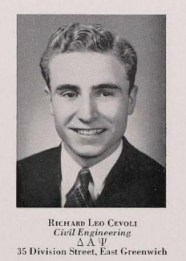
Richard Leo Cevoli was born October 24, 1919 in East Greenwich, Rhode Island. He attended Rhode Island State College (now the University of Rhode Island) and was a member of both the American Society of Civil Engineers and Delta Alpha Psi. His senior yearbook chronicles the feelings of the Class of ’41 as world events unfolded around them:

“Europe [is] in flames…This is the last stretch of college life for most of us, but somehow there has been the uneasiness, the restlessness of what is in store for us and for our nation.”

Richard Leo Cevoli 1941 Grist Univ Rhode Island

On October 9, 1941, in the midst of this uncertain future, Richard Cevoli enlisted in the United States Navy. His early assignments were many and varied. Cevoli was enrolled in the very first class of the Navy’s Photographic Interpretation School and graduated in February 1942. The next month he was aboard seaplane tender USS Albemarle (AV-5) while it lay at anchor in Narragansett Bay. This new posting was much more closely related to his engineering background. As a non-flying officer in Patrol Squadron 73 (VP-73), Ensign Cevoli helped review Albemarle’s damage control procedures.

It was a far cry from carrier flight duty, but world-historical events were moving forward at lightning speed. The question posed by his yearbook, “What is in store for us and for our nation,” had been answered. Japan had attacked Pearl Harbor; Singapore had fallen; more recently, MacArthur had been ordered to flee Corregidor. Uncertainty had given way to resolve in the face of these setbacks, not just for the nation but for Cevoli as well.

By the time he joined Fighting 18 in Hawaii (spring – summer 1944), Richard Cevoli held the rank of Lieutenant. In a squadron primarily composed of Ensigns and “jaygees” this made him a senior flier. Rank aside, he proved his worth in the cockpit time and again while attached to Intrepid. October 1944 was a particularly busy month for the ship and its air group. Cevoli was no exception to this rule. In October he logged 18 missions totaling 67.1 hours of flight time and marked a number of ‘firsts’ in the process: first air-to-air engagement, first fleet engagement, and first Navy Cross earned.

During the first full strike of the Formosa Air Battle on October 12, Lt. Cevoli was one of only 5 VF-18 personnel chosen to protect Intrepid’s bombers and its strike leader, Air Group Commander William “Wild Bill” Ellis. Dozens of enemy fighters rose to intercept the strike including a group of Japanese Army Air Force “Oscars” (Ki-43s). Though the Aircraft Action Report for that strike indicates Ellis, Cevoli and another pilot were “jumped” by 3 Japanese fighters while they scouted to the north of the target area, Cevoli came out on top. He survived the enemy’s first pass and maneuvered into position, pouring .50cal rounds into the fuel tanks of one of the attacking aircraft until it “blazed violently” and “the plane spun earthward…” In the ongoing fight, it must have been impossible to follow the Oscar down to the deck to verify the outcome—it was counted as ‘Probably Destroyed.’

On October 24, Lt. Cevoli celebrated a major milestone: he’d survived to see his 25th birthday. That was no small feat. In the grueling weeks prior, at least 7 of his fellow Fighting 18 squad mates had been declared either Missing in Action or Killed in Action. But a birthday doesn’t buy a day off in wartime, least of all when a massive formation of Japanese battleships is steaming towards you full-tilt. The Battle of Leyte Gulf was underway and Cevoli was about to spend the next 3 days strapped in, guns charged, carrying 500 lb. bombs for the largest naval engagement in history.

He spent the first day of his 25th trip around the sun flying through heavy flak raking enemy ships with gunfire. It was dangerous work without the glamour of air combat or the satisfaction of bomb hits, but it was vital work nonetheless. The Aircraft Action Report from the strike records the danger of enemy anti-aircraft guns: 2 TBMs were destroyed and 3 Helldivers were damaged, including 1 which crashed the deck and was subsequently written off as a loss. Without fighter suppression this could have been much worse.

cevoli-1944 RIAHOFHalsey went north that night to chase Japan’s decoy carrier force, bringing Intrepid and the other ships of Third Fleet to bear against the empty flattops on October 25. When Lt. Cevoli took off that morning sometime between 6:30 – 7:00am, he was loaded with a 500 lb. bomb and determined to make it count. The strike group climbed to 16,000 ft on its way to the strike zone. From that altitude, the whirling and wheeling of the Japanese carriers below must have looked like some kind of toy boat regatta run amok.
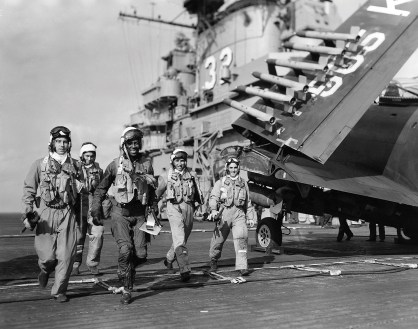
Cevoli watched the Helldivers push over in their dives, then joined his fellow fighter-bombers as they angled their noses down in preparation for their attack on a light aircraft carrier (CVL). His plane picked up speed, diving steeply at 70° through “a terrific barrage of anti-aircraft fire…” He kept his nerve and his aim was true. Out of the 4 fighters engaged in this attack, Lt. Cevoli was 1 of 2 credited with a probable hit on the target. “The CVL slackened speed and appeared to be burning.”

The final day of the Battle of Leyte Gulf required superhuman endurance from a few VF-18 pilots, among them Richard Cevoli. He flew 2 strikes for a total of 9 hours on October 26, and that was after two previous days of flying! He was credited with shooting down a “Jake” seaplane, scoring a near miss on a Kongo-class battleship and subsequently strafing an enemy destroyer, suppressing its anti-aircraft fire while nearby aircraft continued to hammer the battleship. For his actions from 24 – 26 October, Lt. Cevoli was awarded the Navy Cross.

At war’s end, the newly-promoted Lieutenant Commander (LCDR) Cevoli decided to stay with the Navy, initially operating out of Quonset Point, Rhode Island as Training Officer. He was thereafter assigned as Executive Officer (XO) of Fighting Squadron 32, and in March 1950 he put out a want ad in the Quonset Scout newspaper: “RIDER WANTED—Someone to drive automobile 1949 Ford, to the west coast first week of April. Call LCDR Cevoli, Ext. 621.” Whether or not someone took him up on the offer, Cevoli made it to the Pacific coast where he was again face-to-face with an Essex-class carrier. This time it was USS Leyte (CV-32), one of the last of its class to enter service. Carrier training quickly gave way to redeployment after North Korean forces pushed past the 38th parallel in June 1950. Richard Cevoli was going back to war.

U.S. Navy history records December 4, 1950 as a day of tragedy and heroism. For flight leader LCDR Cevoli, it started as another freezing cold day flying his F4U Corsair over snow-capped Korean mountains. He was leading a group of pilots—including Jesse Brown, the first African-American Navy aviator—in support of U.S. and U.N. forces fighting a desperate retreat at the Battle of Chosin Reservoir. Being a flight leader and division leader in a squadron breaking the race barrier was no easy task, and it was up to Cevoli to make sure the pilots flying with Brown trusted him and were willing to take orders from him. Lt. Thomas Hudner, a Naval Academy graduate senior in rank but junior in flight experience to Brown, was interviewed by Cevoli and found to have “the right stuff” to fly with this groundbreaking division.

Ensign Jesse L. Brown, first African-American Naval Aviator

Ensign Jesse Brown and other members of Fighting Squadron 32 aboard the USS Leyte.

Though he wasn’t facing massive anti-aircraft guns like the ones encountered at Leyte Gulf, enemy small arms fire still represented a threat to Cevoli and his division as he led them in towards the target. There was always the “golden bb” to worry about, that proverbial magic bullet that could hit a pilot or a vital area of his aircraft. Even a round from a soldier’s rifle could spell disaster for a plane flying at low enough altitude.

On the way in, another pilot assigned to the strike, Lt. Bill Koenig, noticed fuel streaming from Brown’s aircraft. It was a worst case scenario: a bullet had punctured his fuel tank. There was no way he could keep his Corsair airborne for long. The ground below was uneven and rocky and the balance of power on the ground was skewed heavily toward enemy forces. Brown had no choice but to go in for a wheels-up landing, putting his Corsair down hard on the slopes below. Cevoli and his fliers circled overhead. After a tense moment, Brown was able to indicate he’d survived the crash. Cevoli radioed for a rescue helicopter and told his fliers to stay on station, but time ticked by and Brown remained inside his cockpit. The crash had buckled part of his plane and pinned him down. He was trapped.

Lt. Hudner couldn’t bear to stand helplessly by in the holding pattern overhead. He defied his orders and intentionally crash landed near Brown’s plane, trying in vain to rescue his friend. Hudner was ultimately unable to free Brown from the cockpit, and as the sun went down he was forced to board the rescue chopper, watching as the broken Corsair receded into the distance. For his efforts that day Lt. Thomas Hudner earned the Medal of Honor. He was the first naval aviator to achieve that distinction in the Korean War.

The loss of Jesse Brown was a bitter pill to swallow but Cevoli and his fliers had to power through it. The men on the ground still needed them. Strike efforts continued into the new year. The Quonset Scout reported on January 14, 1951, “Warehouses and supply depots in the area were left in flames by a flight led by LCDR Richard L. Cevoli, USN. Twenty-five military buildings were destroyed, plus attacks on 18 troop concentrations.” Fighting 32 was already known for its excellence—in fact they’d won the battle efficiency ‘E’ the previous year—but it’s easy to imagine that they pushed themselves even harder in 1951 to avenge the loss of their squadron mate.

After Korea, Cevoli’s experience and excellence propelled him to command of his own unit, Fighting Squadron 73. He had more than 10 years as a naval aviator under his belt. He’d gone from propeller powered Hellcats and Corsairs to the jet-powered Grumman Cougar. But no amount of experience guarantees safe return from a mission. Whether it’s a “golden bb,” mechanical failure or anything else, the hand of fate can claim the life of an aviator at any time. On the night of January 18, 1955, at the conclusion of gunnery training with his squadron, Cevoli took off towards Oceana, VA. Something went wrong shortly after takeoff. His plane crashed into a heavily wooded area along the flight path.

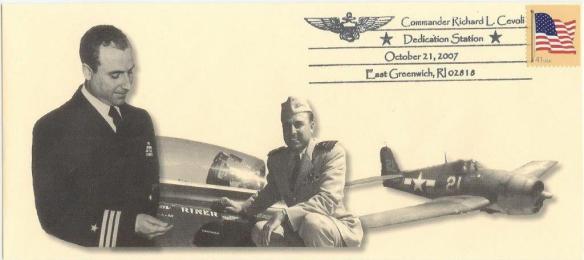
Commander Richard L. Cevoli was buried with full military honors later that month. He left behind a wife and four children, including a week-old son, Richard L. Cevoli, Jr. His home state of Rhode Island—which he returned to time and again during his Navy career—inducted him into its Aviation Hall of Fame. In 2006 the Rhode Island state legislature passed a bill renaming the post office in Cevoli’s hometown of East Greenwich in his honor. And today, whatever day you might be reading this, we join together to honor the life and legacy of an American hero whose career as a combat aviator started close to 75 years ago aboard USS Intrepid.

cevoli-cover (1)


Two-a-Day Tales: Supporting Cast

Before takeoff, during flight and after landing, combat pilots are assisted by a large group of highly specialized individuals. Without coming close to cataloging the whole cast of characters, there are: parachute riggers, aviation machinists, fighter director officers (FDOs), landing signal officers (LSOs), flight surgeons. Their jobs aren’t as romantic as a fighter pilot’s, but without their expertise the fighters would never get airborne in the first place. Without them, the odds of a pilot’s survival plummet. And finally, without their support, a pilot’s physical and mental well-being—constantly under assault by the stresses of war—deteriorate markedly. These behind-the-scenes experts greatly influence a squadron’s success.

Jeep Daniels

Some truly remarkable men filled these roles aboard Intrepid. Robert W. Daniels, Jr., whom everyone called “Jeep”, served as one of the ship’s fighter director officers. His job was to monitor radar returns in the Combat Information Center (CIC). Upon sighting an unidentified aircraft (a ‘bogey’), he’d vector the ship’s fighters toward its location for intercept. It took a specialized group of individuals to fill this role. Ideally they had experience as fighter pilots themselves. It helped, too, for an FDO to have managerial experience, since radar returns could indicate enemies coming towards the carrier from every direction. These men needed a kind of “big picture” mentality to adequately and simultaneously address threats from all quarters.

Jeep fit the bill to a ‘T’. He flew fighter missions from the escort carrier Sangamon in 1942 during the Allied landings at North Africa. Amazingly, Jeep’s unit, Fighting 26, had been commanded by none other than William Ellis, the commander of Air Group 18 aboard Intrepid. As a result, Jeep had valuable experience as well as a personal connection to the fighters he directed from CIC. Daniels’ managerial prowess is attested to by his post-war success. He went on to become one of the fathers of cable television and is responsible for bringing broadcast TV out beyond the Rockies.

One Fighting 18 pilot, Robert “Dave” Davis, recalled the kind of magic Jeep could work. October 29th, 1944 was the busiest Combat Air Patrol (CAP) mission Dave Davis could recall. His 4-plane division was flying with fighters from Hancock and as such was under the control of the fighter director from that carrier. The Hancock FDO was hard-pressed to intercept the numerous kamikaze aircraft in the sky that day. Since he was less familiar with the Intrepid fighters, Davis and company wound up circling over the fleet awaiting orders while the Hancock fighters were getting their vectors. It almost seemed as if his group was forgotten amidst the chaos.

Then Davis heard a voice coming through over the radio. “Dave, I’ve got one for you.” It was Jeep stepping in to pick up a bogey the Hancock FDO had apparently missed. It turned out to be a “Val” dive bomber—one of the types of aircraft Japan used to attack Pearl Harbor. Jeep directed Dave out to the lone kamikaze plane, keeping in constant contact until the Val appeared in a hole in the clouds right below him. Dave Davis brought the Japanese plane down before it could complete its deadly errand. It was Davis’s last aerial victory of the war, and at number 5, the one that made him an ‘ace’ fighter pilot.

Doc Fish

Back aboard the carrier, it was the responsibility of another man to tend to pilots after their ordeal. October 29th introduced Fighting 18 to Japan’s shocking new suicide tactics. It also proved to be a day of wild air-to-air combat. Intrepid’s fighters shot down almost 50 enemy planes over Clark Field. Including Dave Davis’s CAP kill, Two-A-Day 18 added 4 aces to its roster. Some men were shot down and listed as Missing In Action; others returned to the ship in poor shape. Two suffered from wounds caused by 20mm shell explosions and 7.7mm rounds slicing through their planes. Kenneth Crusoe had the tail hook tear right off his Hellcat during landing. His plane careened into the crash barrier in the middle of the flight deck hard enough that he was listed “Status SERIOUS—cracked or broken vertebra.”

John Winston Fish, the air group’s flight surgeon, was there right away to minister to the pilots and crews. Men with nerves frayed by the day’s events could count on bourbon from “Doc” Fish. Kenny Crusoe definitely got a stronger prescription for his wrecked back.

A flight surgeon’s job was difficult. On the one hand, Doc Fish had to care deeply for his flyboys, keeping detailed records concerning their mental and physical wellbeing. On the other, he couldn’t become so attached that he allowed himself to make decisions which diminished the strength of the air group. Keeping pilots flying and flying effectively was his primary responsibility. Doc must have walked this line remarkably well. He was popular not only with the pilots but with the ship’s officers as well, including Admiral Gerald Bogan.

The lives of these two men—Jeep Daniels and Doc Fish—came together in a remarkable way on Intrepid’s darkest day, November 25th, 1944. Doc’s battle dressing station was on the gallery deck, beneath the flight deck. He was busy working to save the lives of men injured as a result of the first kamikaze hit. Jeep, meanwhile, was virtually next door in one of the squadron ready rooms. Just then a second suicide plane barreled into the ship, sending shrapnel slicing through the flight deck into the space below. Men were cut down in ready rooms and gallery deck hallways. Doc Fish, unfazed by the first kamikaze strike, working diligently with a team of men to keep the injured alive, was cut down where he stood by the second plane. His whole team was killed by the blast.

If Jeep had been in a different ready room, he too would have been killed. As it was he could hear the groans of survivors floating through the smoke choking the gallery deck. He sprang into action. “…one of my squad mates was trapped with his leg half blown off. I had to apply a tourniquet, cut off the rest of his leg, administer morphine, and carry him up two flights to the flight deck for help.” He came out topside for fresh air and to deposit the wounded man, but he didn’t stay there long. Around 25 men from Air Group 18 were trapped down in the torpedo workshop. Jeep Daniels and a member of the ship’s company went back into the ship armed with smoke helmets. They reached the suffocating group in the workshop and managed to lead them up out of the ship; sometimes Jeep had to carry them.

Someone brought Doc Fish’s body to the flight deck. Anguished men of the air group worked for hours to resuscitate him—to no avail. They were stunned. The man who’d kept them living and breathing throughout months of grueling combat could not himself be saved. John Winston Fish was posthumously awarded the Bronze Star for his service aboard Intrepid. The men of Fighting 18 surely never forgot him. Robert William Daniels, Jr. was likewise awarded the Bronze Star for his efforts to save men trapped inside his burning ship. Jeep Daniels never forgot the men of Fighting 18, especially those who didn’t come home. “…I saw so many of my squad mates and friends fail to return from missions or killed right before my eyes….I think they should have been as lucky as I was to return home to their families.”

These two men are just the tip of the iceberg. When we think of “Two-A-Day 18” and their success in the Pacific, we should do our best to remember the remarkable men back aboard the ship who made it all possible.

Two-a-Day Tales: Clarence Blouin


Clarence Blouin Portrait Navy Uniform for First Wife Eunice

Fighting 18’s nickname derived from the squadron’s prowess in air-to-air combat, but serving in a WWII Navy fighter squadron entailed so much more: Combat Air Patrol, Snooper/Anti-Submarine Patrol, bomber escort, photo. reconnaissance, strafing targets on land and at sea, vector searches…the list goes on and on.

Though lacking in Hollywood glitz and glamour, these other functions were equally if not more important than dogfighting. Clarence ‘Pent’ Blouin didn’t knock down as many Japanese planes as Mallory or Foltz (previous subjects in this series). However, his outstanding leadership and ability were instrumental to the success of both his squadron and his air group.

Clarence Arthur Blouin was born January 27, 1917 to Lucien and Agnes Blouin. Clarence grew up in Whitinsville, MA, home of the Whitinsville Machine Works—at one time the world’s leading producer of textile machinery. Whitinsville was one of those rare examples of a beneficent company town. Profits were plowed back into the construction of community centers; company stores sold goods without price gouging. At peak, the Whitin family company employed more than half of the village’s 10,000 residents.

Among them was Lucien Blouin. His 53rd year of employment with the company and 50th wedding anniversary were both celebrated in the machine works’ annual newsletter, The Whitin Spindle, in 1959. Also mentioned in that publication are his four sons’ “outstanding records in the armed forces.” That’s no exaggeration: after distinguished careers, the Blouin boys retired with ranks ranging from Commander to Vice Admiral.

‘Pent’ Blouin was one of VF-18’s oldest and most experienced pilots. He’d actually spent time at shipboard duty as a bluejacket in the late 1930s before he made himself a ‘Mustang,’ earning his commission as an officer—a naval aviator—in March 1942. He was also probably the first man in the squadron to encounter enemy forces. On 10 May 1942, while piloting a PBY Catalina as part of Patrol Squadron 71, Blouin and his crew were attacked by a Japanese ‘Mavis’ flying boat. The huge, four-enginge Mavis opened fire first and was in turn fired upon by Blouin and co. Though his plane took a beating, Blouin’s gunners managed to flame one of the enemy’s motors, causing the burning Japanese plane to turn tail and run.

By the time he came to Fighting 18, Clarence was a full Lieutenant and considered experienced enough to lead his own four plane division of fighters. He led selflessly and always from the front, undertaking risky low-level strafing missions against land and ship-based antiaircraft fire. He was awarded the Silver Star for doing so. But in the Pacific, sometimes the weather proved just as deadly an adversary as any man.

Perhaps Pent felt the hand of fate on his side on 29 October 1944. After all, the previous day he’d “splashed” a Japanese bomber long before it could reach Intrepid. It couldn’t hurt that his call sign was “Lucky 2.” Good omens abounded. However, his luck—and the luck of the other men flying Strike 2 Charlie, the third strike of the day on the 29th—ran out just shy of the ship.

Clarence Blouin Early Career PBY5 Damage

The strike itself had gone well: an even dozen enemies shot down in the air without a single loss to the bombers or fighters. Blouin’s ship was on the other hand being…uncooperative. Intrepid had taken her inaugural kamikaze hit right around noon. Enemy aircraft continued to loiter about Task Group 38.2 throughout the afternoon in the hopes of inflicting still more damage. It must have been with a measure of relief, then, that Admiral Bogan found his ships enveloped in a storm just before sundown. The squall would shield his flattops from further assault. It would also make coming back to base an absolute nightmare for the men of Strike 2C.

Nighttime carrier landings are harrowing enough. The “Mission Beyond Darkness” (20 June 1944) is embedded in Navy lore for a reason. But trying to find the flight deck in the dark with wind and rain and pitching seas? Operational losses could have stacked up tremendously. Could have, if not for the brave efforts of Bud Williams, Cecil Harris, and, at the center of it all, Clarence Blouin.

Williams managed to keep his Avengers together on their night run in towards the ship. Seeing the weather and assessing the fuel situation, he decided to bring all his ‘turkeys’ down for a group water landing. Normally losing so many aircraft would be frowned upon, but these certainly qualified as extenuating circumstances. With the consummate skill of a conductor, Williams led all 6 planes down, landing them close enough to one another that the men were able to lash their rubber rafts together into a veritable flotilla. All 18 men made it free of their sinking bombers and were subsequently rescued by destroyers.

Blouin had other ideas for the Hellcats and Helldivers. Leaving the rest of the planes circling on the edge of the storm front, Pent plunged into the miserable weather to grope his way blindly towards Intrepid. He tried to radio clear-weather coordinates to the ship, but she wouldn’t budge. Winging back out to the periphery, Blouin steeled himself and disappeared into the storm for another check. Time and again he braved the elements, trying in vain to coax the ship out to meet its planes. But making all of these passes further taxed his scant fuel reserves. Time was running out.

Risk a water landing in the clear or a carrier landing in the storm? There was no easy answer. Blouin was leaning towards the water option when Cecil Harris cut in on the radio saying he thought he could make it to the ship. And just like that Harris was off into the stormy night.  Miraculously, he found not only a carrier in the murk, he found his carrier! Blouin and the other men followed suit until only a few planes remained in the air. Some planes from Cabot and Hancock even came back to Intrepid. Thanks to Blouin and Harris’s daring, just one fighter pilot was lost in the storm.

Pent’s bravery and leadership took him far in the Navy. From division leader, he went on to command his own squadron (VF-172) and then Air Task Group. He was promoted to Captain and held a post on the 2nd Fleet staff before ultimately advancing to skipper of his very own Essex-class carrier, the Lake Champlain. Clarence Blouin retired after 35 remarkable years in the service, blazing a trail from enlisted man to captain as confidently as if he were flying into the teeth of a storm.

Clarence Blouin, wife Mary Gene and Children


Two-a-Day Tales: Edward Ritter


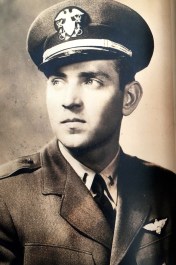
Official Navy Portrait

Edward Arthur Ritter was born January 3, 1921. A Brooklyn native and Pratt Institute graduate, Ed worked as a layout artist at the advertising firm of Abraham & Straus before answering his country’s call. While in training at Naval Air Station (NAS) Melbourne in Florida, Ed took advantage of a five day home leave to get married to his childhood sweetheart, Joan. She sojourned back to Florida with him after tying the knot.

Lord knows it wasn’t easy for the newlyweds. They stayed at a motel off base—no air conditioning!—and Joan would wait for Ed to come home after dangerous days training in F4F Wildcats. One day while she was out at the beach, the Ritters’ friend Larry came sprinting through the sand with an urgent message: Ed’s plane had crashed. Larry was short on detail; Joan was long on imagination. She expected the worst.

It turned out Ed had come down hard after gunnery practice—hard enough to blow both his tires. His plane veered into a sandy embankment on the side of Melbourne’s narrow runway where his flat tires bit into the soft ground below, suddenly halting and then flipping his Wildcat upside down.  But an angel must have been riding on the wing that day. Ed walked away with only a bad headache. After a visit to the hospital, a precautionary spinal tap and a week off, he was returned to flight duty.

Fortunately for Ed his angel stuck around. He lost at least two more planes during his stint in the Navy, once at Pensacola when another pilot collided with his, and again over the fleet when his shot-up plane couldn’t deploy its landing gear. Both times he came away unscathed. In his later years, when he recounted these incidents to his granddaughter Valerie, Ed turned on his typical self-effacing humor: “I got as many of our planes as I got of the enemy.”

Ed’s time aboard Intrepid was characterized by this combination of equal parts hard luck and miracle. While flying cover during a photographic mission on 12 October, his plane was hit by anti-aircraft fire that spread shrapnel throughout his cockpit and set fire to his external fuel tank. Ignoring the bits of metal freshly embedded in his arms, Ed held his Hellcat steady and jettisoned the burning external tank. Despite damage to his plane and person, Ed managed to shoot down a Japanese fighter pilot that attacked him on the way back to Intrepid.

But he wasn’t home free yet. He also survived friendly fire from fellow fighters. Navy pilots used their belly fuel tanks, which Japanese fighter aircraft usually lacked, to distinguish between friend and foe. After being forced to get rid of his tank Ed may as well have painted rising sun ‘meatballs’ on his wings. Fortunately, the other fighters realized their mistake before Ed’s plane took any more abuse.

By late October Ed had managed to set an impressive record: for almost two months straight, he’d been given a “cut” by the Landing Signal Officer on his first pass landing aboard Intrepid. NAS Melbourne had clearly been a learning experience. Ed’s streak was unfortunately broken in dramatic fashion on 29 October. Flying as part of Strike 2C that day, following Blouin and Harris through the storm discussed in last month’s installment, he found it virtually impossible to get into the groove for landing. It took 13 passes (lucky number 13!) before he got the signal to cut his engine. Then the pitching deck of the ship heaved up into his landing gear, buckling the metal to send him skidding across the flattop into a gun mount just shy of the island.

Yet another close call for Ritter, who made his angel work overtime.

Ed’s credentials as a fighter pilot are unassailable. He shot down four enemy planes during his time in the Pacific. He was also handpicked to fly as wingman to VF-18’s first squadron commander, Edward Link, while the group was still training stateside. Ed shared something with his squadron that was even greater than his skill at the stick, though: his talent as an artist.

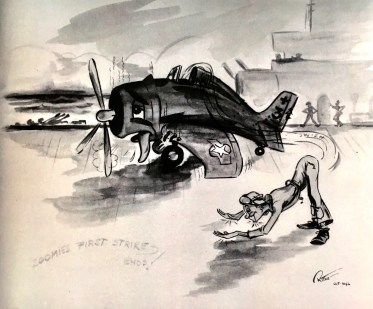
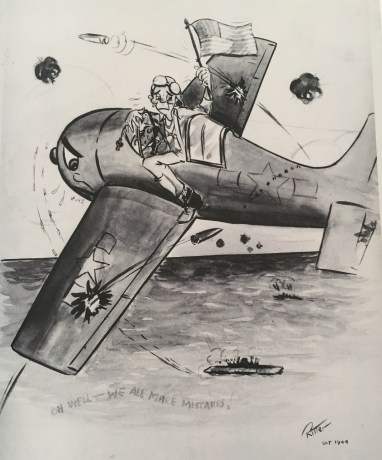
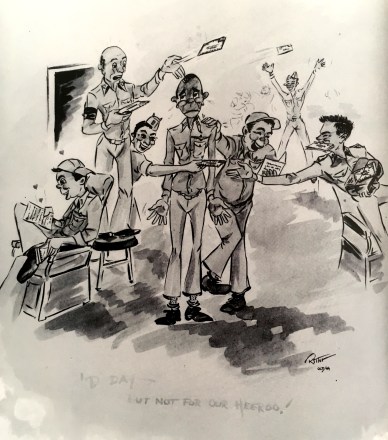
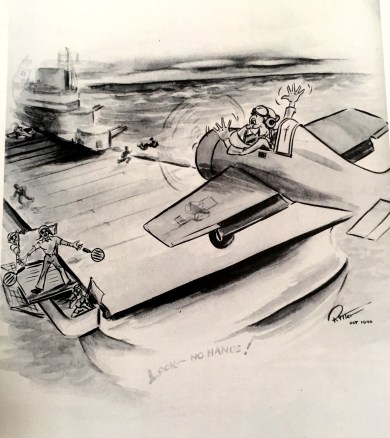
Between October and November 1944, Ed painted 26 watercolors which bring to life the daily experience and emotion of a WWII carrier pilot. Most popular among Ed’s creations was Snipo, a cock-sure, carefree cartoon character modeled—at least in terms of looks—on fellow “Two-A-Day” pilot E.G. Blankenship. Snipo was funny, charismatic, a daredevil through and through. In one piece we see Snipo goofing off, coming in for a “hands-free” landing aboard Intrepid. In another he’s daydreaming about War Bond tours with beautiful women. The men in the squadron no doubt commiserated with Snipo going stir-crazy after three months aboard his ship; Snipo outnumbered and in trouble in the air; Snipo drinking (perhaps too much) in the officer’s club; Snipo forlorn and empty-handed as everyone else got mail from back home. It’s all here in deft brush strokes, captured with a clarity surpassing even official squadron histories.

Needless to say, everybody awaited the next installment with bated breath. Who was going to get lampooned this time? What new mischief would Snipo get up to? Ed’s art buoyed his shipmates’ spirits in trying times, giving voice to their shared fears and aspirations. “The Fox” gets singled out for spreading hopeful rumors about making it home in time for Christmas. From the cockpit, Snipo waves an American flag, hoping friendly flattops will stop shooting at his plane. When “our hero” Snipo lands back aboard after his first strike mission, the carrier deck “looks good enough to kiss.” Sure enough, the big-eared fighter jock is pictured bent double, affectionately patting and kissing his flattop.

We’re lucky on a number of counts that these paintings survive today. The ship’s photographer thought they were excellent specimens and took pictures of the whole lot in November ‘44. On the 25th of that month, when two kamikazes crashed through Intrepid’s flight deck, all of the originals were consumed by the ensuing flames. That very well could have been the end of it. Ed suspected Snipo was long gone. Almost a year later, he was surprised when he received a bulky package containing photos of his artwork. These reproductions were donated to the museum by his granddaughter and are now held among the museum’s collections.

Edward Ritter won two Distinguished Flying Crosses during his tenure aboard Intrepid in addition to numerous battle stars and the award of a Purple Heart. After the war, Ed and Joan moved to Glen Cove, Long Island to raise their two children. Ed returned to work doing what he loved, finishing out a successful career as a professional advertising artist. In 1982 he must have thrilled to sit in the lead car during that year’s Memorial Day Parade where he received a special proclamation from the town’s mayor. And of course, just months later, Intrepid was pulled up to dock on the west side to testify to the valor and sacrifice of men like Ed. Mr. Ritter passed away on July 31, 2010.

Ritter Snipo Deck KissRitter Snipo Friendly FireRitter Snipo Mail CallRitter Snipo No Hands

A postscript for Snipo. Gerald Blankenship, the model for Ritter’s screwball pilot, died only a few years after the war, leaving behind a three year old son named Gary. Like Valerie, Gary has donated some of his father’s effects to the museum. Last year in Intrepid Advancements, Gary said of Ritter’s art, “I feel like I finally got to know my dad, through the personality of Snipo.”

Two-a-Day Tales: William Mufich

Bill Mufich Asst Football Coach 1945

“Butte Rat” sounds like an insult to the uninitiated. Rats are thought of as dirty. They scurry about underground in their hardscrabble existence, getting only brief glimpses of sunlight and whatever food they can pilfer from the world above. But residents of Butte, Montana wore the Rat label with pride. They thrived on adversity. They shared a unique set of experiences which they carried into outlying areas—into university towns and centers of commerce seemingly a world apart from the mining town that led to their nickname.

William P. Mufich was a Butte Rat par excellence. He was born on December 5th, 1919, the youngest of 4 children. Growing up, Bill spent time outside the classroom helping in the mines alongside his father and older brother. He was smart and athletic, and actively encouraged by his father and the bosses in the mines to pursue a college education.

His athletic talent helped him get there. As a member of the Butte High School ‘Bulldogs,’ Mufich caught 3 passes for 46 yards in the 1937 State Championship game, helping bring the title home to Butte. His performance that year earned him a slot in the All-State team as well as a scholarship to play pigskin with the University of Montana ‘Grizzlies.’ Bill wasn’t the fastest man on the field and he wasn’t the biggest, either. He was known instead for his toughness, intelligence and accuracy. More than anything else, though: “He was a teammate kind of guy. Whatever his role was he just bolstered up the other guys.”

These attributes stood Bill in good stead after his college graduation in 1942, when he enlisted in the U.S. Navy. Aviation was his path from the get-go. Bill took naval aviation courses at Carroll College in Montana before being shipped off to Pre-Flight School at St. Mary’s in Oakland, CA. He couldn’t have known back in high school that the skills he developed playing football would see him through life-and-death trials untold miles from home, far above the underground world of his youth. His alma mater’s fight song would soon ring with portentous meaning:

Up with Montana, boys / Down with the foe

Good ol’ Grizzlies / out for a victory

We’ll shoot our backs / ‘round the foemen’s line

Hot time is coming now / Oh brother mine

Bill graduated from Corpus Christi just 1 week before Intrepid’s commissioning. At that point Ensign Mufich still had a long way to go before he was ready to join Fighting 18. While the core members of his future squadron conducted carrier qualification aboard the USS Copahee, Bill continued to work his way through the training process. He made it to Hawaii just in time to integrate into VF-18 before their assignment to Intrepid and their deployment to the Pacific. Because he was not an original member of the squadron, there are virtually no mentions of Bill’s daring flying in War Diaries or War Histories. Those records were written and curated by men already welded into a decidedly closed fraternity—like “plank owners” to a ship. Instead, we have to look to the Aircraft Action Reports to learn more about Mufich’s time aboard the Fighting I. It’s evident looking through these documents that Bill served in the air the same way he had on Montana’s football team: as a quiet, competent team player who contributed to the squadron’s overall success.

Twice in October he flew alongside Cecil Harris. “I was lucky to serve with him,” Bill later said, and with good reason: Harris was in the air with him on both of his scoring days. These weren’t just days that put rising sun flags under Mufich’s belt. They were days of blood, sweat and tears on the part of Fighting 18; days that hearkened back to Bill’s college fight song: “Hot time is coming now oh brother mine.”

Bill’s first scoring day arrived on October 14th amidst the Japanese counter-attack on Third Fleet. Formosa absolutely had to be neutralized before the liberation of the Philippines, but there was serious risk stationing the carriers that close to the nexus of enemy air power. The Japanese attempted a series of ‘shuttle bombing’ attacks during the Formosa Air Battle, using their unsinkable aircraft carriers—the Ryuku Islands, Formosa and the Philippines—to stage hit-and-run raids on Mitscher’s flattops.

Bill Mufich Senior Living MedlinePlus Article WWII Suited Up

Fighting 18 would have none of it. A Combat Air Patrol (CAP) of 12 fighters launched in the early afternoon to swat down Japanese attack aircraft. Bill Mufich was in one of the 3 divisions circling protectively overhead Task Group 38.2, waiting for hours until enemy planes arrived on the scene. It’s easy to think about these missions in football terms. The Fighter Director Officer aboard Intrepid was the play caller, making sure the men in the air knew the overall game plan and were ready to execute. The senior flyer in the air became the quarterback, calling audibles as necessary. Once the two sides were lined up it became a game of inches.

That’s where the analogy ends. No referee blew the whistle for too many men on the field despite the fact that around 30 Japanese planes showed up to test the defensive capabilities of Intrepid’s dozen Hellcats. They came in low over the water in small groups to throw off radar—no such thing as ‘Offside’ in war. Still, they didn’t stand a chance against Two-A-Day 18. Most were D4Y ‘Judy’ dive bombers, including the 2 planes shot down by Mufich. He must have been skimming the water, since he took his first plane head-on and from below. Bill dropped the second plane from behind, scoring hits “all over” the enemy plane according to official reports of the CAP flight. 23 of the 22 Japanese pilots who attempted to break through Fighting 18 were shot down; 1 plane broke through to score a near miss on the Hancock, but enemy forces were routed without much to show for it.

By late October, kamikaze attacks proved that a single airborne enemy plane posed a deadly threat to the carrier fleet. This new menace needed to be rooted out at the source, and that’s exactly what Intrepid’s Air Group 18 attempted to do on October 29th. Strikes flew throughout the day bombing, strafing, and otherwise disabling the hub of kamikaze activity at the former Clark Air Base. Bill Mufich departed Intrepid with Strike 2C, the last arrow in the quiver sent out from CV-11 that day. On retirement from their strikes the bombers were attacked by 12 Japanese fighters, all of which were shot down by Intrepid’s 13 Hellcats. Mufich claimed 2 of these and in so doing, helped to prevent any of Intrepid’s bombers from being shot down by enemy fighters.

For the above actions Bill Mufich was awarded first a Distinguished Flying Cross, then a Gold Star in lieu of a second DFC. Mufich was also awarded an Air Medal for strafing a destroyer during the Battle of Leyte Gulf. He left the Navy in 1945 with the end of the war. “The Navy was good to me,” Bill admitted, not least because he met his future wife Thelma, a WAVE, at NAS North Island. It also bears mentioning that Mufich was one of many men who returned to VF-18 stateside for its reformation and anticipated redeployment. The Butte footballer knew he was on a winning team.

Bill returned to his native Montana later that same year. Despite having a full plate as assistant football coach for the Grizzlies, attending law school and settling down as a newlywed, Bill continued to serve his country in various capacities. Notably, Mufich served for 20 years with the Montana Air National Guard, retiring as a Major; and spent 15 years in the Montana wing of the Civil Air Patrol, retiring as the unit’s Executive Officer. His twin loves were flying and football, and he stuck with them to the very end.

William P. Mufich—World War II fighter pilot, successful lawyer, Butte Sports Hall-of-Famer and all around outstanding American—died of natural causes on February 10th, 2010 in his native Montana. Bill avoided the spotlight but would have been heartened to see that in a 2013 poll of his fellow ‘Rats,’ he was voted as the No. 2 ‘Butte sports legend.’ It’s only fitting that we likewise honor his service at the Intrepid Museum and remember the part he played in Fighting Squadron 18. Rest In Peace Mr. Mufich.

Bill Mufich Older

Two-a-Day Tales: Frank Foltz

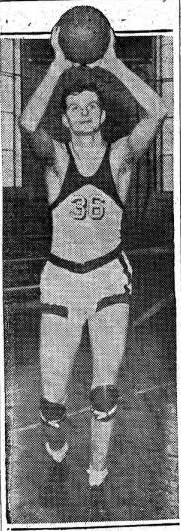
Foltz 7-15-1942 Stetson BBall

Your selection as a naval aviator would deprive others more fitted to the task.’

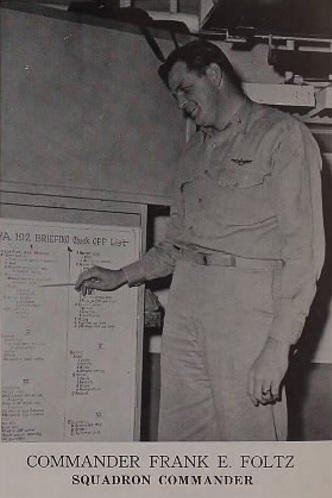
That was essentially the message Frank Foltz received from Admiral Nimitz’s office in 1942. He was twice turned down for shipboard duty, but Frank was persistent – after all, he wouldn’t let ¼” determine his fate. His sheer size was the problem. At 6’4”-and-change, 275lbs., the Navy thought Frank was just too big for a life that would consist of swinging through tiny hatches and cramming himself into the cockpit of a Hellcat.

His height hadn’t always been a drawback. Foltz, who picked up the nicknames “Biggie,” “Spider” and “Duke” during his naval service, used his formidable frame to great advantage as part of the Stetson University “Hatters” basketball team. He lettered his freshman year, helping the Hatters finish their season with a 9-1 record and AAU state co-champion title. Fortunately for Frank, basketball turned out to be an integral part of life aboard Intrepid. Per the Air Group 18 official War History,

The only thing that could pass for organized sport was basketball, played on the forward elevator. Pop Thune and his five usually trimmed the highly touted ships-company team, even when Burley and Newsome were on our side.

Perhaps there was something about basketball that suited players to fighter pilot duty. Hal Thune played Big 10 ball for the University of Minnesota; VF-18 commanding officer Edward Murphy prowled the court for Marquette. Whatever the wellspring of his talent, the Navy was fortunate to have Frank flying. He always seemed to come out on top even when the odds were stacked against him.

On 29 October 1944, the odds were about as long as they come.

According to the War History, by late October the men were “depleted and exhausted”. Months of continuous operation were starting to take their toll. The Japanese were also getting wise to strike procedure. Lt. Comdr. Murphy complained that when strikes joined up at the same coordinates throughout the day, enemy aircraft learned exactly where to intercept incoming planes. The Americans were too predictable.

Even worse, Murphy felt that his fighters were not being used to their maximum advantage. Sometimes the Hellcats were loaded with bombs on escort missions. How were they supposed to protect the Avengers and Helldivers with heavy ordnance reducing their planes’ rate of climb and agility?

None of these issues were resolved by 29 October. Though the first full strike of the day, Strike 2A, ran into almost 40 enemy planes in the air over Clark Field, no significant changes were made to the day’s second strike (2B). That didn’t bode well for Frank. He lifted off Intrepid as part of Strike 2B a little before noon. Climbing into the air with a bomb-loaded Hellcat, he must have wondered how he was supposed to simultaneously function as a fighter-bomber and an escort.

Foltz Intrepid

Clark Field spread out below him, pockmarked and blackened in places by the morning’s bombing raid. Frank watched as the Helldivers and Avengers of Strike 2B contributed to the devastation, wrecking parked planes and buildings alike. Once the bombers had lightened their loads, Frank picked out his target: a large hangar. He flew through a curtain of anti-aircraft fire to drop his bomb, and…he couldn’t tell if he scored a hit! There was no time to take a closer look, either. Japanese fighters were waiting in the wings for the Hellcats to descend. As soon as the coast was clear, they pounced on the unescorted men of Bombing and Torpedo 18.  Frank poured on the coal. He urged his lightened plane up after the gaggle of Intrepid bombers.

They were already fighting for their lives up there. The Helldiver pilots managed to down a couple enemy planes, and tail and turret gunners in Avengers accounted for two more. But there were once again 40 or so Japanese fighters swarming above Clark Field. The exact problem noted by Ed Murphy – the inability of his fighters to provide consistent escort while themselves dropping bombs – was rearing its ugly head.

Frank was undeterred. Despite the disadvantage in altitude and numbers, he and a dozen or so Fighting 18 pilots flew right into the teeth of the enemy. They weren’t about to let their bomber brethren take it on the chin. The U.S. carrier fighters were superior pilots, flying superior planes, and they knew it. The results speak for themselves. While their Hellcats returned to Intrepid with considerable combat damage, they returned. VF-18 didn’t lose a single pilot; one bomber, an Avenger piloted by Nick Roccaforte, was lost over Luzon. In exchange, they destroyed 11 Japanese planes and claimed another 10 as probably destroyed or damaged.

Frank shot down two Zeros himself. He tagged a third plane as well, but its pilot wisely fled the scene while his plane was still airworthy. It was a virtuoso’s performance. Like a basketball player, Frank had been asked to play offense and defense virtually simultaneously.

It was later confirmed that Frank scored a direct hit on the hangar. Between his successful bombing run and the part he played fending off a force of enemy fighters twice as big as his own, Frank Foltz was awarded the Distinguished Flying Cross. October was really Frank’s month: on the 14th he shot down an enemy when the odds were 3-1 (awarded the Air Medal), and during the Battle of Leyte Gulf, Frank was credited with strafing an enemy cruiser and scoring a direct bomb hit on the #3 turret of the Yamato (awarded the Navy Cross).

After the war, Frank transferred from the Reserves to career Navy, rising through the ranks until his retirement as a Captain. He served as skipper of a carrier fighter squadron – the “World Famous Golden Dragons” of The Bridges at Toko-Ri fame – as well as commanding officer of VFP-62, based at Cecil Field.

Your selection as a naval aviator would deprive others more fitted to the task.’ Well, nobody is right 100% of the time. We’ll give Admiral Nimitz a pass on this one.

FEFoltz

Two-a-Day Tales: Charles Mallory

Charles Mallory

Charles Mitchell Mallory (1920-2013) was a dyed-in-the-wool West Virginian. He was born and raised in Kanawha County, a veritable outdoorsman’s paradise whose manifold waterways and verdant woods Charles came to know like the back of his hand. There was absolutely no place he’d rather be—at least not on earth.

The skies were a different matter. Like so many combat airmen in World War II, “Charlie” caught the flying bug through his university’s Civilian Pilot Training Program. When war came, this “Flying Mountaineer” left West Virginia University to do his part in the Pacific.

He did it well. Mallory was one of Fighting 18’s photo reconnaissance specialists. Throughout September 1944, he, along with his squad mates “Red” Beatley and Harvey Picken, took aerial photographs of the Philippines. Included among their targets: Leyte, the site of future allied landings, whose gulf would lend its name to one of the largest naval battles in world history.

September 21st 1944 was a milestone for the Third Fleet and for Intrepid’s air group. For the first time since the Philippines fell to Japan in 1942, the carriers were going to strike Luzon, the largest and most populous island in the archipelago. Charles Mallory was assigned photo duty that day alongside Picken, with Beatley and George Eckel flying as escorts. These photographic missions were deemed so important that Mallory and company had orders not to engage enemy aircraft unless directly attacked themselves. The orders purportedly came from Admiral William “Bull” Halsey himself. Charlie’s CO—his Commanding Officer—made sure this point was crystal clear before takeoff. Any deviation from this directive would result in serious military discipline up to and including court-martial.

The photo team left Intrepid around 0910 with the second strike of the day. While the rest of the formation continued on to Subic Bay, the four pilots of the photo unit split off to reconnoiter Clark Field, a former U.S. Army Air Corps base the Japanese were using as a hub in the region.

Japanese planes were already swarming over Luzon. They’d been caught on the ground by the morning’s first strike, which had taken off only an hour prior. Now they were up and spoiling for a fight. The first enemies Charlie encountered were six “Betty” bombers, twin engine, land-based attack aircraft used by the Imperial Japanese Navy. They were flying low and in loose formation; they didn’t appear to notice the photo planes.

Despite earlier admonitions, this opportunity was too good to pass up. As the fighters bore down, Mallory pounced on the first bomber to break formation. His machine guns sent it careening out of control to be finished off by Beatley. While those two headed below the clouds, Picken and his wingman Eckel easily dispatched the remaining bombers. What was the harm in engaging the enemy if the results were total victory?

All four pilots reconvened shortly thereafter over Clark Field, snapping pictures and scouting the terrain below. They were the only U.S. planes over an airdrome buzzing with enemy activity and bristling with anti-aircraft guns.

Beatley spotted another Betty escorted by a single fighter. He rolled in after the slow bomber and squeezed the trigger until his quarry exploded. Mallory, keeping a watchful eye from above, saw the day’s first real threat: a number of “Tony” fighters scrambling up on an intercept course. He alerted his division that enemies were incoming. Eckel heard the call and scanned his horizon for enemy aircraft. A formation of eight Betty bombers caught his eye. Were these Mallory’s bogeys?

Eckel engaged immediately. He was so eager, in fact, that he repeatedly overshot the lumbering bombers, chasing them low across the airfield. After finally landing hits and sending a plane spinning down to the ground below, he pulled up—just in time to see the Tonys lining up a gunnery run on him. Fortunately, his F6F Hellcat had more than enough power to pull him up and away from the Japanese pilots.

The Tonys went after Beatley next. Looking over his shoulder, Red realized they were only 100-or-so feet behind him and closing fast. Before the four Japanese fighters could seal the deal, however, Mallory cut in, putting .50cal rounds in and around the cockpit of the lead plane. The next Tony in line swerved onto Mallory’s tail, riddling his plane Tony may have had a tighter turning radius, but the Hellcat easily outclimbed them. The Japanese pilots fled as soon as they lost the altitude advantage.

This story would be remarkable enough if it ended here. But photo missions were absolutely crucial. Mallory, Beatley and Picken took off again on the very next strike only an hour and a half after they’d landed aboard Intrepid. They returned to Clark to take more pictures, and almost immediately spotted more Tonys above and below. In the ensuing fight, Charlie downed another two enemy fighters to bring his total for the day to five. He had accomplished a rare feat, making “ace” in a single day. He also disobeyed orders on two separate occasions.

When Charlie landed back aboard his ship for the second time, his CO was waiting. Not only would he not receive the Navy Cross for his heroism, he was told, he would be lucky to walk away from this incident without a court-martial. Earlier, he’d flown his plane back with 67 bullet holes in it. Then, on his second flight, he’d interrupted his picture taking to chase enemy aircraft in protracted aerial battles down almost to the mountaintops. Imagine trying to explain that!

Though he never received the Navy Cross, during his service with Fighting 18 Charles Mallory was credited with shooting down 11 enemy aircraft, making him one of the squadron’s hottest pilots.

Mallory 1965 Charleston Sunday Gazette-Mail

C.M. Mallory in 1965

After the war, Charles went back to school to get his degree in Real Estate. He settled back in Kanawha County where he successfully owned and operated both a department store and real estate firm. His employees loved him. In 1969 he was crowned Boss of the Year by the local chapter of the American Business Women’s Association. He even ran for local office, though his platform, “make the word integrity mean something in our state government,” likely rendered him ineligible.

He was always drawn back to the rivers of his youth and back into the air. When he wasn’t hard at work, Charlie could often be found in a canoe or plane. He was a founding member of the West Virginia Wildwater Association and flew all over, from Alaska to the Bahamas. Both river running and flying were lifelong pursuits. Indeed, “the Flying Realtor,” as he was nicknamed by a local newspaper columnist, wielded paddle and yoke into his late 80s. Charles Mallory passed away at age 92 in Kanawha County, leaving behind the patch of earth he loved best in favor of those irresistible skies.