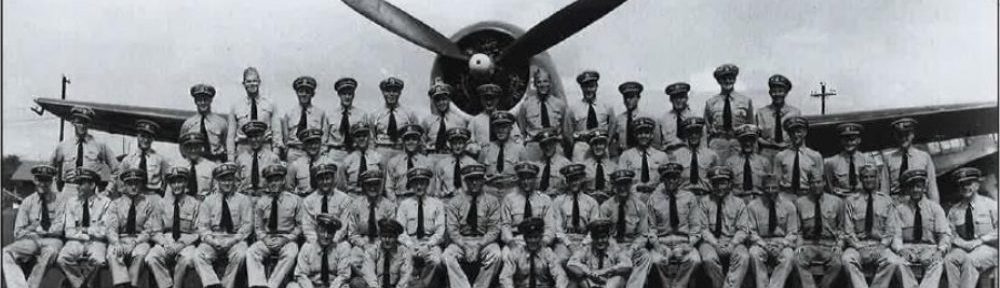
December 1944 was a month of homecoming for Intrepid. Many of the ship’s sailors made it stateside just in time for the holidays. Her torpedo and dive bombing squadrons, decimated after months of grueling combat, were likewise rotated home at year’s end. A reprieve was at hand for everyone…everyone except Fighting 18.
The Navy needed every Hellcat available to combat the kamikaze menace, so 55 pilots and administrative personnel from the squadron were transferred onto USS Hancock for temporary duty. A new year dawned before VF-18’s exhausted fighters headed home to their families.
If you’ve been here before, you’ve met some of the men in this squadron—men who came home, started families, pursued careers, lived full lives. Having just observed Memorial Day, it seems fitting to talk about those who did not come home; those whose lives are abstracted into glowing names that shine forth from the Intrepid Museum’s Memorial Wall.
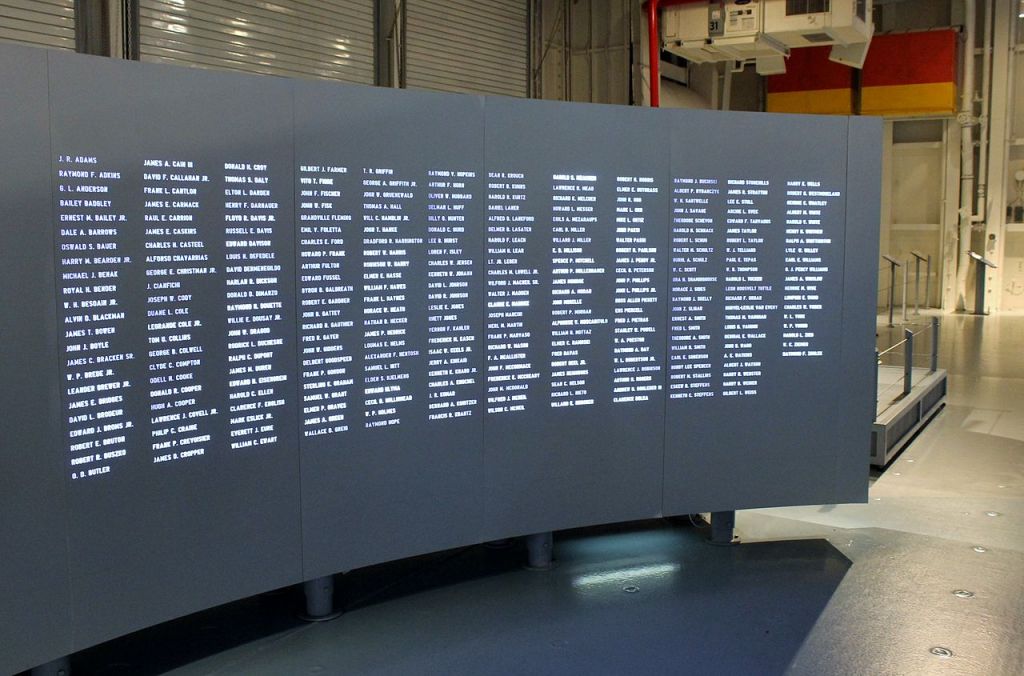
There is unfortunately no shortage of stories of sacrifice. Carrier Air Group 18 (CAG-18) lost approximately 70 men between August – November 1944, including at least a dozen from Fighting 18. That’s more than twice as many men from CAG-18 killed in action than Intrepid‘s other two air groups combined. If you were to pick a name at random from the Memorial Wall, there’s a roughly 1-in-4 chance that man served in Air Group 18.
Losing a pilot was more ephemeral than losing a sailor. When someone was killed aboard the ship, their body was committed to the sea in the traditional way. A 5” shell pulled them beneath the waves. The cracking report of rifles signified their definite departure.
When a pilot failed to return to the ship, on the other hand, the outcome remained in question. The frantic pace of air operations tended to make any definitive statements about their well-being impossible. As such, an absent pilot could be listed as either Missing In Action (MIA) or Killed In Action (KIA).
Men held out hope when their friends went missing. Some of VF-18’s MIA ultimately did come back, if not to the squadron then at least to friendly forces. “Lanky, likeable Buck [James] Newsome” was shot down November 19th. About a month later he was reported safe. Charles W. DeMoss, interviewed by the Museum in 2017, was shot down on 5 November and spotted by one of his squadron mates bobbing in a raft in Lagonoy Gulf. Intrepid received the report that he was safe and sound on November 22nd.
For families waiting to hear about the status of their lost loved ones, those intervening weeks would be some of the longest of their lives. If there was any solace for the families it was that the Navy expended huge amounts of energy trying to rescue its missing aviators. Quentin Reynolds summed it up in one of his Collier’s Magazine articles (pdf):
“…the Navy never gives up hope; the search never stops, and every day Danny or another Danny comes home from what we once thought to be a sort of dark limbo.”
In this specific instance Reynolds was referring to Daniel A. Naughton, a Fighting 18 pilot shot down on October 29th who survived with some help from Filipino guerrillas.
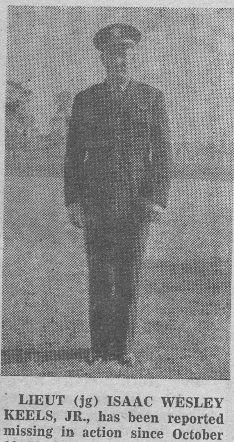
Naughton’s case is unfortunately not representative. The sad truth for Two-A-Day 18 was that the majority of its MIA stayed missing. Harry R. Webster, Ralph C. Dupont and Isaac Keels (pictured above) all were lost on October 12th, the first day of the Formosa (Taiwan) Air Battle. None were recovered. Lt. Cmdr. E.J. Murphy, Commanding Officer of VF-18, wrote a touching letter to Keels’s father explaining just what MIA status meant in this case:
It is with great sadness and deepest sympathy that I write to you to tell you that your son is missing in action. This is tragic news for you and I wish there was something I could say that would lighten the burden of your grief…There is a possibility that Isaac was able to make an emergency landing…I have reported him missing in action rather than killed in action. It is my opinion that there is only a very slight chance that he escaped. Isaac was a conscientious and aggressive fighter pilot, and when last seen, he was engaging enemy aircraft that greatly outnumbered him…I am reluctant to write this but I feel it would be unfair to you to hold out any but the slimmest hope of his survival.
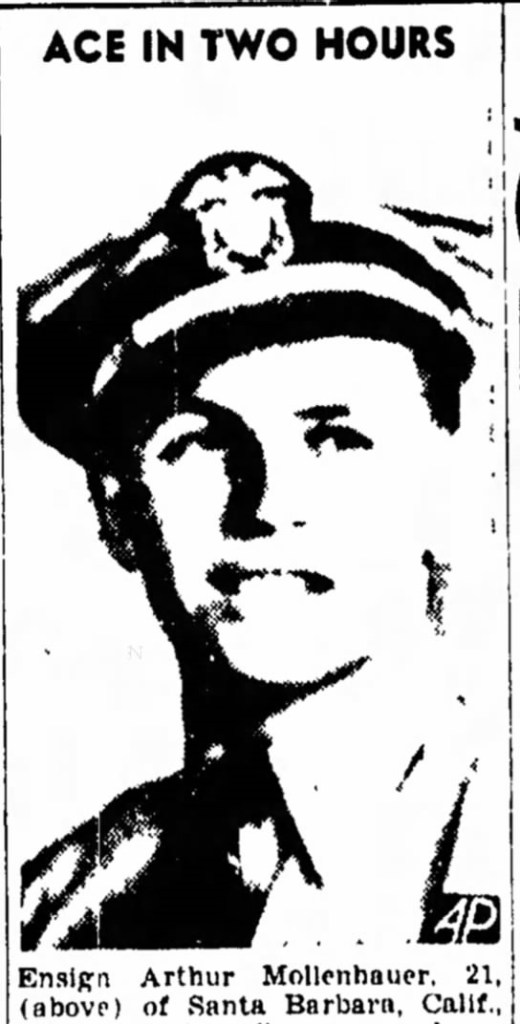
The same day Keels went missing, one of VF-18’s youngest fliers, Arthur P. Mollenhauer, had a banner day. During his very first encounter with Japanese pilots he laced bullets into at least 10 of their planes and earned credit for shooting 5 down. “They just kept flying in front of me,” he modestly explained to reporters aboard Intrepid after his phenomenal run.
On October 29th “Moe” Mollenhauer was involved in yet another air battle, this time over the Philippines. In all the swirling confusion he became separated from his division leader. Mollenhauer failed to return to Intrepid and was never seen or heard from again. It was almost as if he had disappeared into thin air.
In those cases where a pilot was listed as Killed In Action, aviators, just like sailors, had their rituals of loss. They understood the dangers of their job and their own mortality. Men were designated ahead of time to comb through each other’s personal effects so they could be returned to loved ones stateside. But while they were still aboard ship, the surviving fighters had to dispel the thought of their friend’s loss. It would be time to fly again in short order. War did not afford the luxury of grief.
On a few occasions, the men of Fighting 18 saw their fellows killed in the line of duty. James B. Neighbours had the entire tail assembly shot off his plane by anti-aircraft fire on September 13th, causing his Hellcat to spin in and explode in the Philippines. Remarkably, his remains were discovered after the war and his body was repatriated in 1949, bringing some small measure of closure to his family. Walter L. Passi, who was hit by anti-aircraft fire on September 22nd and likewise seen to crash, has a cenotaph at Lake View Cemetery in Minnesota. His body, however, remains somewhere on Luzon.
Sometimes a downed aviator was captured before he could make it to friendly forces. These men became Prisoners Of War (POWs). VF-18 had at least one POW from its ranks and his story is a bitter one.
William “Bill” Ziemer was among those declared MIA on October 12th after becoming separated from his section leader, E.J. DiBatista (whose flight log book is on display in the hangar’s Aces Case). He crash-landed his damaged plane on Formosa and set out on foot. Bill would have known his odds were long. In the Philippines, friendly guerrillas could be expected to smuggle downed pilots back to U.S. forces. This was not the case on Formosa, which had been a Japanese colony and mainstay of Japan’s imperial ambitions since the 19th century. Bill was captured and subsequently transported to Camp Ofuna in Tokyo, the interrogation camp whose horrors were chronicled in “Unbroken,” the biography of Louis Zamperini. Bill suffered under that same cruel regime. Beatings were a regular occurrence. He was kept in solitary confinement from October 1944 to March 1945, slowly losing strength due to malnutrition.

Once Bill was released into the general population at Ofuna he was quickly spotted by fellow Lafayette alumnus Lt. Larry Savadkin. In school Bill was well-built and widely known for his football prowess. Now he looked bone-thin, frail. Though Savadkin was soon transferred out of the camp, he later heard through the grapevine that Bill was suffering from from beriberi and dysentery. Without medical attention for his malnutrition and illnesses, William Ziemer died on August 2nd, 1945, just weeks before the Japanese surrendered. He was the last war casualty from Ocean County, New Jersey.
This is the true, awful face of war. The Tablets of the Missing at the Manila American Cemetery contain the names of some 36,000 American servicemen declared MIA in the Pacific Theater, China, Burma and India during WWII. Roughly 17,000 more who were KIA are buried there. Though it is well and good and right that we celebrate the heroism of these brave men, let us never lose sight of the tragedy or war, nor glorify it.
If we heed these lessons we may spare ourselves the necessity of erecting future memorial walls.
 Two-a-Day 18
May God grant peace and forgiveness to the families that endured such great losses.
LikeLike
Thank you for your kind words, Jerry. I know given your service history that you appreciate more than most what such sacrifice means. I think you will be heartened to know that quite a few of these men have family members who were inspired by their example—who felt compelled to serve to honor their memories. The nephews of Wesley Keels and Harry Webster went on to serve for decades in the Navy.
LikeLike