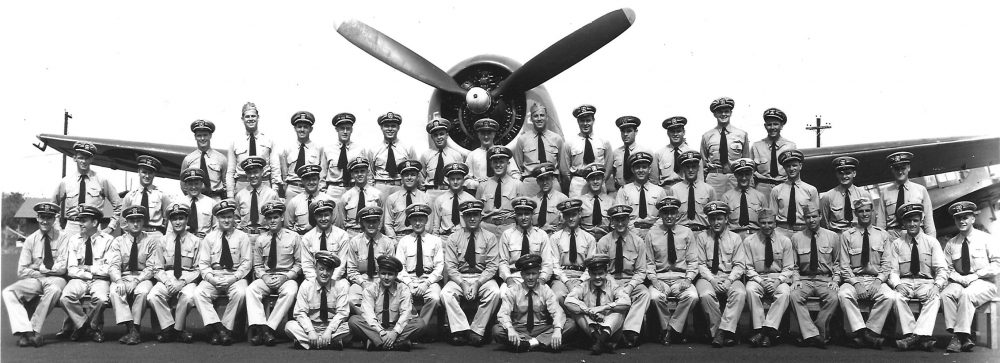
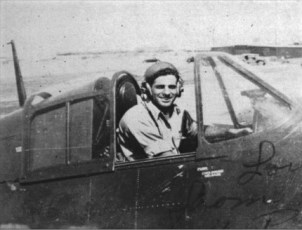
George in the cockpit, from a 2012 veteran’s profile by Sandra Powers (hereafter Powers 2012)
There are a number of men who served in Fighting 18 whose stories may never be told. The material traces of history needed to understand their personalities and lived experience—newspaper clippings, photographs, personal accounts and correspondence—may never make it into wider circulation. This is especially true for men who went missing or were killed in action, and for replacement pilots who played supporting roles alongside original members of the squadron.
George Naff, up until recently, was an edge case. Some biographical information and photographs exist on the web thanks to his retirement community’s newsletter, but that didn’t constitute enough to write something substantial about George’s character and wartime contribution. Then I stumbled on the the World War II History Project, a non-profit whose mission is to find, record, save and preserve the stories of World War II participants. They conducted an interview with George that I was fortunate enough to transcribe[1]. All of a sudden, another “Two-a-Day” pilot loomed out at me from the shadows of the past.
George Naff was born in Springfield, Ill. on June 13th, 1923, only a year after his parents emigrated from Lebanon to the United States. George’s large family (he was 1 of 7 children) was forced by the Depression to pack up shop and head to Detroit, MI, where his father opened a family-run grocery store.
George was in the middle of his undergraduate education at the University of Detroit when Japan attacked Pearl Harbor. He feared being drafted into the Army—not simply out of a personal aversion to foxholes, but because his loss would put a serious economic burden on the family-run business back home. He solved the problem by heading into the nearest Navy recruiting station and enlisting in February 1942.
Becoming an aviator was a no-brainer for George. He had a fascination with aircraft dating back to childhood bicycle rides past Detroit Municipal Airport, where he’d stop to watch planes take off and land. After completing Navy pre-flight training in early 1943, he was sent to nearby Naval Air Station (NAS) Glenview, just outside of Chicago, for primary flight training. A further trip to NAS Corpus Christi in Texas brought him to the end of his training regimen. He was awarded his coveted Wings of Gold on July 7th, 1943.
George earned himself a prized billet as a fighter pilot, but as the Navy reorganized the fleet and shuffled carrier pilots between units, he found himself tossed hither and yon as a replacement. He was pulled from training with a fleet carrier air group to perform escort carrier duty, then was detached from that ship to fly off land bases in the Admiralty Islands. It was only after this carousel of deployment that George finally landed with Fighting Squadron 18 (VF-18) aboard USS Intrepid.
Because he was not an original squadron member, George felt like something of an outsider. He was close with Charles DeMoss—another “Two-a-Day” pilot we’ll soon meet—but he didn’t feel like he was one of commanding officer Ed Murphy’s favorites. These feelings didn’t seem to have an effect on George’s ability as a fighter pilot, though: he shot down 4 Japanese planes, narrowly missing confirmation of a 5th that was recorded as damaged.
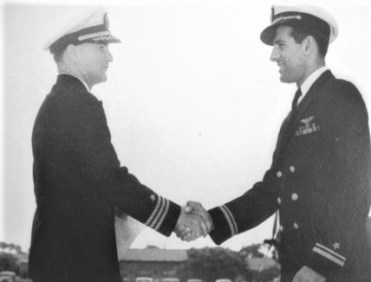
George (right) receiving the Distinguished Flying Cross, from Powers 2012
His first 3 victories came during the Formosa Air Battle, a period of extreme peril for Intrepid. On the evening of October 12th, 1944, enemy bombers sent torpedoes churning through the water around the carrier. A shock felt amidships near the No. 2 elevator was suspected to be a dud torpedo. Attacks against the carrier task force continued through the 13th and 14th as Japanese desperation mounted. Cruisers Canberra and Houston took torpedoes, and these were no duds. George was flying Combat Air Patrol (CAP) on the 14th when a large raid was spotted heading for Intrepid.
The enemy arrived in waves with more than 20 bombers spread out in small groups of 2 and 3 aircraft, forcing Intrepid’s 12 CAP pilots to split up to cover as much sky as possible. George dove down on his first target, closing from the side to shoot at the wing root and fuselage of the plane. It splashed down well shy of the vulnerable flattops. George repeated this a second time: climb for altitude, dive for speed, rake another enemy plane with his .50cals until it careened into the ocean. George was getting closer and closer to Intrepid when a third threat came into view.
One last dive bomber was making headway, zooming up off the ocean’s surface in a huge arc as it entered the first phase of its bombing run. The ships’ guns opened up in a cacophony of noise, throwing up as much flak as possible to drive the invader off. George was undeterred—he knew that if even a single bomber made it to the carriers, it could prove fatal. He closed the distance as the bomber nosed over. His machine guns blazed down over the enemy’s wing until it was practically sawed off by bullets, causing the Japanese plane to spiral out of control towards the water below. Out of over 20 Japanese planes participating in this attack, only 1 broke through the CAP; it didn’t manage to score a hit.
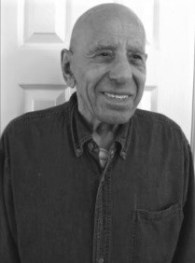
George in his later years, from Powers 2012
George Naff was awarded his second Distinguished Flying Cross for fighting off these attackers. His first was awarded for participation in the Battle of Leyte Gulf. Though he may have been a replacement pilot who felt like an outsider, George’s combat record marks him as a central figure in the saga of Fighting 18.
After the war, George finished out a degree in aeronautical engineering so he could continue to work in the field of flight. To that end, he moved out west with his wife Delphine to start a career with the Hughes Aircraft Company. George and his growing family remained on the west coast where he worked his way up into a management position within Hughes.
Following his retirement in 1997, George attended regular meetings of the “Old Bold Pilots Association,” a group of combat aviators and test pilots from around the world who, like George, maintain a lifelong love of flying. Their name pokes fun at the old adage that, “There are old pilots and bold pilots, but no old, bold pilots.” George died on March 23rd, 2017; in his nineties, having participated in some of the largest sea and air battles in the Pacific: an old, bold pilot.
[1] I want to call attention to and thank all those Intrepid volunteers who transcribe the Museum’s oral histories. Speaking as both a volunteer and employee, these documents are critical to the interpretation of the ship’s history, as well as the Museum’s collections and exhibits.
 Two-a-Day 18
Hello.
My girlfriend’s father was in the Navy and was with VF-18. I have some photos and Roster of Officers for VF-18.
LikeLiked by 1 person
Mike, please feel free to email me at fightingsquadron18@gmail.com with more information! I’d love to know more about who he was and to see some photos of him. Thanks so much for reading and commenting. Cheers, Mike Fink
LikeLike
Sent you a few photos via email. Only sent 3 for now.
You might recognize some of the names on the documents i have.
Mike
LikeLike