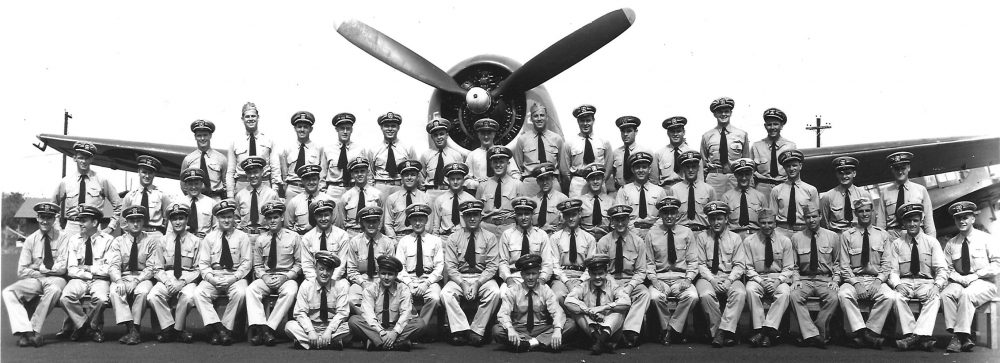
Before takeoff, during flight and after landing, combat pilots are assisted by a large group of highly specialized individuals. Without coming close to cataloging the whole cast of characters, there are: parachute riggers, aviation machinists, fighter director officers (FDOs), landing signal officers (LSOs), flight surgeons. Their jobs aren’t as romantic as a fighter pilot’s, but without their expertise the fighters would never get airborne in the first place. Without them, the odds of a pilot’s survival plummet. And finally, without their support, a pilot’s physical and mental well-being—constantly under assault by the stresses of war—deteriorate markedly. These behind-the-scenes experts greatly influence a squadron’s success.
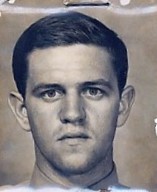
Some truly remarkable men filled these roles aboard Intrepid. Robert W. Daniels, Jr., whom everyone called “Jeep”, served as one of the ship’s fighter director officers. His job was to monitor radar returns in the Combat Information Center (CIC). Upon sighting an unidentified aircraft (a ‘bogey’), he’d vector the ship’s fighters toward its location for intercept. It took a specialized group of individuals to fill this role. Ideally they had experience as fighter pilots themselves. It helped, too, for an FDO to have managerial experience, since radar returns could indicate enemies coming towards the carrier from every direction. These men needed a kind of “big picture” mentality to adequately and simultaneously address threats from all quarters.
Jeep fit the bill to a ‘T’. He flew fighter missions from the escort carrier Sangamon in 1942 during the Allied landings at North Africa. Amazingly, Jeep’s unit, Fighting 26, had been commanded by none other than William Ellis, the commander of Air Group 18 aboard Intrepid. As a result, Jeep had valuable experience as well as a personal connection to the fighters he directed from CIC. Daniels’ managerial prowess is attested to by his post-war success. He went on to become one of the fathers of cable television and is responsible for bringing broadcast TV out beyond the Rockies.
One Fighting 18 pilot, Robert “Dave” Davis, recalled the kind of magic Jeep could work. October 29th, 1944 was the busiest Combat Air Patrol (CAP) mission Dave Davis could recall. His 4-plane division was flying with fighters from Hancock and as such was under the control of the fighter director from that carrier. The Hancock FDO was hard-pressed to intercept the numerous kamikaze aircraft in the sky that day. Since he was less familiar with the Intrepid fighters, Davis and company wound up circling over the fleet awaiting orders while the Hancock fighters were getting their vectors. It almost seemed as if his group was forgotten amidst the chaos.
Then Davis heard a voice coming through over the radio. “Dave, I’ve got one for you.” It was Jeep stepping in to pick up a bogey the Hancock FDO had apparently missed. It turned out to be a “Val” dive bomber—one of the types of aircraft Japan used to attack Pearl Harbor. Jeep directed Dave out to the lone kamikaze plane, keeping in constant contact until the Val appeared in a hole in the clouds right below him. Dave Davis brought the Japanese plane down before it could complete its deadly errand. It was Davis’s last aerial victory of the war, and at number 5, the one that made him an ‘ace’ fighter pilot.
Back aboard the carrier, it was the responsibility of another man to tend to pilots after their ordeal. October 29th introduced Fighting 18 to Japan’s shocking new suicide tactics. It also proved to be a day of wild air-to-air combat. Intrepid’s fighters shot down almost 50 enemy planes over Clark Field. Including Dave Davis’s CAP kill, Two-A-Day 18 added 4 aces to its roster. Some men were shot down and listed as Missing In Action; others returned to the ship in poor shape. Two suffered from wounds caused by 20mm shell explosions and 7.7mm rounds slicing through their planes. Kenneth Crusoe had the tail hook tear right off his Hellcat during landing. His plane careened into the crash barrier in the middle of the flight deck hard enough that he was listed “Status SERIOUS—cracked or broken vertebra.”
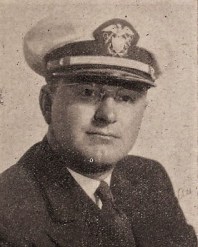
John Winston Fish, the air group’s flight surgeon, was there right away to minister to the pilots and crews. Men with nerves frayed by the day’s events could count on bourbon from “Doc” Fish. Kenny Crusoe definitely got a stronger prescription for his wrecked back.
A flight surgeon’s job was difficult. On the one hand, Doc Fish had to care deeply for his flyboys, keeping detailed records concerning their mental and physical wellbeing. On the other, he couldn’t become so attached that he allowed himself to make decisions which diminished the strength of the air group. Keeping pilots flying and flying effectively was his primary responsibility. Doc must have walked this line remarkably well. He was popular not only with the pilots but with the ship’s officers as well, including Admiral Gerald Bogan.
The lives of these two men—Jeep Daniels and Doc Fish—came together in a remarkable way on Intrepid’s darkest day, November 25th, 1944. Doc’s battle dressing station was on the gallery deck, beneath the flight deck. He was busy working to save the lives of men injured as a result of the first kamikaze hit. Jeep, meanwhile, was virtually next door in one of the squadron ready rooms. Just then a second suicide plane barreled into the ship, sending shrapnel slicing through the flight deck into the space below. Men were cut down in ready rooms and gallery deck hallways. Doc Fish, unfazed by the first kamikaze strike, working diligently with a team of men to keep the injured alive, was cut down where he stood by the second plane. His whole team was killed by the blast.
If Jeep had been in a different ready room, he too would have been killed. As it was he could hear the groans of survivors floating through the smoke choking the gallery deck. He sprang into action. “…one of my squad mates was trapped with his leg half blown off. I had to apply a tourniquet, cut off the rest of his leg, administer morphine, and carry him up two flights to the flight deck for help.” He came out topside for fresh air and to deposit the wounded man, but he didn’t stay there long. Around 25 men from Air Group 18 were trapped down in the torpedo workshop. Jeep Daniels and a member of the ship’s company went back into the ship armed with smoke helmets. They reached the suffocating group in the workshop and managed to lead them up out of the ship; sometimes Jeep had to carry them.
Someone brought Doc Fish’s body to the flight deck. Anguished men of the air group worked for hours to resuscitate him—to no avail. They were stunned. The man who’d kept them living and breathing throughout months of grueling combat could not himself be saved. John Winston Fish was posthumously awarded the Bronze Star for his service aboard Intrepid. The men of Fighting 18 surely never forgot him. Robert William Daniels, Jr. was likewise awarded the Bronze Star for his efforts to save men trapped inside his burning ship. Jeep Daniels never forgot the men of Fighting 18, especially those who didn’t come home. “…I saw so many of my squad mates and friends fail to return from missions or killed right before my eyes….I think they should have been as lucky as I was to return home to their families.”
These two men are just the tip of the iceberg. When we think of “Two-A-Day 18” and their success in the Pacific, we should do our best to remember the remarkable men back aboard the ship who made it all possible.
 Two-a-Day 18
LCDR John Winston Fish was my Father’s Cousin. His Dad and Mom were devastated when they learned he had been KIA on the Intrepid. His Mom never really recovered from that. I was born 12 years later in 1956. I met his Parents when I was a boy in the 1960’s.
LikeLike
I can only imagine their grief. I wonder if they knew the circumstances surrounding his death and his heroic efforts to save his fellow shipmates. The men of Air Group 18 absolutely loved him. They wrote of him fondly in their war history, and the main air intelligence officer wrote about how hard various officers tried to revive him after the kamikaze attacks. I’d love to learn more about his background and life if any of the family have any materials related to his life. I only know what I gleaned from newspaper articles and his death notice in the journal of the American medical association. Thank you for remembering him!
LikeLike