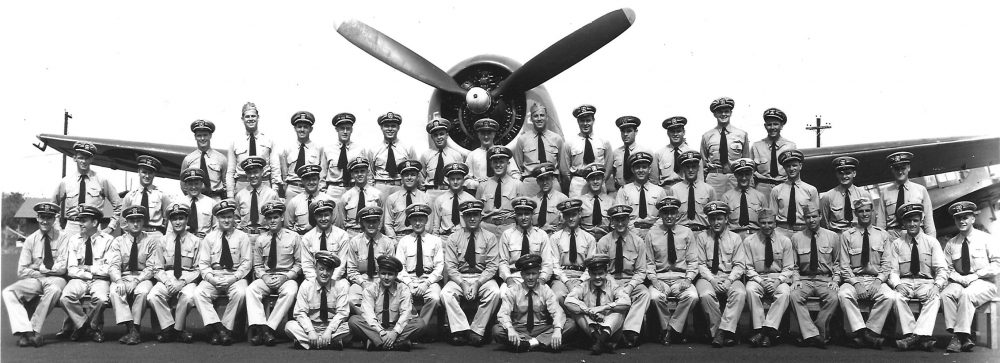

Fighting 18’s nickname derived from the squadron’s prowess in air-to-air combat, but serving in a WWII Navy fighter squadron entailed so much more: Combat Air Patrol, Snooper/Anti-Submarine Patrol, bomber escort, photo. reconnaissance, strafing targets on land and at sea, vector searches…the list goes on and on.
Though lacking in Hollywood glitz and glamour, these other functions were equally if not more important than dogfighting. Clarence ‘Pent’ Blouin didn’t knock down as many Japanese planes as Mallory or Foltz (previous subjects in this series). However, his outstanding leadership and ability were instrumental to the success of both his squadron and his air group.
Clarence Arthur Blouin was born January 27, 1917 to Lucien and Agnes Blouin. Clarence grew up in Whitinsville, MA, home of the Whitinsville Machine Works—at one time the world’s leading producer of textile machinery. Whitinsville was one of those rare examples of a beneficent company town. Profits were plowed back into the construction of community centers; company stores sold goods without price gouging. At peak, the Whitin family company employed more than half of the village’s 10,000 residents.
Among them was Lucien Blouin. His 53rd year of employment with the company and 50th wedding anniversary were both celebrated in the machine works’ annual newsletter, The Whitin Spindle, in 1959. Also mentioned in that publication are his four sons’ “outstanding records in the armed forces.” That’s no exaggeration: after distinguished careers, the Blouin boys retired with ranks ranging from Commander to Vice Admiral.
‘Pent’ Blouin was one of VF-18’s oldest and most experienced pilots. He’d actually spent time at shipboard duty as a bluejacket in the late 1930s before he made himself a ‘Mustang,’ earning his commission as an officer—a naval aviator—in March 1942. He was also probably the first man in the squadron to encounter enemy forces. On 10 May 1942, while piloting a PBY Catalina as part of Patrol Squadron 71, Blouin and his crew were attacked by a Japanese ‘Mavis’ flying boat. The huge, four-enginge Mavis opened fire first and was in turn fired upon by Blouin and co. Though his plane took a beating, Blouin’s gunners managed to flame one of the enemy’s motors, causing the burning Japanese plane to turn tail and run.
By the time he came to Fighting 18, Clarence was a full Lieutenant and considered experienced enough to lead his own four plane division of fighters. He led selflessly and always from the front, undertaking risky low-level strafing missions against land and ship-based antiaircraft fire. He was awarded the Silver Star for doing so. But in the Pacific, sometimes the weather proved just as deadly an adversary as any man.
Perhaps Pent felt the hand of fate on his side on 29 October 1944. After all, the previous day he’d “splashed” a Japanese bomber long before it could reach Intrepid. It couldn’t hurt that his call sign was “Lucky 2.” Good omens abounded. However, his luck—and the luck of the other men flying Strike 2 Charlie, the third strike of the day on the 29th—ran out just shy of the ship.
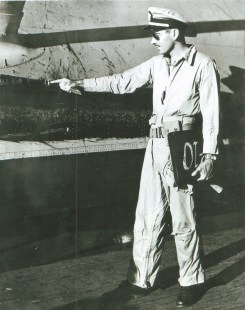
The strike itself had gone well: an even dozen enemies shot down in the air without a single loss to the bombers or fighters. Blouin’s ship was on the other hand being…uncooperative. Intrepid had taken her inaugural kamikaze hit right around noon. Enemy aircraft continued to loiter about Task Group 38.2 throughout the afternoon in the hopes of inflicting still more damage. It must have been with a measure of relief, then, that Admiral Bogan found his ships enveloped in a storm just before sundown. The squall would shield his flattops from further assault. It would also make coming back to base an absolute nightmare for the men of Strike 2C.
Nighttime carrier landings are harrowing enough. The “Mission Beyond Darkness” (20 June 1944) is embedded in Navy lore for a reason. But trying to find the flight deck in the dark with wind and rain and pitching seas? Operational losses could have stacked up tremendously. Could have, if not for the brave efforts of Bud Williams, Cecil Harris, and, at the center of it all, Clarence Blouin.
Williams managed to keep his Avengers together on their night run in towards the ship. Seeing the weather and assessing the fuel situation, he decided to bring all his ‘turkeys’ down for a group water landing. Normally losing so many aircraft would be frowned upon, but these certainly qualified as extenuating circumstances. With the consummate skill of a conductor, Williams led all 6 planes down, landing them close enough to one another that the men were able to lash their rubber rafts together into a veritable flotilla. All 18 men made it free of their sinking bombers and were subsequently rescued by destroyers.
Blouin had other ideas for the Hellcats and Helldivers. Leaving the rest of the planes circling on the edge of the storm front, Pent plunged into the miserable weather to grope his way blindly towards Intrepid. He tried to radio clear-weather coordinates to the ship, but she wouldn’t budge. Winging back out to the periphery, Blouin steeled himself and disappeared into the storm for another check. Time and again he braved the elements, trying in vain to coax the ship out to meet its planes. But making all of these passes further taxed his scant fuel reserves. Time was running out.
Risk a water landing in the clear or a carrier landing in the storm? There was no easy answer. Blouin was leaning towards the water option when Cecil Harris cut in on the radio saying he thought he could make it to the ship. And just like that Harris was off into the stormy night. Miraculously, he found not only a carrier in the murk, he found his carrier! Blouin and the other men followed suit until only a few planes remained in the air. Some planes from Cabot and Hancock even came back to Intrepid. Thanks to Blouin and Harris’s daring, just one fighter pilot was lost in the storm.
Pent’s bravery and leadership took him far in the Navy. From division leader, he went on to command his own squadron (VF-172) and then Air Task Group. He was promoted to Captain and held a post on the 2nd Fleet staff before ultimately advancing to skipper of his very own Essex-class carrier, the Lake Champlain. Clarence Blouin retired after 35 remarkable years in the service, blazing a trail from enlisted man to captain as confidently as if he were flying into the teeth of a storm.
 Two-a-Day 18
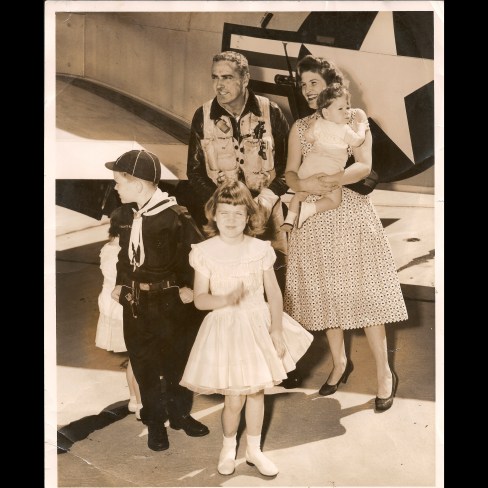
Thanks for recording these stories, Mike, as they are now forever stories for later generations. These men were real, interesting, humans with flaws amidst the heroism and should be remembered. As I will always be the little girl in the pale pink dress meeting her father’s plane, I get to see him again as “Daddy” for a while. He never told us these stories; we only unearthed them when we found his log book while clearing out his last home as he moved to be closer to my sister. He was first a pilot, later a fighter jet pilot. His proud moments always centered around aviation and not the business of war, like many of his experience, I am sure. I am thankful he came home and miss him every day.
LikeLike
I served under him when he was captain of an ammunition ship, in 1962–1963. He was one of the finest, perhaps the finest, naval officer I ever served under.
Tom Murtaugh
LikeLike
How kind of you to remember our father, Tom. Were you assigned to the USS Haleakala in Concord, CA? You must have been early in your navy career. He passed in 2003, in Lake Charles, LA, after moving there to be closer to one of us from Orlando. He would be pleased that you remember him from all those years ago.
LikeLike