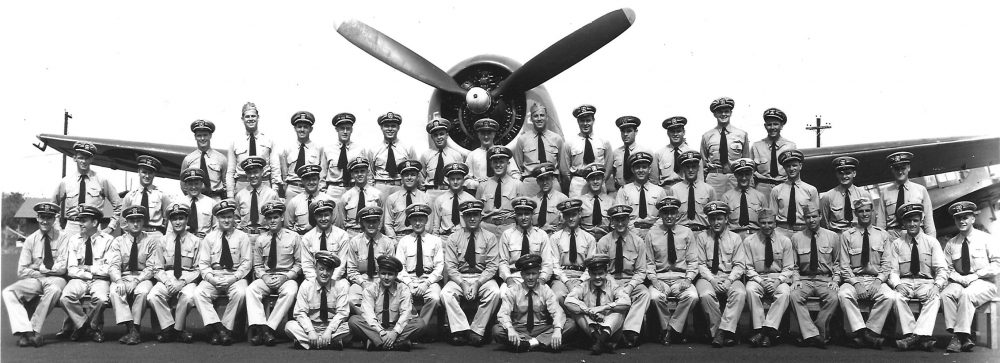
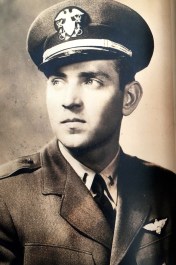
Edward Arthur Ritter was born January 3, 1921. A Brooklyn native and Pratt Institute graduate, Ed worked as a layout artist at the advertising firm of Abraham & Straus before answering his country’s call. While in training at Naval Air Station (NAS) Melbourne in Florida, Ed took advantage of a five day home leave to get married to his childhood sweetheart, Joan. She sojourned back to Florida with him after tying the knot.
Lord knows it wasn’t easy for the newlyweds. They stayed at a motel off base—no air conditioning!—and Joan would wait for Ed to come home after dangerous days training in F4F Wildcats. One day while she was out at the beach, the Ritters’ friend Larry came sprinting through the sand with an urgent message: Ed’s plane had crashed. Larry was short on detail; Joan was long on imagination. She expected the worst.
It turned out Ed had come down hard after gunnery practice—hard enough to blow both his tires. His plane veered into a sandy embankment on the side of Melbourne’s narrow runway where his flat tires bit into the soft ground below, suddenly halting and then flipping his Wildcat upside down. But an angel must have been riding on the wing that day. Ed walked away with only a bad headache. After a visit to the hospital, a precautionary spinal tap and a week off, he was returned to flight duty.
Fortunately for Ed his angel stuck around. He lost at least two more planes during his stint in the Navy, once at Pensacola when another pilot collided with his, and again over the fleet when his shot-up plane couldn’t deploy its landing gear. Both times he came away unscathed. In his later years, when he recounted these incidents to his granddaughter Valerie, Ed turned on his typical self-effacing humor: “I got as many of our planes as I got of the enemy.”
Ed’s time aboard Intrepid was characterized by this combination of equal parts hard luck and miracle. While flying cover during a photographic mission on 12 October, his plane was hit by anti-aircraft fire that spread shrapnel throughout his cockpit and set fire to his external fuel tank. Ignoring the bits of metal freshly embedded in his arms, Ed held his Hellcat steady and jettisoned the burning external tank. Despite damage to his plane and person, Ed managed to shoot down a Japanese fighter pilot that attacked him on the way back to Intrepid.
But he wasn’t home free yet. He also survived friendly fire from fellow fighters. Navy pilots used their belly fuel tanks, which Japanese fighter aircraft usually lacked, to distinguish between friend and foe. After being forced to get rid of his tank Ed may as well have painted rising sun ‘meatballs’ on his wings. Fortunately, the other fighters realized their mistake before Ed’s plane took any more abuse.
By late October Ed had managed to set an impressive record: for almost two months straight, he’d been given a “cut” by the Landing Signal Officer on his first pass landing aboard Intrepid. NAS Melbourne had clearly been a learning experience. Ed’s streak was unfortunately broken in dramatic fashion on 29 October. Flying as part of Strike 2C that day, following Blouin and Harris through the storm discussed in last month’s installment, he found it virtually impossible to get into the groove for landing. It took 13 passes (lucky number 13!) before he got the signal to cut his engine. Then the pitching deck of the ship heaved up into his landing gear, buckling the metal to send him skidding across the flattop into a gun mount just shy of the island.
Yet another close call for Ritter, who made his angel work overtime.
Ed’s credentials as a fighter pilot are unassailable. He shot down four enemy planes during his time in the Pacific. He was also handpicked to fly as wingman to VF-18’s first squadron commander, Edward Link, while the group was still training stateside. Ed shared something with his squadron that was even greater than his skill at the stick, though: his talent as an artist.
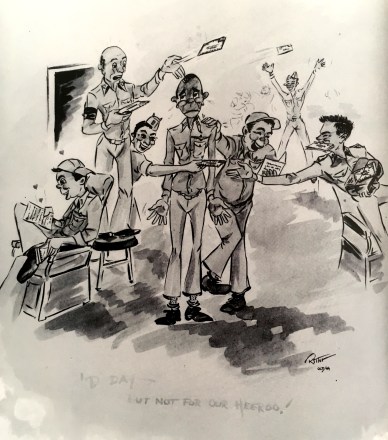
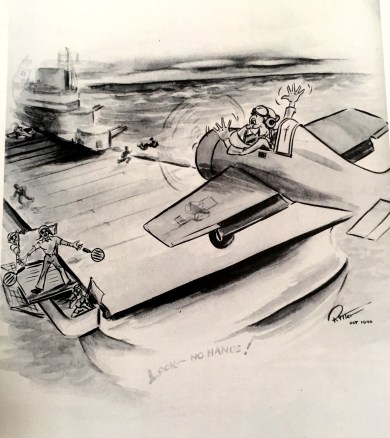
Between October and November 1944, Ed painted 26 watercolors which bring to life the daily experience and emotion of a WWII carrier pilot. Most popular among Ed’s creations was Snipo, a cock-sure, carefree cartoon character modeled—at least in terms of looks—on fellow “Two-A-Day” pilot E.G. Blankenship. Snipo was funny, charismatic, a daredevil through and through. In one piece we see Snipo goofing off, coming in for a “hands-free” landing aboard Intrepid. In another he’s daydreaming about War Bond tours with beautiful women. The men in the squadron no doubt commiserated with Snipo going stir-crazy after three months aboard his ship; Snipo outnumbered and in trouble in the air; Snipo drinking (perhaps too much) in the officer’s club; Snipo forlorn and empty-handed as everyone else got mail from back home. It’s all here in deft brush strokes, captured with a clarity surpassing even official squadron histories.
Needless to say, everybody awaited the next installment with bated breath. Who was going to get lampooned this time? What new mischief would Snipo get up to? Ed’s art buoyed his shipmates’ spirits in trying times, giving voice to their shared fears and aspirations. “The Fox” gets singled out for spreading hopeful rumors about making it home in time for Christmas. From the cockpit, Snipo waves an American flag, hoping friendly flattops will stop shooting at his plane. When “our hero” Snipo lands back aboard after his first strike mission, the carrier deck “looks good enough to kiss.” Sure enough, the big-eared fighter jock is pictured bent double, affectionately patting and kissing his flattop.
We’re lucky on a number of counts that these paintings survive today. The ship’s photographer thought they were excellent specimens and took pictures of the whole lot in November ‘44. On the 25th of that month, when two kamikazes crashed through Intrepid’s flight deck, all of the originals were consumed by the ensuing flames. That very well could have been the end of it. Ed suspected Snipo was long gone. Almost a year later, he was surprised when he received a bulky package containing photos of his artwork. These reproductions were donated to the museum by his granddaughter and are now held among the museum’s collections.
Edward Ritter won two Distinguished Flying Crosses during his tenure aboard Intrepid in addition to numerous battle stars and the award of a Purple Heart. After the war, Ed and Joan moved to Glen Cove, Long Island to raise their two children. Ed returned to work doing what he loved, finishing out a successful career as a professional advertising artist. In 1982 he must have thrilled to sit in the lead car during that year’s Memorial Day Parade where he received a special proclamation from the town’s mayor. And of course, just months later, Intrepid was pulled up to dock on the west side to testify to the valor and sacrifice of men like Ed. Mr. Ritter passed away on July 31, 2010.
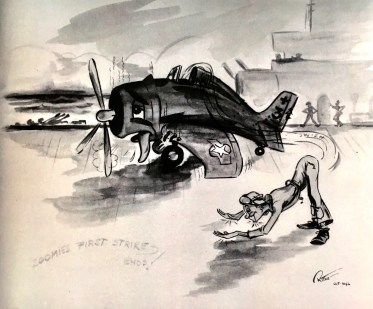
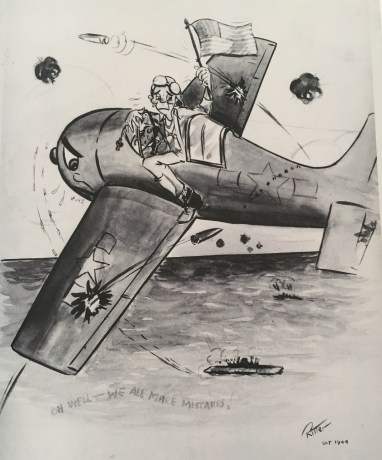
A postscript for Snipo. Gerald Blankenship, the model for Ritter’s screwball pilot, died only a few years after the war, leaving behind a three year old son named Gary. Like Valerie, Gary has donated some of his father’s effects to the museum. Last year in Intrepid Advancements, Gary said of Ritter’s art, “I feel like I finally got to know my dad, through the personality of Snipo.”
 Two-a-Day 18
Pingback: Two-a-Day Tales: Brothers in Arms | Two-a-Day 18