Superstition has always been a part of the sea services. The caprice of nature and the awesome power of the sea have led people across time and space to invoke the supernatural when setting sail. The color of the sky or the appearance of a bird can foretell disaster—or salvation. Even those who don’t usually put stock in superstition may find themselves comforted by a good luck charm when the sky darkens and waves begin to pitch their ship.
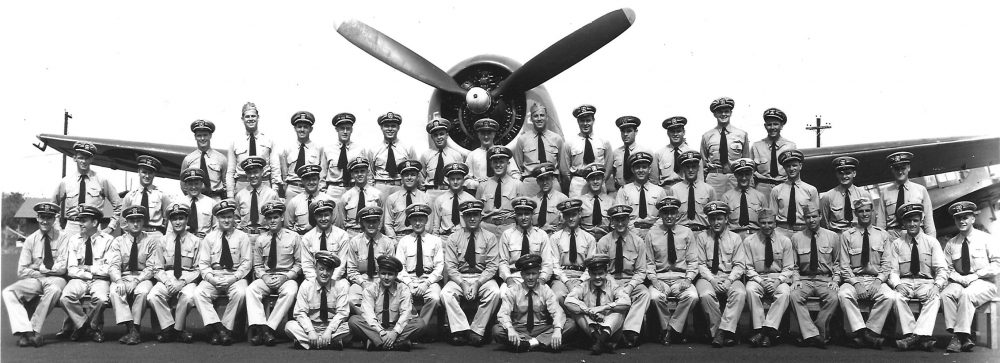
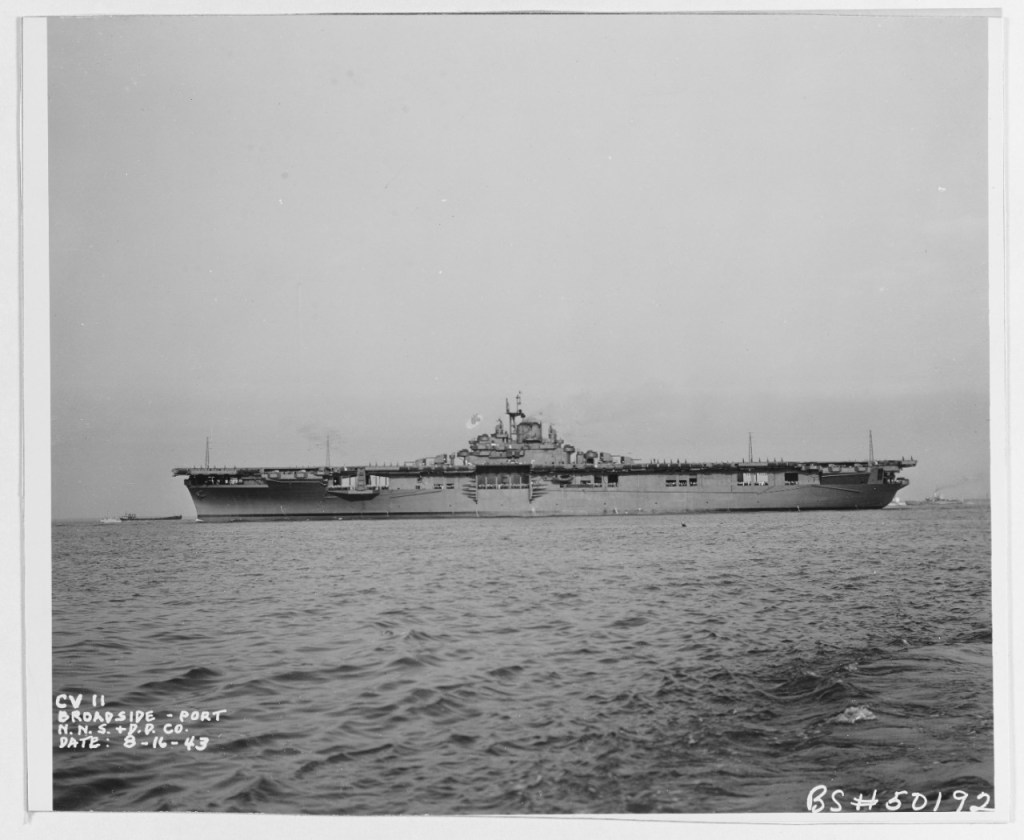
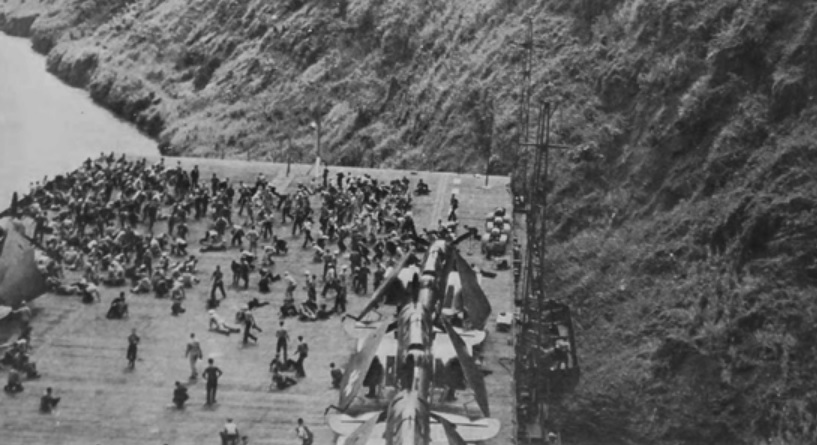
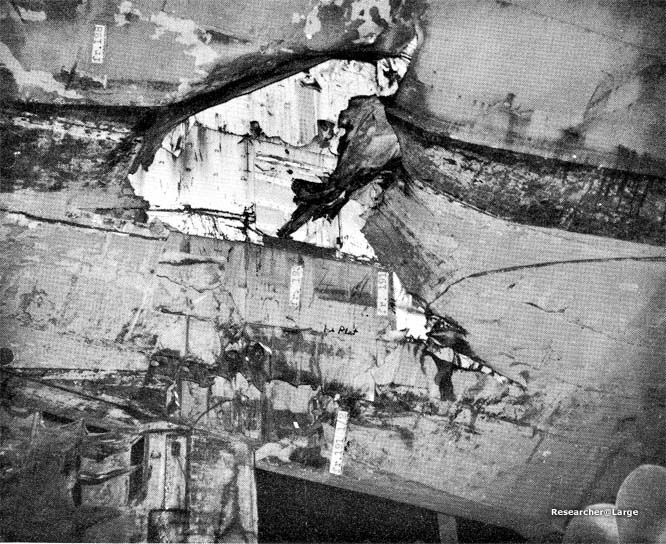
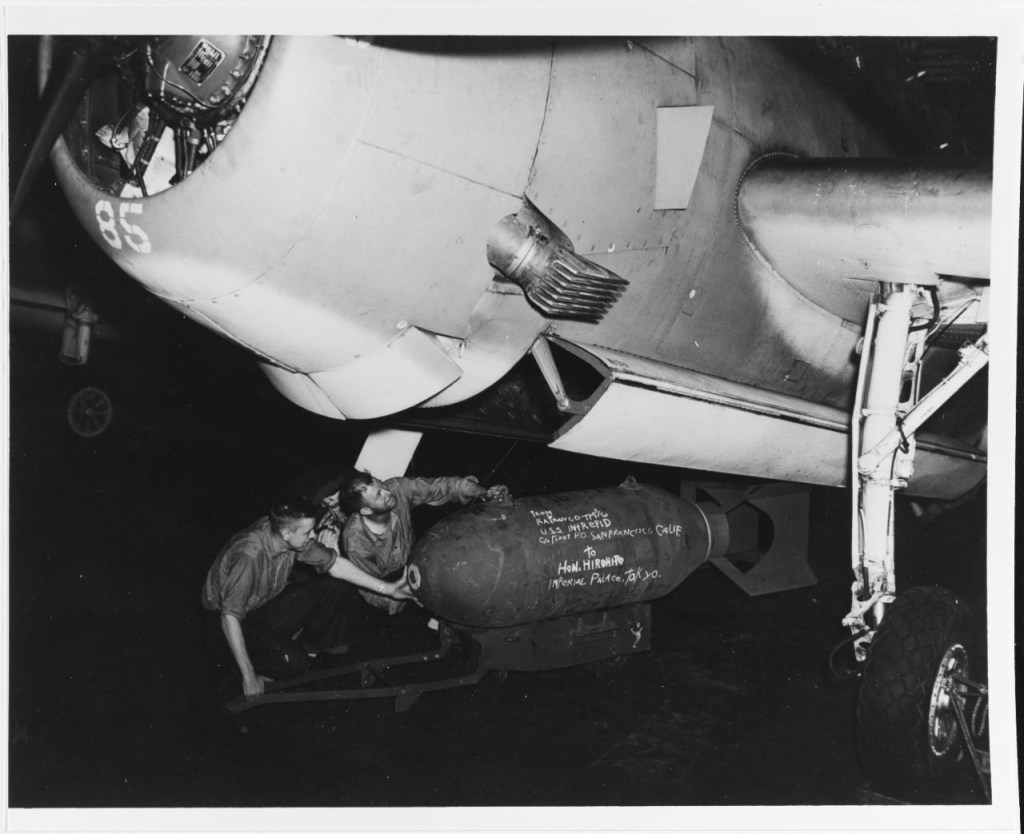
That’s why it must have felt like a cruel joke when the men of Fighting 18 learned they would be going aboard USS Intrepid, a ship that seemed ill-fated after less than a year in commission. Intrepid was first damaged on its maiden trip through the Panama Canal—in other words, before ever seeing combat. The ship was forced to make a detour to Hunters Point for hull repairs. Soon thereafter, Intrepid joined the fight in the Central Pacific. The ship was torpedoed during the assault on Truk in February after less than a month in action. Intrepid headed back to Hunters Point, where the shipfitters must have blinked a couple times to make sure they weren’t having a bad dream. Was Intrepid jinxed?
This article is not just about Intrepid’s former bad-luck reputation as the “decrepit” or the “Dry I” or the “Queen of the Dry Docks”—names which Fighting 18 pilots were warned not to repeat when they came aboard ship in August 1944. It’s about the fact that virtually every member of Fighting 18 was serving temporary duty aboard nearby ships when Intrepid was torpedoed. What follows is a snapshot of their experiences serving in the Pacific a full six months before Intrepid became their home.
Assessing the Target
The Japanese base at Truk was shrouded in mystery. Command staff and pilots alike thought of it as Japan’s Pearl Harbor, a sort of “Gibraltar of the Pacific.” When he learned that Truk was his next target, Lt. Cdr. Philip Torrey, Commander Air Group 9, recalled, “My first instinct was to jump overboard.” He must have been envisioning scores of anti-aircraft batteries, legions of fighters, and battleships bristling with massive guns. If the battle-hardened leader of an entire air group felt that way, you can imagine what the young pilots under his command were thinking.
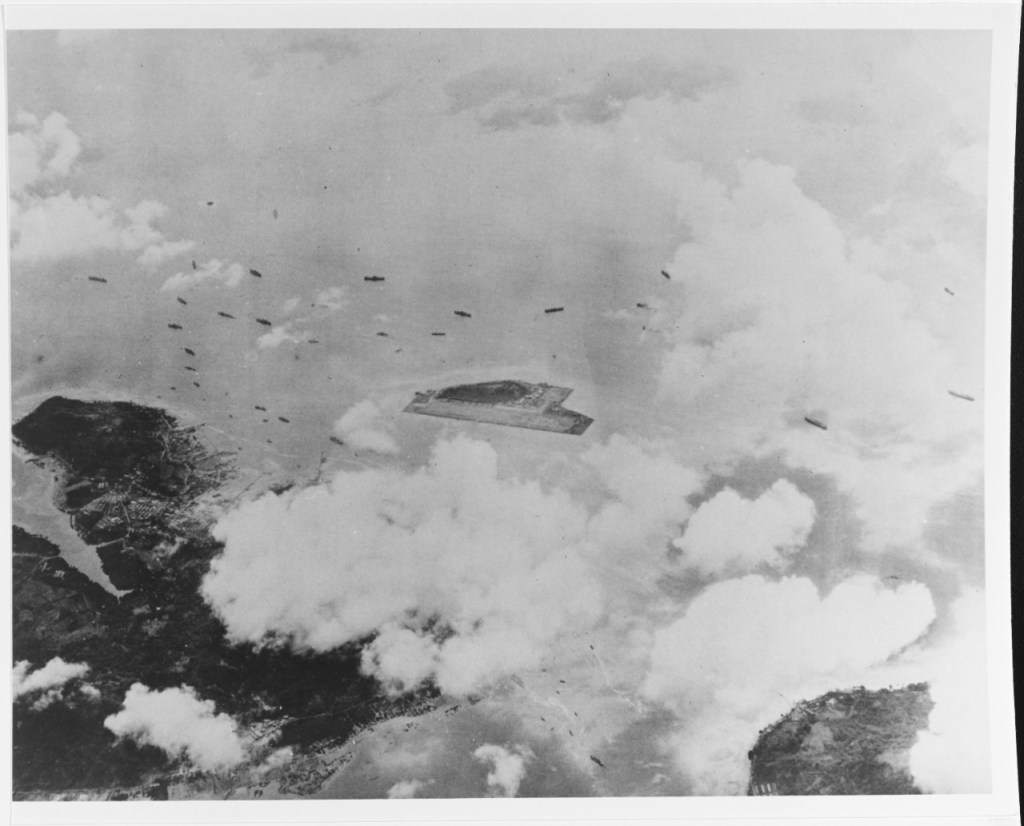
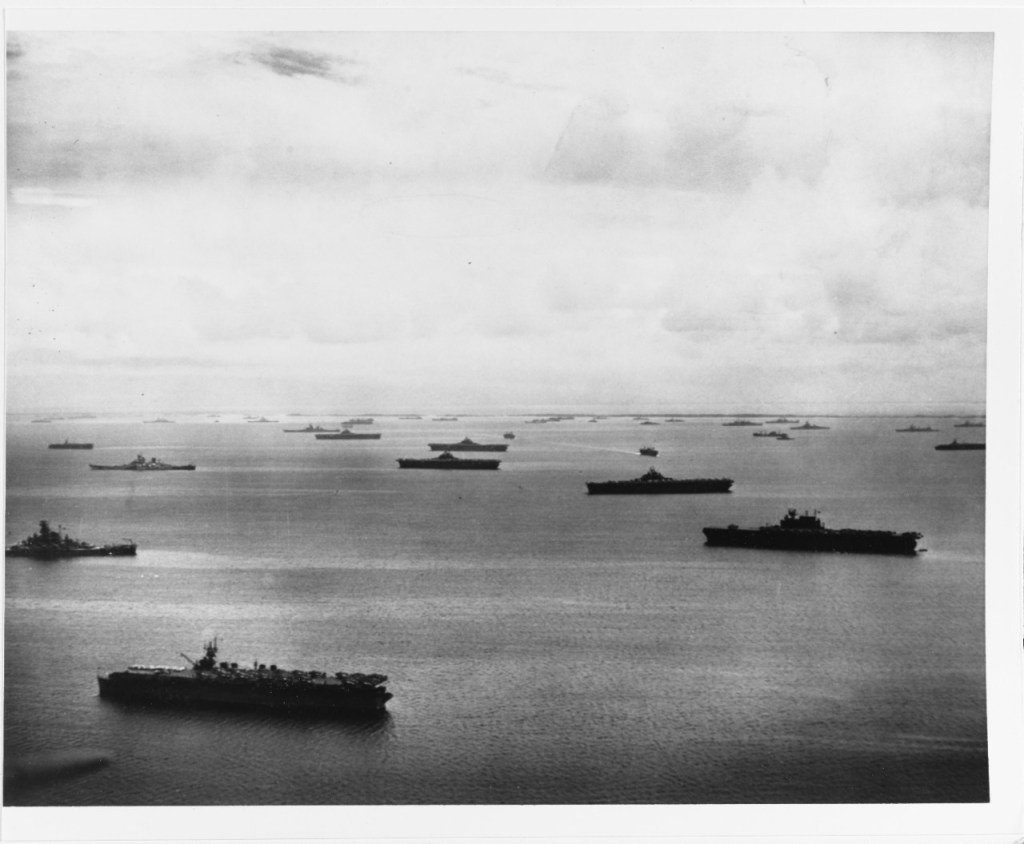
Reflecting these assumptions, the Navy deployed a massive force including 9 carriers, more than 200 support vessels and over 560 planes. Given the tonnage of bombs and the number of planes involved in the strike on Truk, it was aptly codenamed Operation Hailstone. Unlike strikes on the Marshall Islands just weeks earlier, the goal of the attack on Truk was not to seize a new fleet anchorage: it was simply to pound the base into submission, to be bypassed and left useless and desolate for the remainder of the war.
In stark contrast to the mystique that had cropped up around it, Truk was never actually developed to its full potential. Even after the Japanese began a crash program to expand its facilities and defenses in late 1943, Truk’s major islands sported only a handful of modest airfields, 40 fixed anti-aircraft batteries, no major power stations and no underground fuel storage facilities to protect supplies from attack. Japanese surface ships in the anchorage would have posed a deadly threat to pilots, but they had all been moved out of Truk to the Palau Islands where they would be safe from the Allies’ rapid advance. What remained behind were largely cargo and supply vessels. In other words, an ill-prepared Truk was left to fend for itself in the face of the largest carrier onslaught to date.
That’s not to say the attack on Truk was a cakewalk, or a “milk run” in aviator parlance. Some pilots encountered significant anti-aircraft fire; others dueled with Japanese fighters. Even if the air had been clear and the gun emplacements silent, combat flight duty and carrier operations were inherently dangerous. Some men were not coming home.
Flying with the Pros
Lt. Clarence Blouin, Lt. Thomas Rennemo, Lt. Harvey Picken and Lt.(jg) Sidney McGurk, all of whom had been training together in Hawaii, were temporarily attached to Fighting Squadron 9 (VF-9) aboard Essex. Because this was VF-9’s second combat cruise, its veteran aviators—including Hamilton McWhorter, the first Hellcat ace, and Eugene Valencia, soon to be one of the Navy’s top scorers—understandably ran the show.
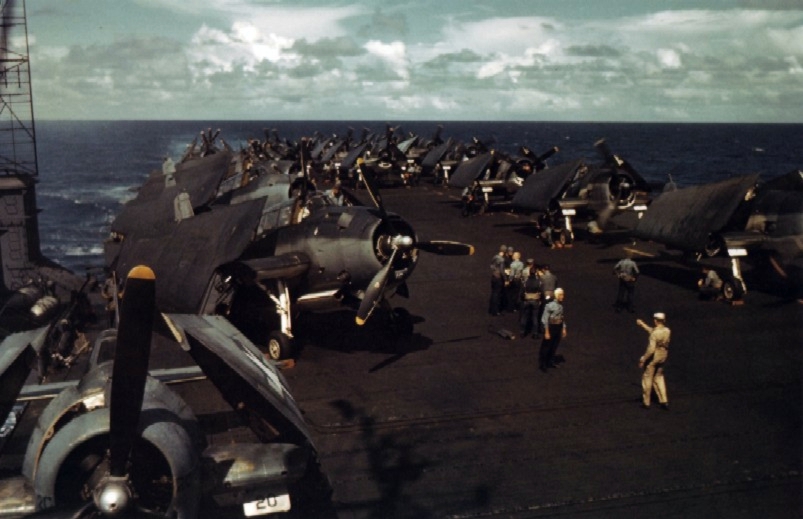
The first day of Operation Hailstone, 17 February 1944, started with fireworks for Fighting 9. Pilots on the morning fighter sweep claimed 21 enemy planes blasted out of the sky at the cost of one missing Hellcat. Then on the second strike of the day, Strike 2B, another dozen or more Japanese fighters fell. This time all the Essex pilots made it home, even if one ran out of fuel and had to be scooped out of the drink by a friendly destroyer.
On the third strike, Lt. Blouin was assigned command of a four-plane division. As with the previous strikes of the day, the Essex Hellcats escorted bombers from their ship and the nearby Intrepid. Their mission was to scour the anchorage for targets of opportunity. As luck would have it, they flew right over a single destroyer that had made it out of North Pass, one of the few points of ingress or egress from the atoll. With no friendly aircraft to drive away the Americans, the destroyer was subject to dive bombing and strafing attacks by dozens of planes. Ammunition clanged off the hull and tore through decking; oil poured out into the water; a small explosion blossomed amidships. Despite the damage Blouin and company heaped on the destroyer, when all was said and done that plucky little ship was still trudging along—albeit back towards Truk, where it would undoubtedly meet its end.
Two hours later, Sidney McGurk and Harvey Picken flew as part of Strike 2D, the fourth strike of the day. More ships had spilled out of North Pass in the mad dash from Truk. Four in particular—two destroyers, a cruiser and an oiler—were about 15 miles beyond the coral fringes of the atoll when McGurk, Picken and the rest of the fighters started circling overhead. They stayed over the ships for two hours, first raking them with their guns, then observing as the Essex and Intrepid bombers did their work. It was a sight to behold. According to both the Fighting 9 and Torpedo 9 action reports, the oiler was well-plastered, and the cruiser suffered multiple bomb hits as well. The oiler sank 20 minutes after the attack. The cruiser was left dead in the water and was pummeled by subsequent strikes.
Five days later, Rennemo joined Blouin, McGurk and Picken as part of a photographic mission over Saipan. The Navy continued to cast its eyes west toward Japan and needed as much intelligence as possible on the Marianas, the next stepping-stone in the island hopping campaign.This important recon mission was perhaps the last one these four men all flew together. The next day, 23 February 1944, Lt.(jg) McGurk was returning to Essex from routine combat air patrol duty when something went wrong. On final approach to the carrier, his plane spun in, crashing into the sea aft of the ship. This tragic loss occurred only five days before Air Group 9 was relieved and the men aboard Essex headed back to Hawaii. Out of the many VF-18 pilots on temporary duty in February, Lt.(jg) Sidney Wells McGurk was the only one to miss his date with Intrepid later that year.
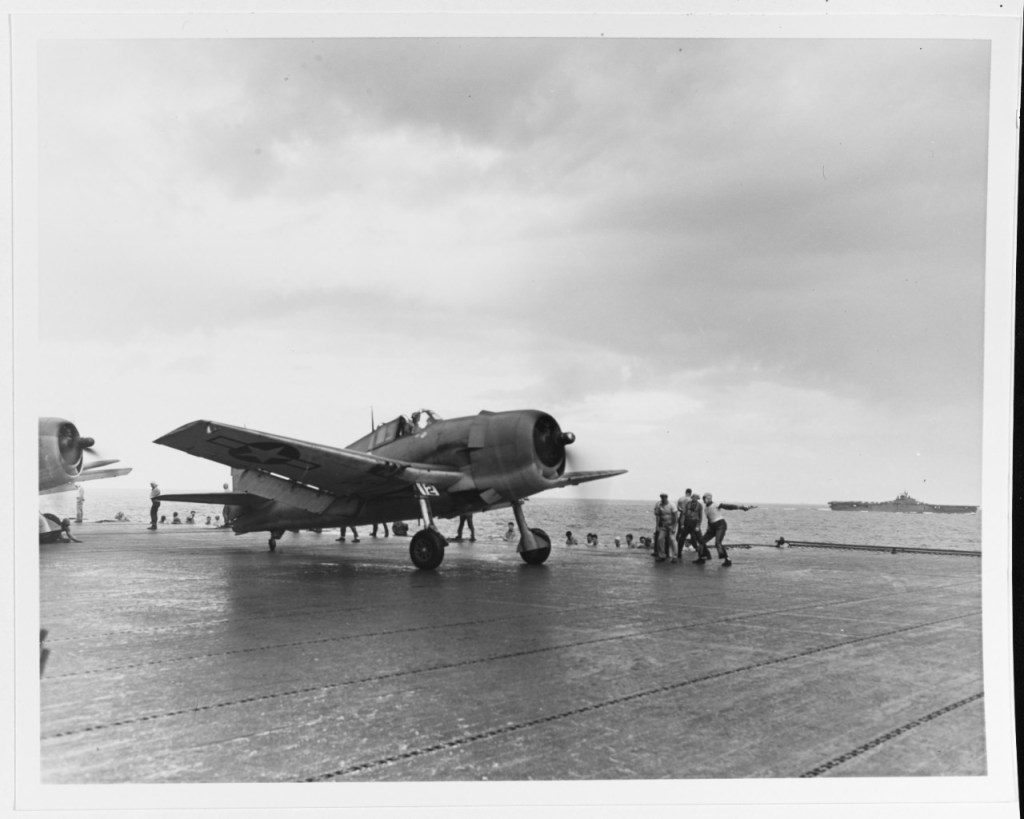
VF-9 Hellcat preparing for early morning strike, 17 February 1944 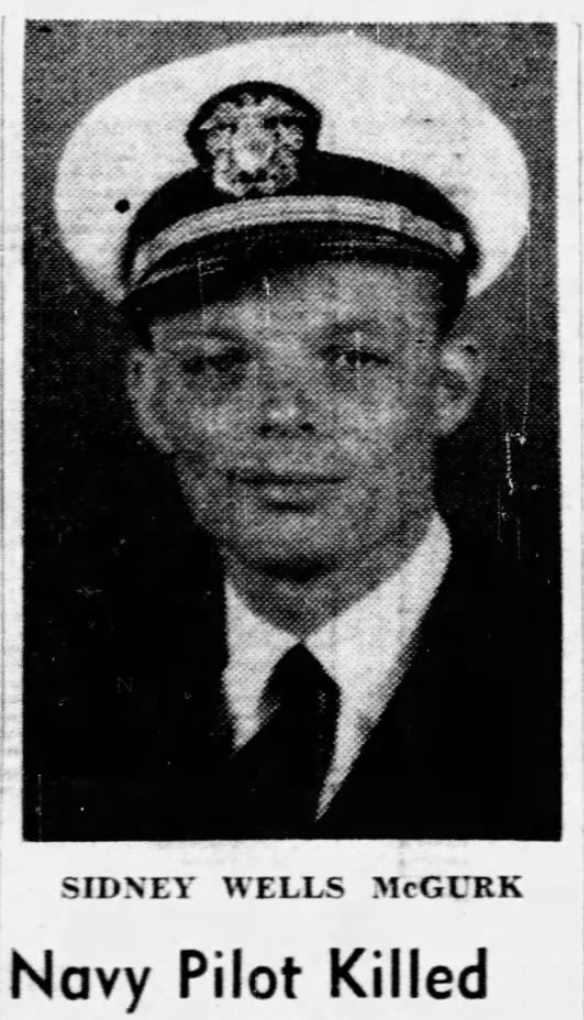

Lt. Clarence Blouin 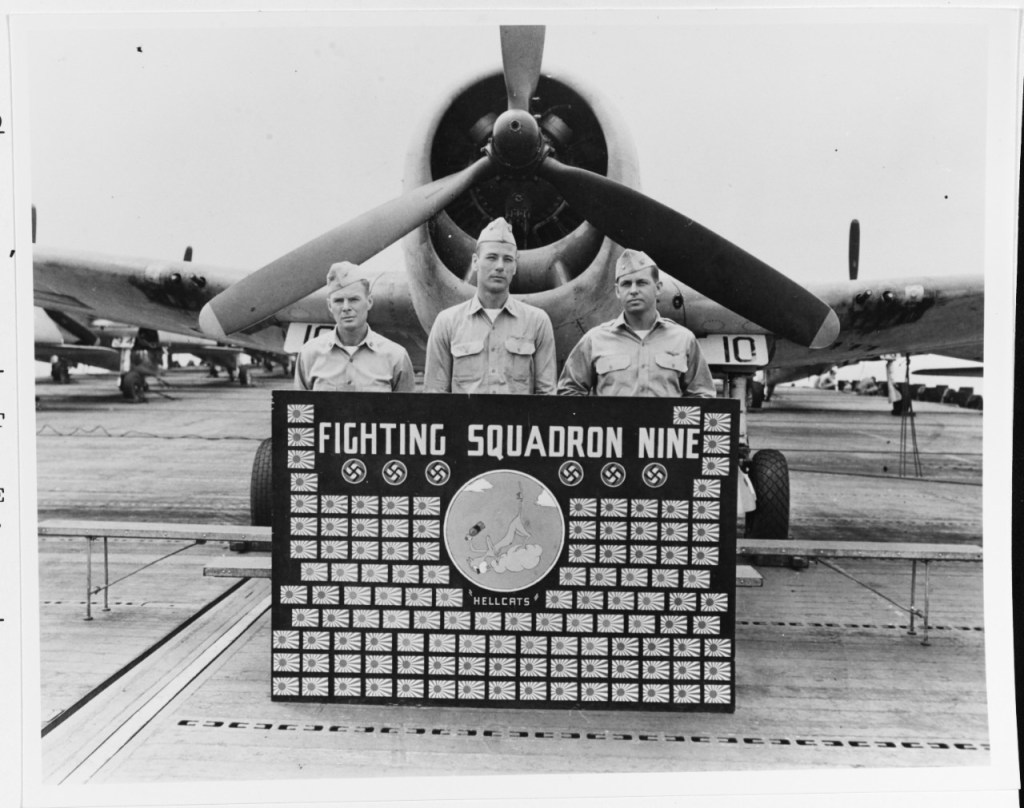
VF-9 scoreboard circa late February 1944
Scoring in the Marianas
It wasn’t all fleet carriers for the men of Fighting 18. There were also light carriers (designated CVL), which could keep up with their larger siblings but carried a smaller air group; and slower, even smaller escort carriers (CVE), which were used as close-in support for Marine and Army forces on the ground. Generally speaking, pilots on these ships did not receive the same level of notoriety as their counterparts on the big flattops. Their squadrons contained fewer men and fewer planes, and were more frequently assigned less glamorous duties like combat air patrol (CAP) and anti-submarine patrol (ASP). They therefore had fewer opportunities to rack up big scores like the one posted by the men of Fighting 9. Nevertheless, they played an important role in the Pacific and exhibited no less valor than their peers
Ed Ritter and Robert “Frog” Hurst found themselves assigned to light carrier USS Monterey (CVL-26) with Fighting Squadron 30. Flying with aircraft based off of Bunker Hill on 17 February, they encountered oilers, barges and destroyers near North Pass—perhaps some of the same ships spotted by pilots from Fighting 9. Ritter and Hurst were surely happy to be assigned to the lagoon and not to targets over Truk’s principal islands, where anti-aircraft fire was listed as intense and accurate. Aside from the aforementioned ships, only one enemy plane was encountered in the air that day. All in all, it was fairly uneventful work. That all changed five days later, when Monterey, like Essex, headed to the Marianas.
Ed Ritter was assigned to fly as part of the initial fighter sweep over Tinian on 22 February. Still operating with Bunker Hill, his group of 23 Hellcats took off at 0600 hours into overcast skies. The clouds cast a thick and unbroken blanket starting at 8,000ft, meaning that the strike would rely on instruments and Navy intel to determine when they should descend into the murk—and hopefully arrive successfully over target.
Ritter’s division was one of two to lead the charge through the overcast. Speeding towards the ground at more than 300 knots, his altimeter steadily unwound without any change in the cloud cover until finally, at the last moment, the airfield below materialized. He pulled out of his dive at perilously low altitude to find that his division leader was gone. The other division was nowhere to be seen. That left Ritter and fellow flier Ens. Walter King to fend for themselves.
The two were out of position to hit aircraft parked along the runway, but as they roared overhead they took full advantage of the lack of airborne opposition. Their guns were charged. Their targets, a control tower and buildings lined up along the field, were strafed until they started to throw off smoke and flames. Just then Ens. King heard a transmission on his radio. It was the leader of the second division broadcasting his position and orders to join up. Though they did meet up with a third pilot en route, who must have also heard the transmission, the second division leader was missing. The prospect of getting the fighters back together for a coordinated attack was becoming increasingly dim.
Ritter’s band of three now circled around the southern tip of the island—the only area free of the overcast. It didn’t take long for them to see the lumbering form of Avenger torpedo bombers heading up the west coast, looking for a hole in the clouds from which to start their bombing runs. The planes were unescorted, so Ritter and his two fellow fighters headed out to provide them with protection. It may not have been part of the original plan, but that had all gone out the window anyhow. At least this would be doing something productive.
Like seemingly everything else that morning, their new mission immediately went off the rails. Ens. King spotted two Japanese fighters below and head of him, steadily gaining altitude as they climbed towards the Avengers. He and the third pilot quickly broke off to engage. The Japanese pilots never had a chance. Approaching from above and behind, King and the third pilot in the group quickly shot down the two interlopers.
That left Ed Ritter, who spotted a solitary enemy off to his right trying to sneak by low on the water. Ritter didn’t want to go on a wild goose chase. Instead, he broke right and sent a quick burst of fire hurtling in the direction of the plane, which he identified as either a “Zeke” or an “Oscar,” both different types of single-seat Japanese fighters. As he quickly snapped back to the left to reconvene with his group, he saw the enemy plane steadily losing altitude. It wasn’t smoking or showing any other signs of damage, but it nevertheless continued down almost serenely until it slammed into the water.
That moment made Ed Ritter the only member of Fighting 18 assigned to temporary duty during this period to score in air-to-air combat.
USS Monterey Hellcats and Avengers circa late 1943 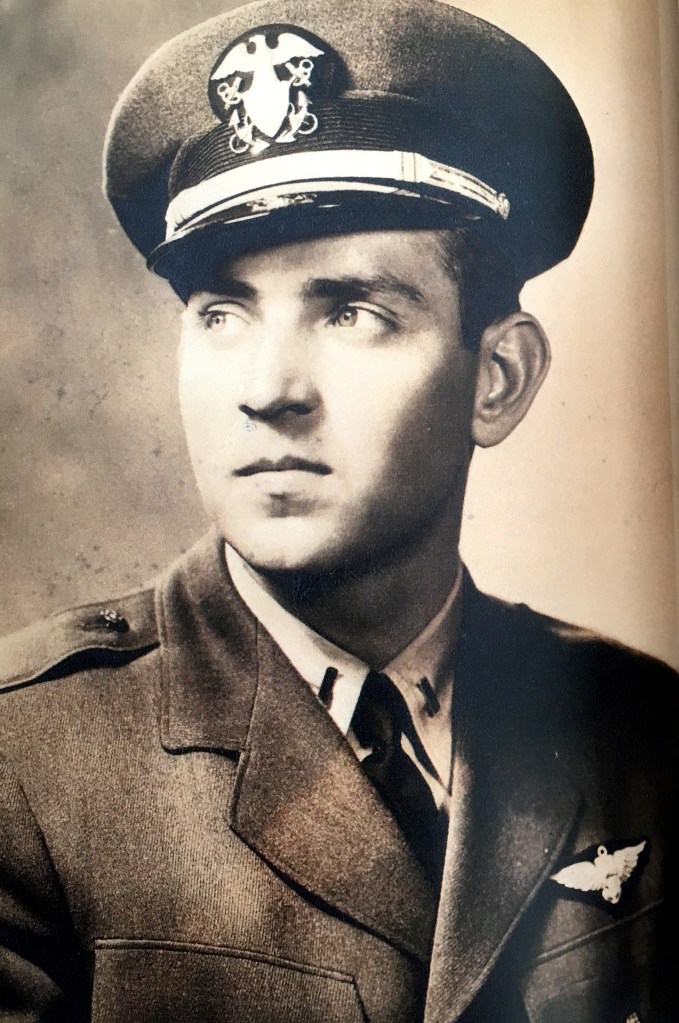
Ed Ritter, VF-18’s top scorer in February ’44
Pacific Punching Bag
At the same time Truk was undergoing relentless assault by the carriers of Task Force 58, a more modest assemblage of ships was quietly carrying out anti-submarine and combat air patrol duty east of Truk, in the Marshall Islands. Taroa Island in particular was singled out for attack given its position as the easternmost Japanese air base in the Pacific. It had been the subject of persistent hit-and-run raids by Allied aircraft since 1942 for this very reason. More recently, in late January 1944, it had been so thoroughly worked over that there probably wasn’t a single operational aircraft left on the island. The Navy wanted to keep it that way. Additional strikes were authorized for February 1944 and would continue to be authorized practically to the end of the war, by which time the tiny island had been hit by over 4,000 tons of ordnance.
Noel “Big Tom” Thompson and Anthony Denman were both assigned to participate in these strikes as part of VC-66 aboard the escort carrier USS Nassau. They arrived on 12 February from USS White Plains with replacement aircraft and orders to stick with the squadron until its return to Pearl Harbor. Unlike the fleet and light carriers, escort carriers were so small that they didn’t have air groups with independent bombing and fighting squadrons. Instead, the ‘VC’ stood for ‘composite,’ a mixed squadron made up of fighters and torpedo bombers. Another difference was that the escort fighters flew Grumman-designed Wildcats as opposed to the newer Hellcats operated by pilots on bigger ships. The Wildcat was slower and less well-armed than the Hellcat, but it was still an excellent plane in skilled hands.
As the squadron prepared to hit Taroa, its War History recalls that the men:
“Had a chance today to look at our handiwork as the Nassau steamed into Majuro lagoon and we saw at close range, the immense size of the lagoon and the tremendous collection of floating power assembled there…This marks the first time that the bulk of the new Pacific Fleet has assembled in one harbor, and what a sight it is!”
On 16 February, Thompson and Denman participated in a strike against Taroa Airfield. Their FM-1 Wildcats were loaded with two bombs: one 100lb. general purpose explosive, and one 100lb. incendiary. Though the island was already in shambles from two years of attacks, anti-aircraft fire—from the chatter of machine guns to the booming thump of big artillery pieces—was intense. Pilots remained stalwart in the face of heavy fire. One diving plane had a round tear through its starboard wing, severing the wires that served to charge guns and arm bombs. Its pilot returned to base with its payload. Even with one plane effectively out of the fight, the remaining 7 Wildcat pilots logged 7 hits with their general purpose bombs: 2 on a barracks, 4 on assorted buildings and 1 on “elbow pier” on the shore of the island. Incendiaries were dropped but the results were labeled “a distinct failure.” Only a few small fires were noted.
Thompson and Denman’s experience with the unit likely jives with the reminiscences of the War History:
“In combat operations, the squadron accomplished its mission of neutralizing Taroa and Wotje, even though the bulk of hours in the air were spent on CAP and ASP. The gang had enough close scrapes to feel indoctrinated in the business of war…As the Nassau steamed back toward Pearl, stripped of her planes and ammunition (and beer), but carrying seventeen Jap prisoners, the Seagulls of 66 decided that they had been to war, for a while at least.”

Noel Thompson, 25 years old, during training in 1942 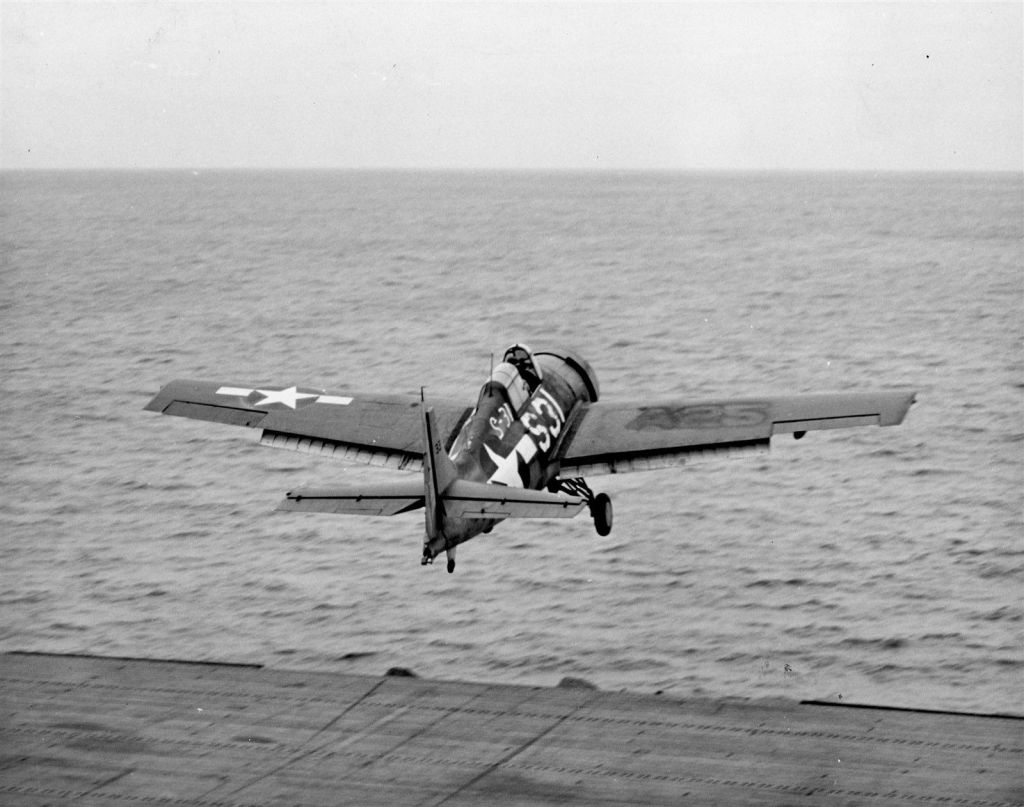
FM-1 Wildcat taking off from USS Nassau 
Anthony Denman towards the end of his long Navy career 
Tiny Taroa Island and its airfields
Reunion
By 3 March 1944, Thompson and Denman were transferred from Nassau back to squadron training with VF-18. A day later, Blouin, Rennemo and Picken arrived from Essex. They had to break the sad news about Sidney McGurk. Ritter and Hurst came from Monterey, and the rest of the men—Robert “Fox” Morris from Yorktown and others from all manner of carriers—all filtered back to Hawaii. They had a bit more experience under their belts and a renewed sense of purpose. They were ready to get back out there in a squadron of their own, where they’d have the opportunities they were typically denied as replacement pilots. By May 1944 they were ready to go aboard Intrepid for their inaugural tour of duty, just in time to participate in the Marianas Turkey Shoot.
Intrepid, on the other hand, was far from ready. The torpedo that knocked the ship out of commission in February created lasting headaches for repairmen, who could not seem to iron out the kinks in the ship’s propulsion system. As a result, Intrepid did not ultimately leave Hawaii until August—three months late for its date with destiny. For the crew of Intrepid, the torpedo ordeal represented a trial by fire they passed with flying colors. All hands had come together to ensure the ship’s survival; its battle wounds were proof positive of their competence as sailors. It therefore makes sense that when the novice aviators of VF-18 came aboard their ship, the crew would suffer no slights against it.
Despite their initial suspicions of the ship and the hostility—real or imagined—they sensed from Intrepid’s crew, the men of Fighting 18 ultimately followed Ernest Hemingway’s advice to his son: “”You make your own luck…” Fate wasn’t determined by portents and omens, it was the product of action, for better or worse. Through hard fighting in some of the Pacific’s biggest air and sea battles, Fighting 18 became welded to Intrepid and thought of their ship not as the “Dry I,” but as all of the synonyms for which Intrepid stands: bold, brave, courageous and daring. And they wouldn’t abide any slander on its name from anyone else, either. By the end of their tour, the air group’s War History recorded:
“Several pilots from another Air Group in the same boat let it be known that their group had sunk the entire Jap fleet, single-handed. They passed several remarks about the “Queen of the Drydocks” and her “green” air group. Duke Delaney [VT-18] quietly worked himself around beside one of these gentleman and when he opened his mouth again he hit him and knocked him ten feet to the deck. Duke jumped on him and looking around said, “Anyone else from his group here?”
There apparently wasn’t. Air Group EIGHTEEN and the INTREPID have come a long way together since they first met. The Air Group will listen to no slurs on the name of their ship…”
 Two-a-Day 18
Am I missing the password?
Regards, Steve
LikeLike
Hey Steve! I shot you an email, still finishing the draft but I’d love for you to take a look and tell me what you think. Cheers.
LikeLike
Robert “Frog” Hurst was my great uncle!
Just now learning about his service. Would do anything to read more about him.
LikeLike
Charlie, would be happy to share what I know! Shoot me an email at fightingsquadron18@gmail.com and I’ll reply with the photos, records, and other information I’ve been able to gather over the years. Cheers!
LikeLike