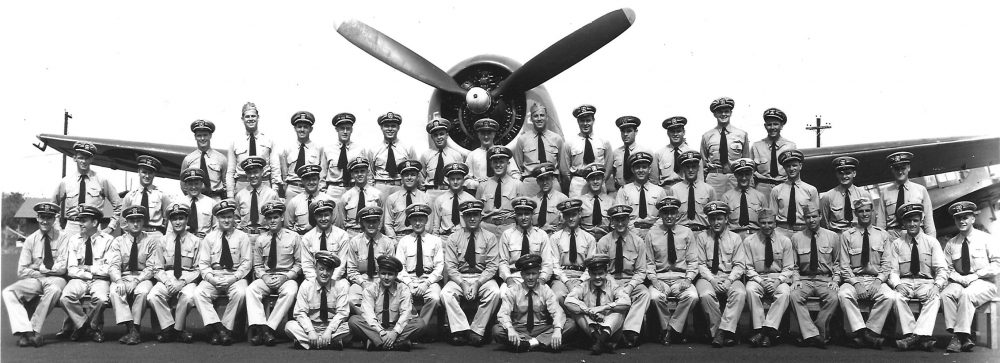
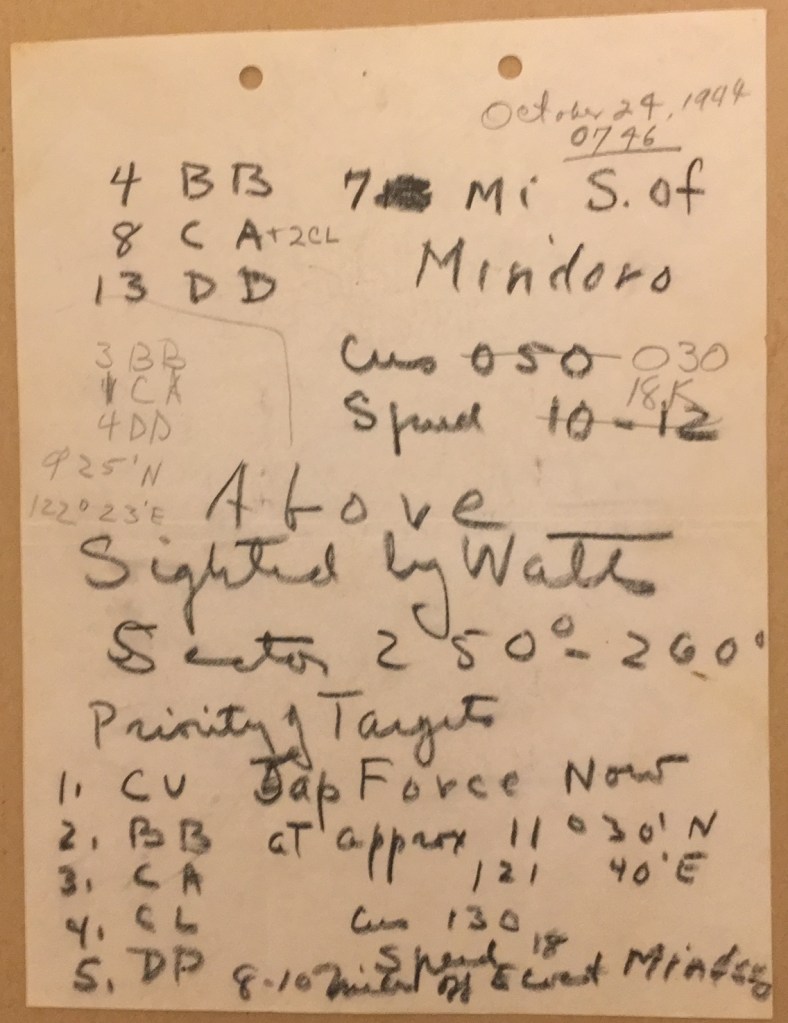
At 0820, Lt. Bill Verity of Cabot raised a shout that everybody heard: “I see ‘em.” He reported the Japanese formation on an easterly course off Mindoro Island. “Big ships,” he yelled. Two minutes later the voice of Cdr. Mort Eslick of Intrepid’s Bombing 18 came on—relayed loud, clear, and very cool: “Four battleships, eight heavy cruisers and 13 destroyers, course east, off the southern tip of Mindoro.”
It was the sighting of the day. Others would be more startling, but none so timely and accurate…Said Mick Carney, “Never in any main action at sea has the intelligence information from searching been so good, so thorough, so quickly put through, and so complete.”
-Carl Solberg, Decision and Dissent
This account of the Battle of Leyte Gulf has been cited in major works, including Evan Thomas’s Sea of Thunder and, more recently, Ian Toll’s Twilight of the Gods. Its author is rightly considered an authoritative source given his role as Admiral Halsey’s air combat intelligence officer (ACIO) during this epic showdown. There is just one problem: the names mentioned above—Bill Verity and Mort Eslick—are not correct, and even if they had been, those men were not there that fateful morning. In the case of Eslick, whose name was Mark, not Mort, it was because he was killed in action over Formosa almost two weeks prior. Regarding Bill Verity, there is no record of such a pilot aboard Cabot at that time, and at any rate, there’s virtually no evidence that USS Cabot had anything to do with the searches that found the Japanese battleships.
All of this raises the question, who actually deserves credit for spotting “the largest armada seen massed together in the entire war…”? Who broadcast the “timely and accurate” sighting report to Halsey? On the 76th anniversary of the Battle of Leyte Gulf, it is time to finally give the correct men their due, starting with Fighting 18 pilot Donald Watts, Jr.
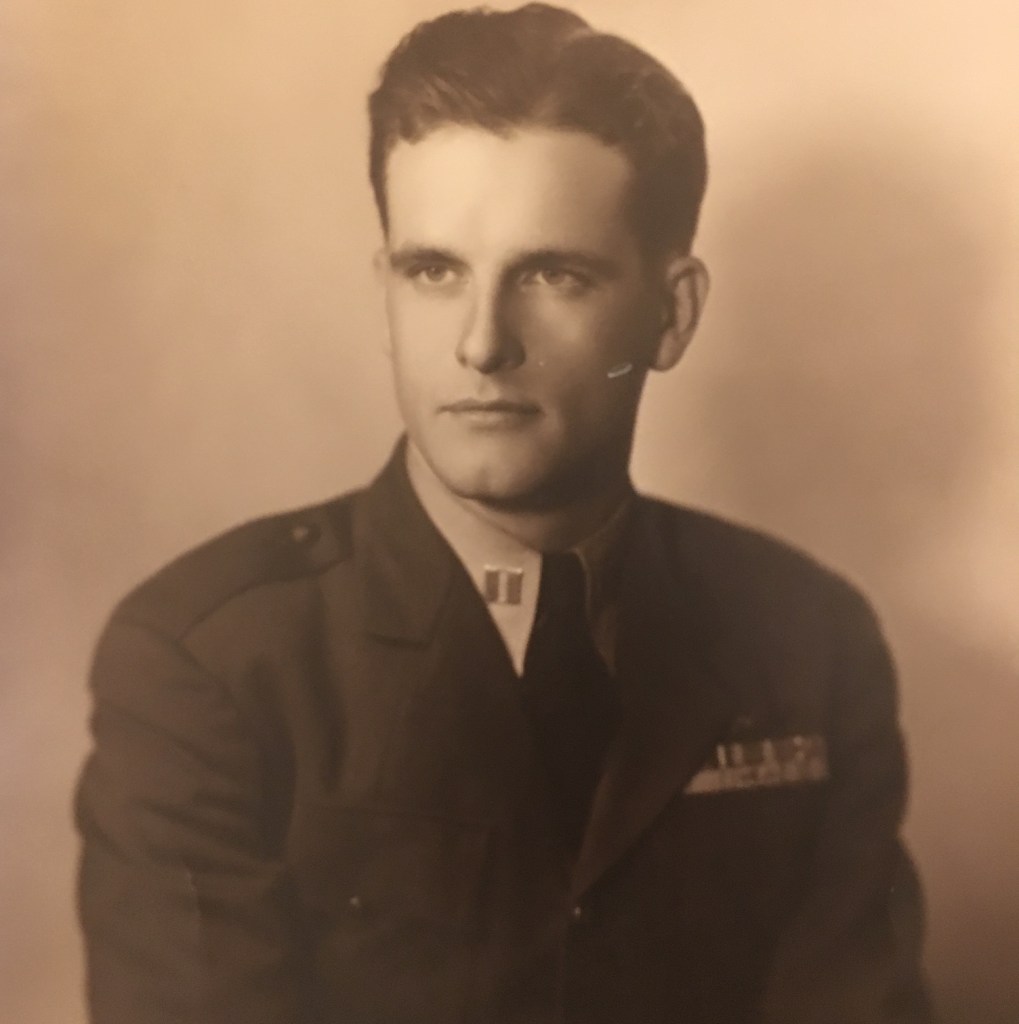
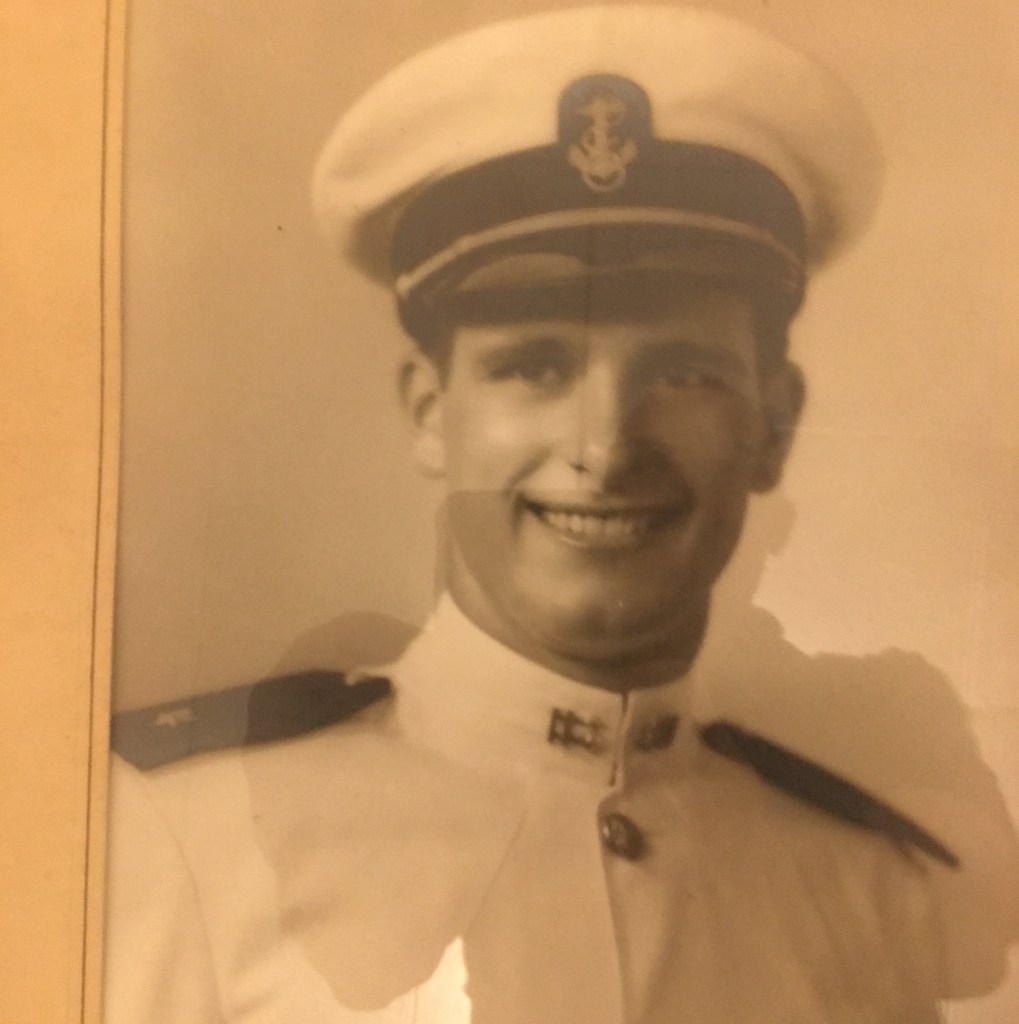
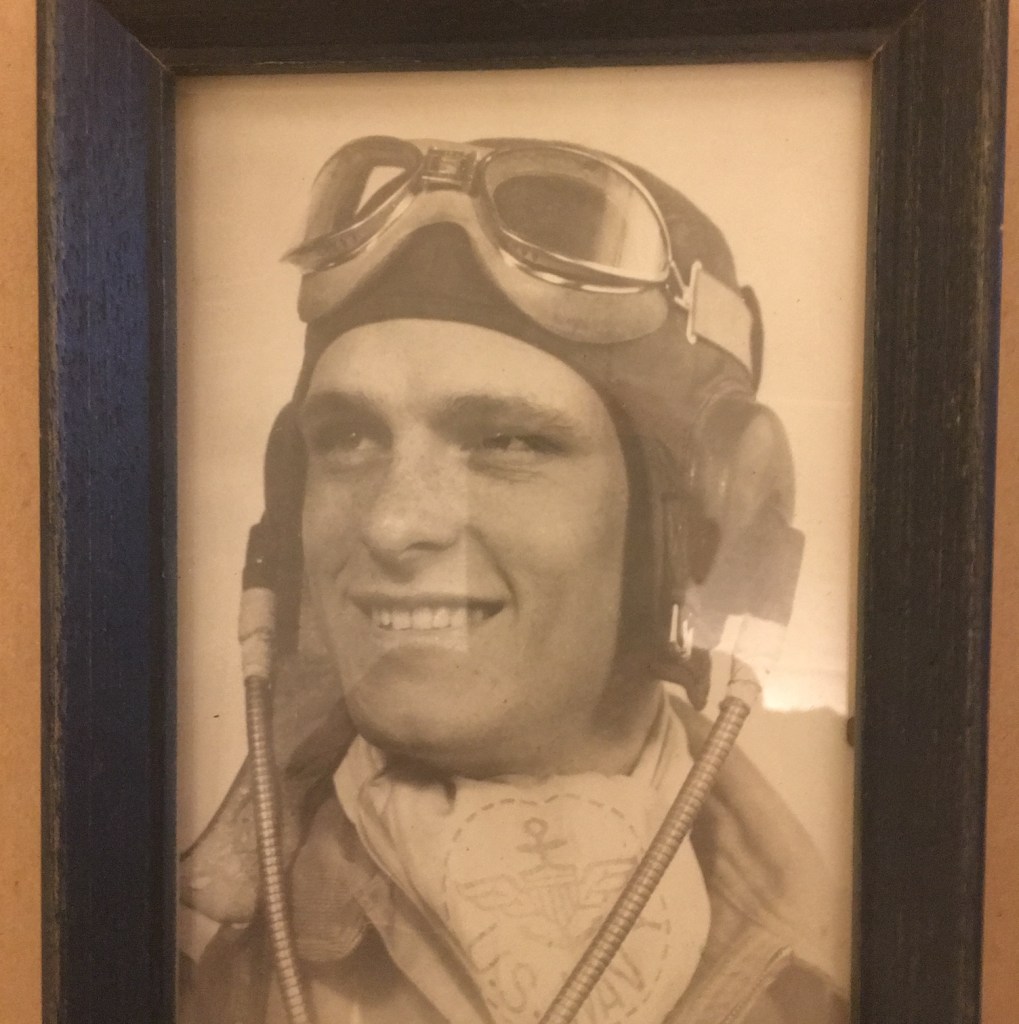
Donald Leavitt Watts, Jr., was born March 3, 1921, in California. His love affair with all things fast began as early as age 14, with an Indian motorcycle he rode around the Burlingame area. At 17 he signed up for the National Guard, though it would only be a couple of years before the siren call of the Navy made him switch branches. Maybe it was the sharp dress whites that sealed the deal. More likely, it was the prospect of being strapped into the cockpit of a carrier plane that would make his Indian look like a bicycle. Either way, it would have put him at odds with his younger brother Jack R. Watts during the annual Army-Navy football game. Jack enlisted in the Army in early 1941 and ultimately joined the 501st Parachute Infantry Regiment, 101st Airborne Division.
Watts’ leadership abilities were apparent from the very beginning. He went from corporal to sergeant in the National Guard, commanding the 3rd platoon, 159th Infantry Regiment by the time of his release in 1940. At Naval Air Station Corpus Christi, he served on his class’s regimental staff as commissary officer and then as regimental sub-commander. He graduated first in his class in December 1941, just as war arrived on American shores. He had achieved all of this by the time he was 20 years old.
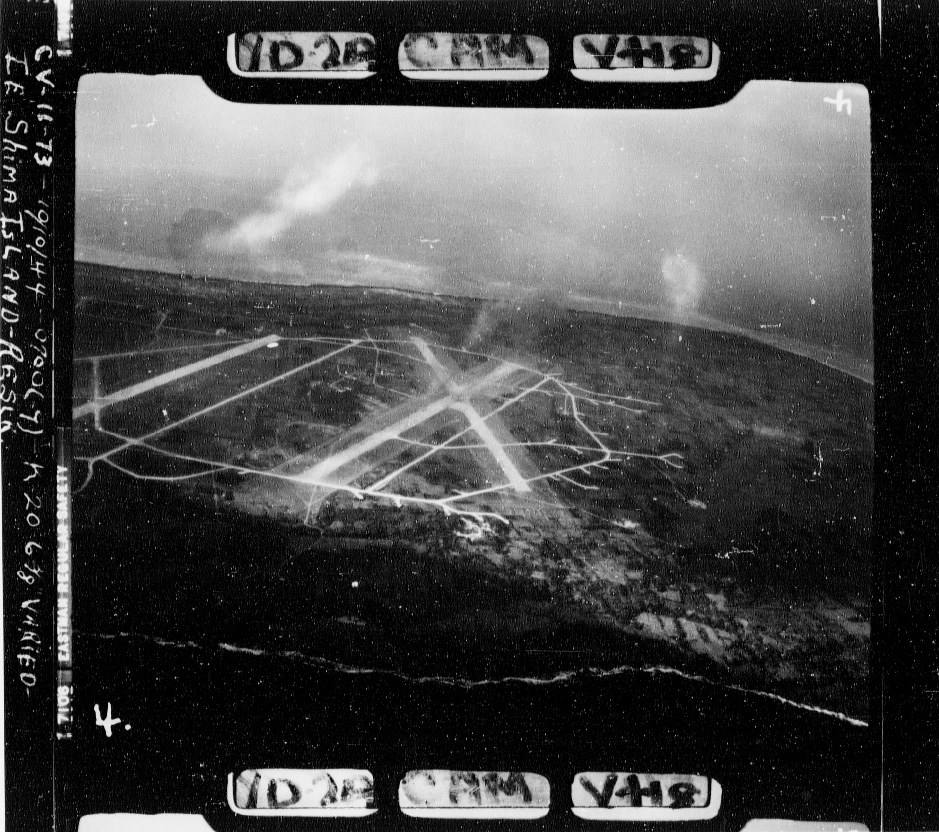
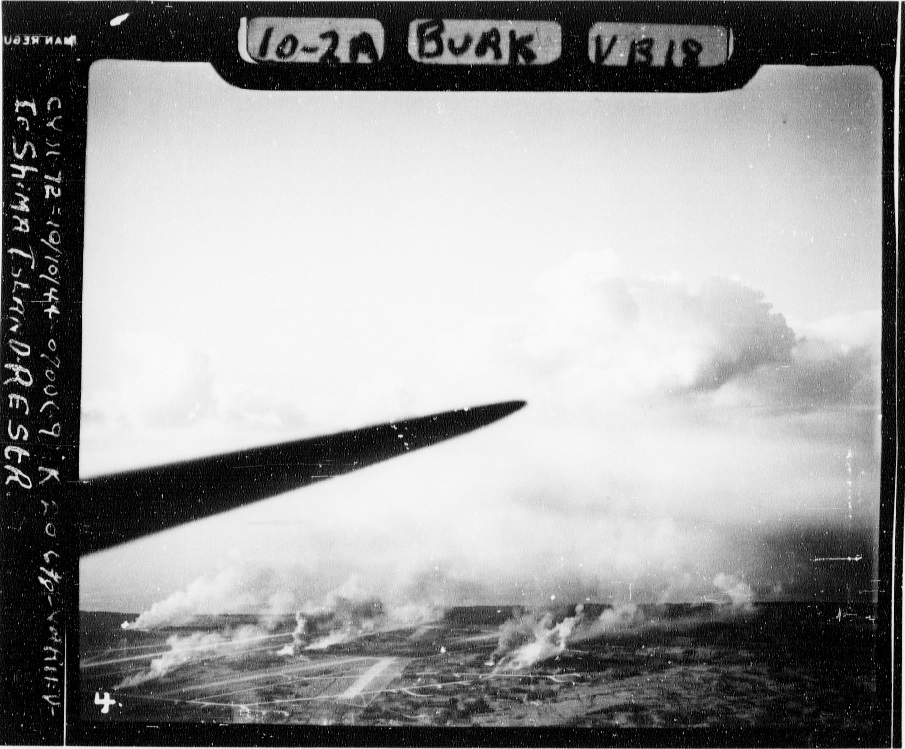
Once deployed, Watts proved to have an eagle eye and a nose for juicy targets. His first big score came on October 10, 1944, during strikes on northern Okinawa. After escorting Intrepid’s bombers to their targets—shipping on the coast and air facilities inland—Watts looked for something worth planting his 500lb. bomb on. He noticed a little island in one of the channels running out to sea. For some reason, it just didn’t look right to him. Watts dropped his bomb over the target but narrowly missed. Despite the threat of anti-aircraft fire, he flew lower and opened up with his Hellcat’s six machine guns, raking the “island” from stem to stern. Branches flew into the air. Netting tore open. Gasoline poured from the three barges carefully hidden beneath the debris. The water around the barges burned fiercely, casting the 200’ vessels in stark relief. Watts’ hunch had paid off.
Two days later he was at it again. On “the third strike of the day against heavily fortified, strongly defended Kiirun Harbor, northern Formosa,” Watts led his section through intense anti-aircraft fire against three SC’s or “Sugar Charlies,” small cargo ships that were attempting to hide out in a cove. Watts and his wingman, Ensign Winton Horn, hosed the ships down with .50 caliber rounds. As with the previous day, he really knew how to pick them: “These ships were evidentally [sic] loaded with ammunition or explosive for they blew up with violent explosions leaving nothing but debris and purple slick.” He wasn’t done yet, though. “Two more SC’s were sighted 10 miles north of Kiirun Harbor. Lt. Watts sank one and seriously damaged another.”
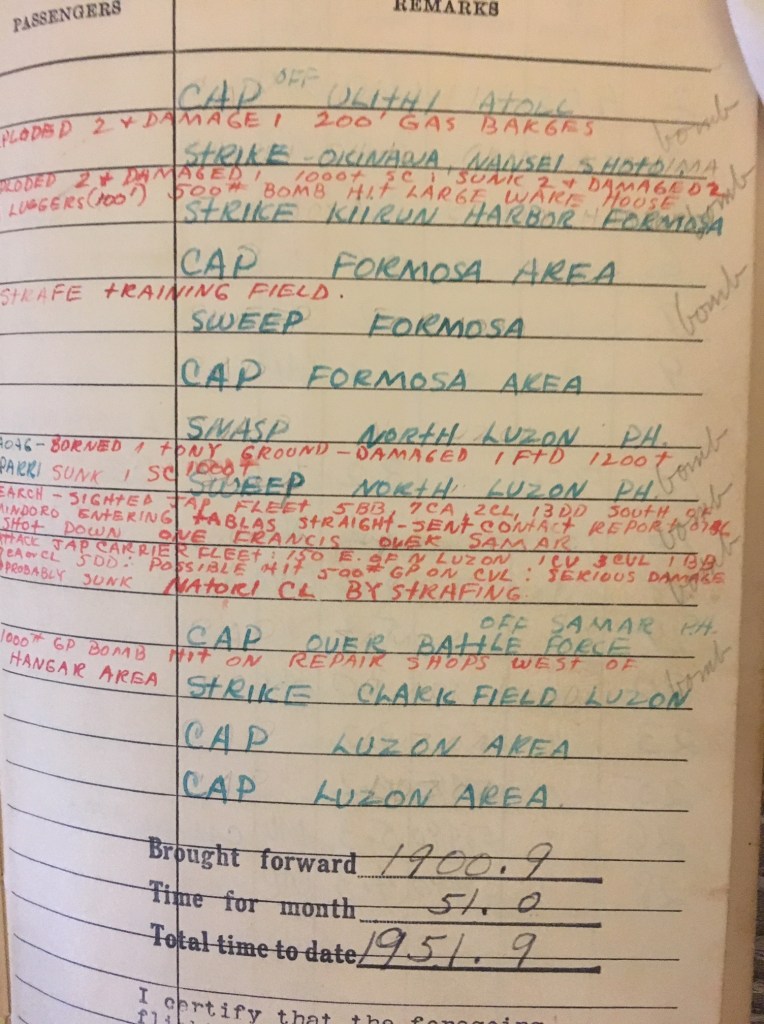
These were just warm-ups for Watts. His biggest single-day tally came on the morning of October 25 as Halsey’s carriers pounced on the unprotected remnants of Japan’s carrier force. Although this was a decoy force lacking the protection of Japanese fighter planes, the big ships steaming below still bristled with guns that could throw up walls of flak against attacking Helldivers, Avengers and Hellcats.
Air Group Commander Ellis led Intrepid’s 25-plane strike to the target. The weather was absolutely perfect. He arrived on the scene at the same time as other carrier groups, leaving the sky above Japan’s beleaguered carriers jam-packed with ordnance. Without harassment by Japanese planes, there was plenty of time to organize the dozens of aircraft into a carefully orchestrated attack. Admiral Mitscher aboard Lexington instructed his ship’s air group commander, callsign “Mohawk,” to take the lead. Mohawk handed out target assignments. Each group got into position, awaiting the order to “check all switches,” and finally, “commence high speed run in.”
Dive bombers pushed over first. Despite facing intense anti-aircraft fire, the action report filed after the strike recorded five pilots scoring confirmed hits and one probable on the light carriers they had been assigned. Four VF-18 pilots, including Donald Watts, followed on the heels of the bombers. Their dives were as steep as 70 degrees as they hurtled from 16,000’ down as low to 2,500’. Cevoli and Amerman recorded probable hits on a light carrier; Frederick Tracy scored a direct hit on the after flight deck of Japan’s one remaining fleet carrier, Zuikaku. It was hard to tell what happened with Watts’ bomb drop in the chaos of the moment. The action report records a near miss on a light carrier. His flight log book indicates a possible hit. His citation for the Silver Star Medal determined that Watts “probably scored” a hit.
After pulling out of his dive, Watts craned his neck around to pick a new target. He may have expended his one 500lb. bomb, but there was still plenty of ammunition packed into the wings of his Hellcat, and he knew from experience that it would cause plenty of damage. His flight path was going to put him in line with a light cruiser on the edge of the scattered and battered Japanese formation. Watts pulled his plane up and dove at the ship, firing as he picked up speed. This wasn’t a duel with another fighter pilot, where the prudent thing would be to conserve ammunition by firing short bursts. No, the more rounds the better. Watts held down the trigger and let ‘er rip. Bullets tore into the base of the cruiser’s smokestacks as he hurtled over it at 500’. He threw his stick around as he left the scene, jinking his plane violently to avoid counterfire from the cruiser. One mile distant and feeling bold, Watts banked to get a good look at his quarry. It was smoking heavily. A moment later, there was a massive explosion. If the ship was still afloat beneath the pall of oily black smoke, it probably wouldn’t be for long.

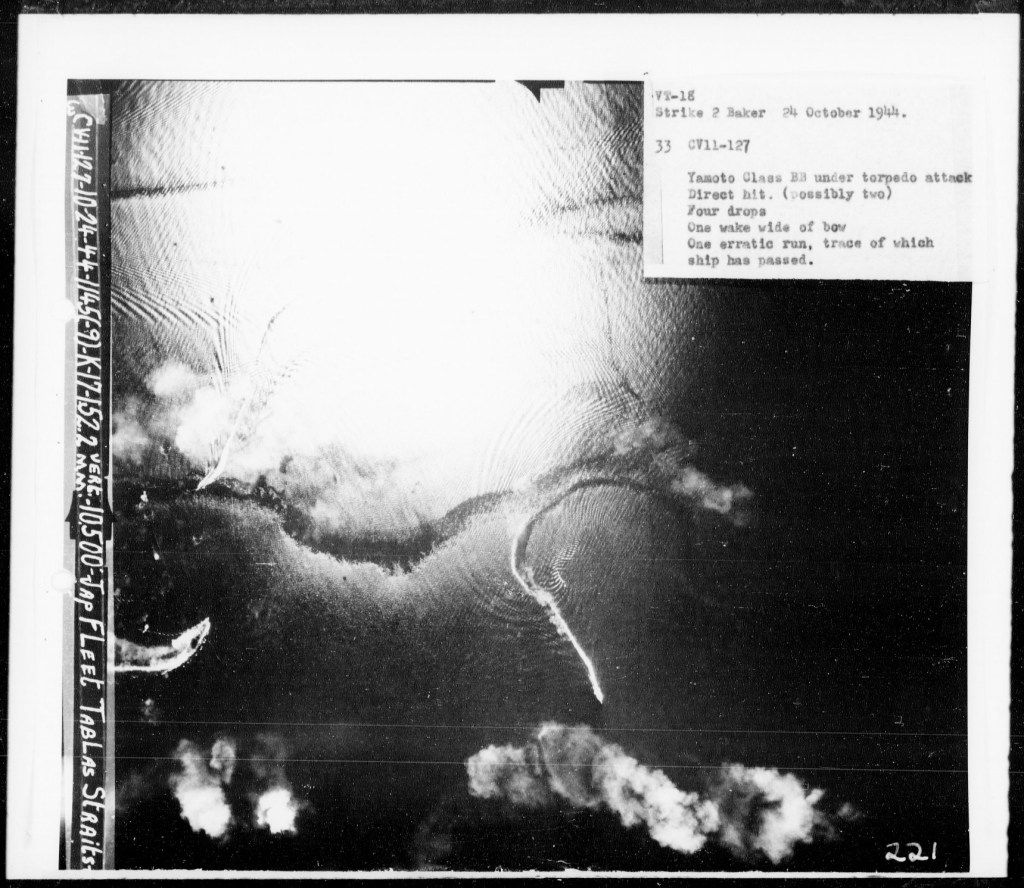


All of this is impressive, but Watts’ most significant contribution to the Battle of Leyte Gulf did not come from bombs or bullets: it came from his keen eye, cool head, and unflagging resolve. Unfortunately, his actions on the morning of October 24, 1944, have been obscured by inaccuracy and confusion in the historical record. For the reader’s sake, the full discussion of that event can be found at the end of this article. Watts’ citation for the Distinguished Flying Cross will suffice to explain what a significant role he played in this battle:
For heroism and extraordinary achievement in aerial flight as a Fighter Pilot in Fighting Squadron EIGHTEEN, attached to the U.S.S. INTREPID, in action against major units of the Japanese Fleet, during the Battle for Leyte Gulf, Philippine Islands, October 24, 1944. Launched at dawn, Lieutenant Commander (then Lieutenant) Watts took off on a hazardous search for the Japanese Battleship Force reported south of Mindoro Island and, upon sighting the enemy Fleet, boldly flew within range of its powerful gun batteries where he remained for approximately one and one-half hours and accurately reported the composition and movement of the Japanese Naval Force, thereby assisting materially in the development of our attack upon the enemy. By his skilled airmanship, gallant fortitude and unwavering devotion to duty, Lieutenant Commander Watts contributed essentially to the success of our operations in this historic battle, and his great personal valor in the face of grave peril upheld the highest traditions of the United States Naval Service.
After returning home from his stint aboard Intrepid, Watts, like many of his peers in Fighting 18, elected to stick with the unit. He trained throughout 1945 in anticipation of a second deployment. The grim odds of making it through yet another tour of duty were not lost on Watts, whose younger brother Jack was killed on September 27, 1944, as he jumped into Holland.
Fortunately for Donald Watts, 1945 would be a year of weddings, not combat. He and Jane Ellen Faries, Alpha Chi Omega at UCLA and chairman of the local War Loan drive, were married July 14. A month later, after Japan came to understand the full force the United States would bring to bear to end the war, the odds of being deployed a second time became 0. Donald Watts had done his duty as a reservist and was ready to reintegrate into civilian life.
It didn’t last. When the Korean War broke out only a handful of years later, the Navy again needed as many trained carrier pilots as it could get its hands on. By this point, Donald Watts was a Lieutenant Commander in charge of his own reserve fighting squadron flying F4U Corsairs. The squadron was activated as VF-874, put aboard USS Bon Homme Richard, one of Intrepid‘s sister ships, and sent to the Pacific to join the 7th Fleet. Few of the WWII veterans wanted to be there—a fact made plain by the squadron’s insignia, which features a wreath with the letters ‘WDV’ for ‘We Didn’t Volunteer’—but they were going to make the best of a bad situation and serve their country with distinction.
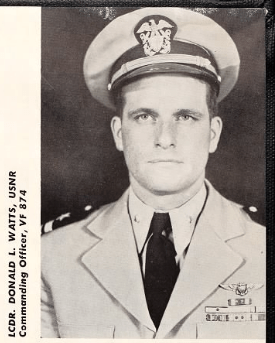
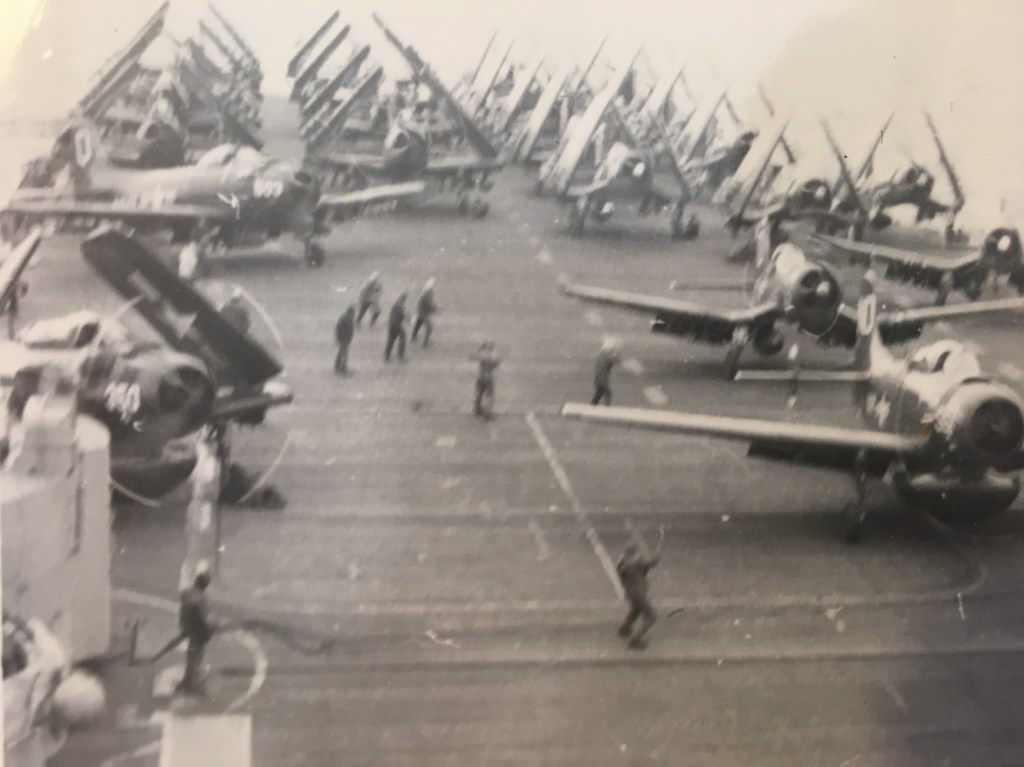

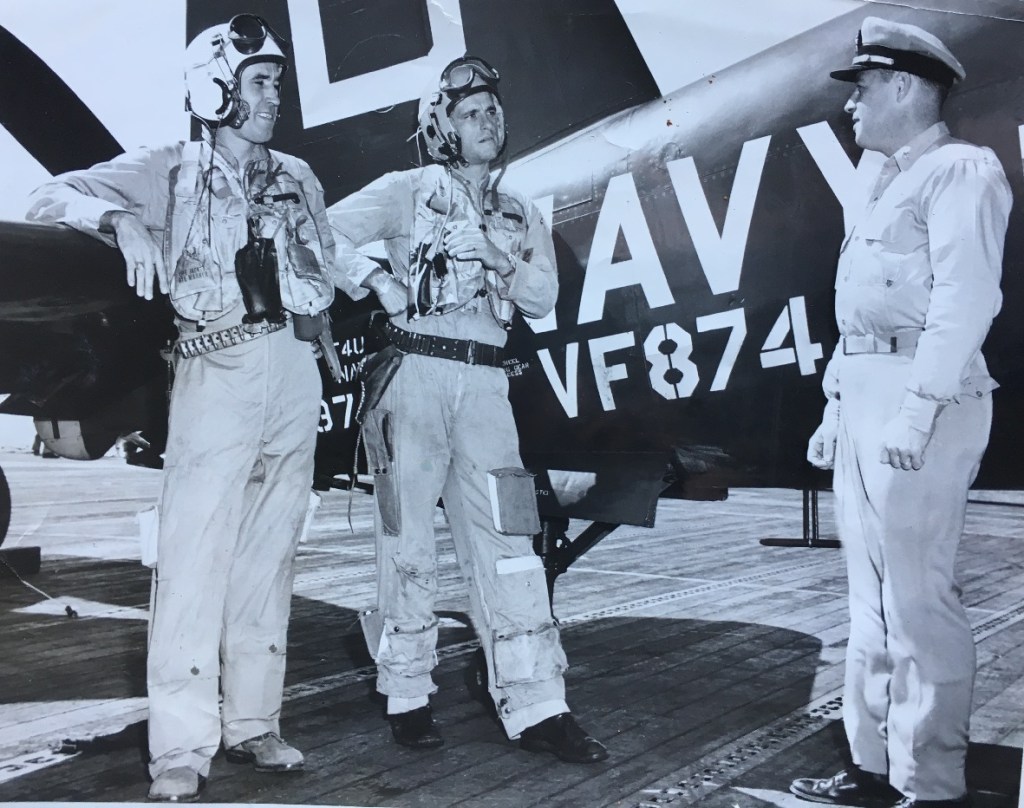
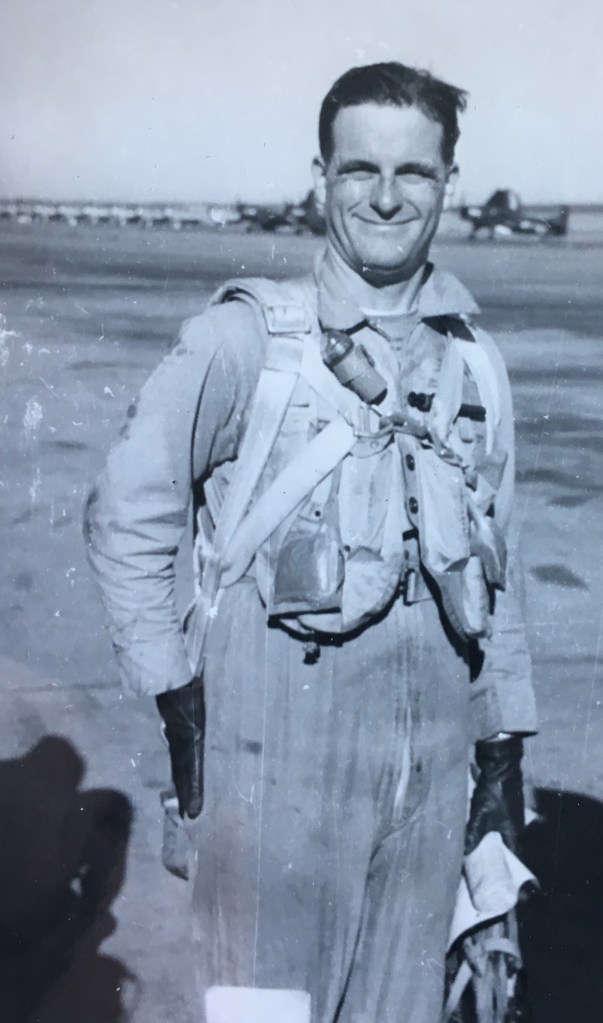

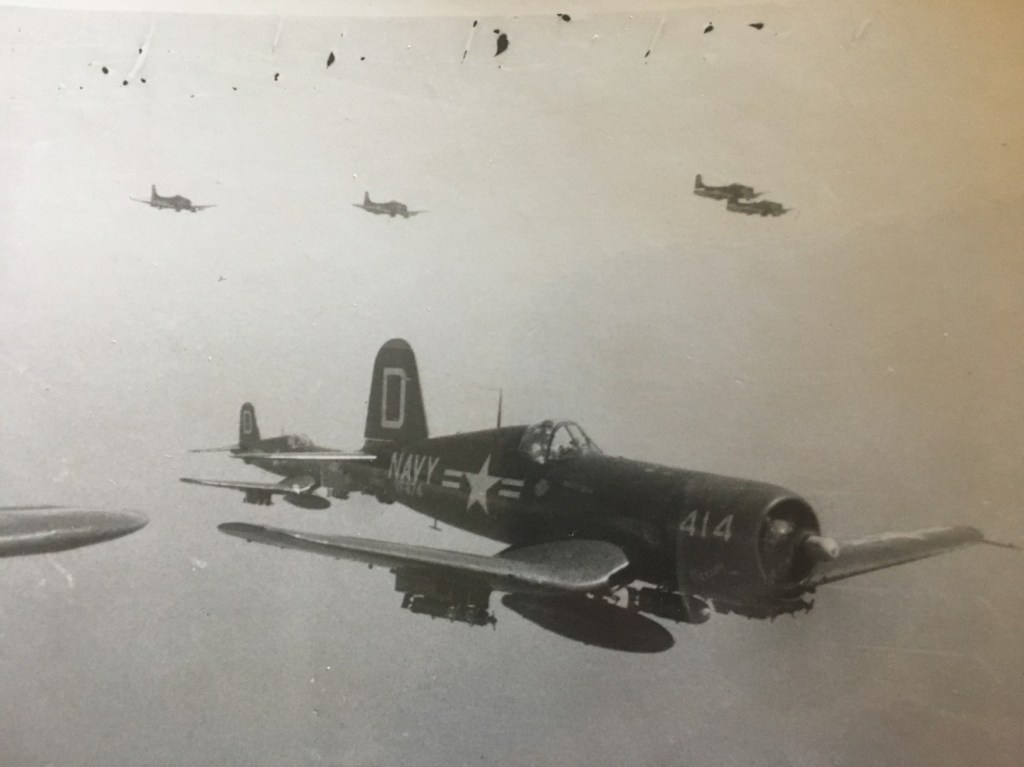
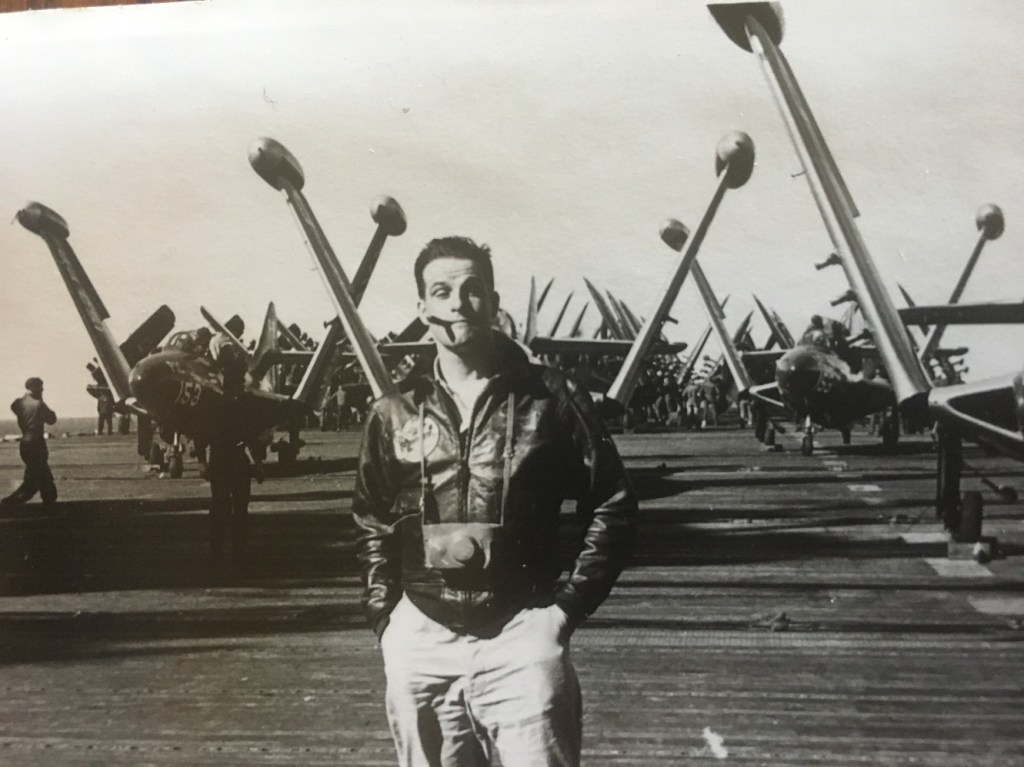
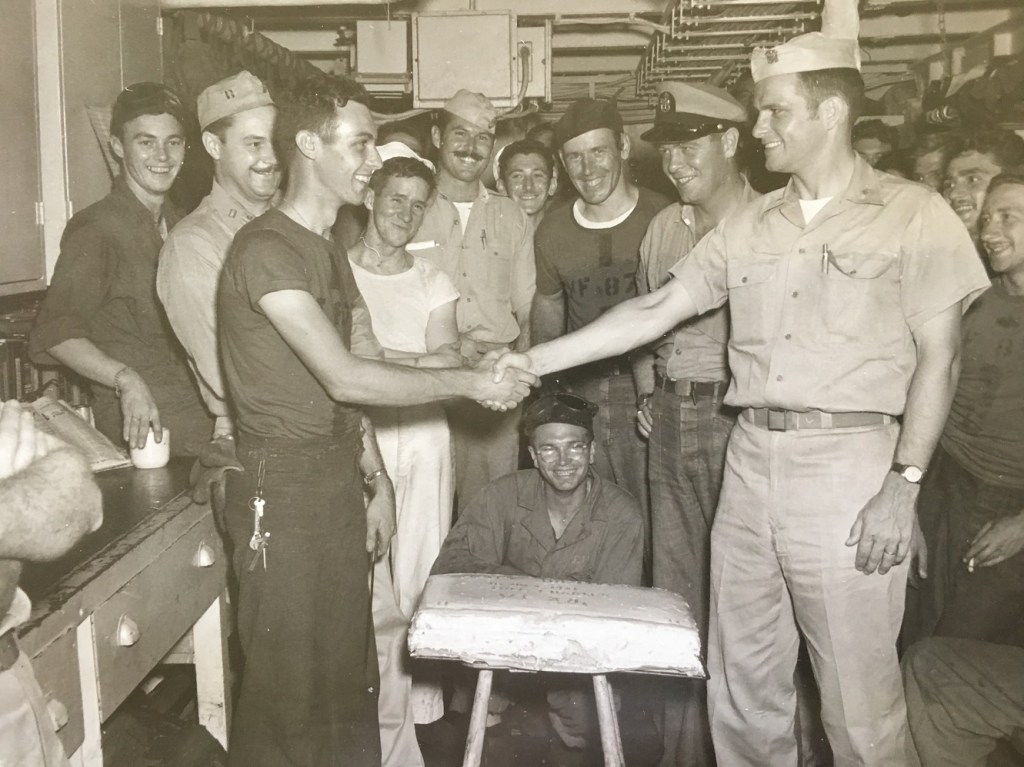
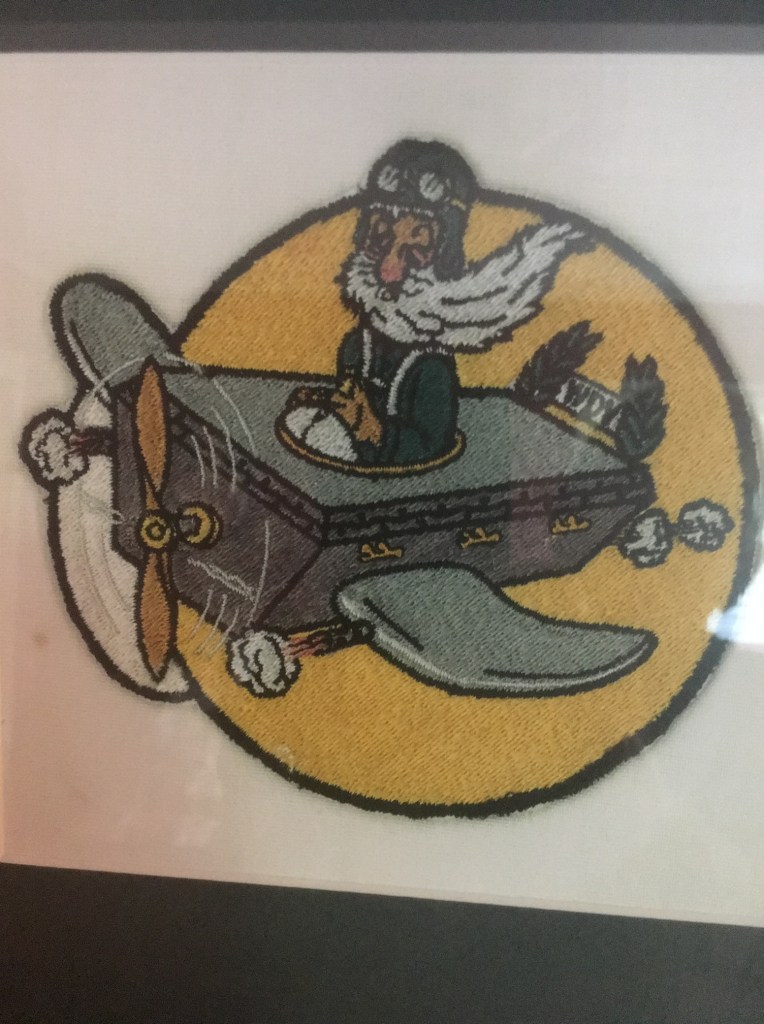
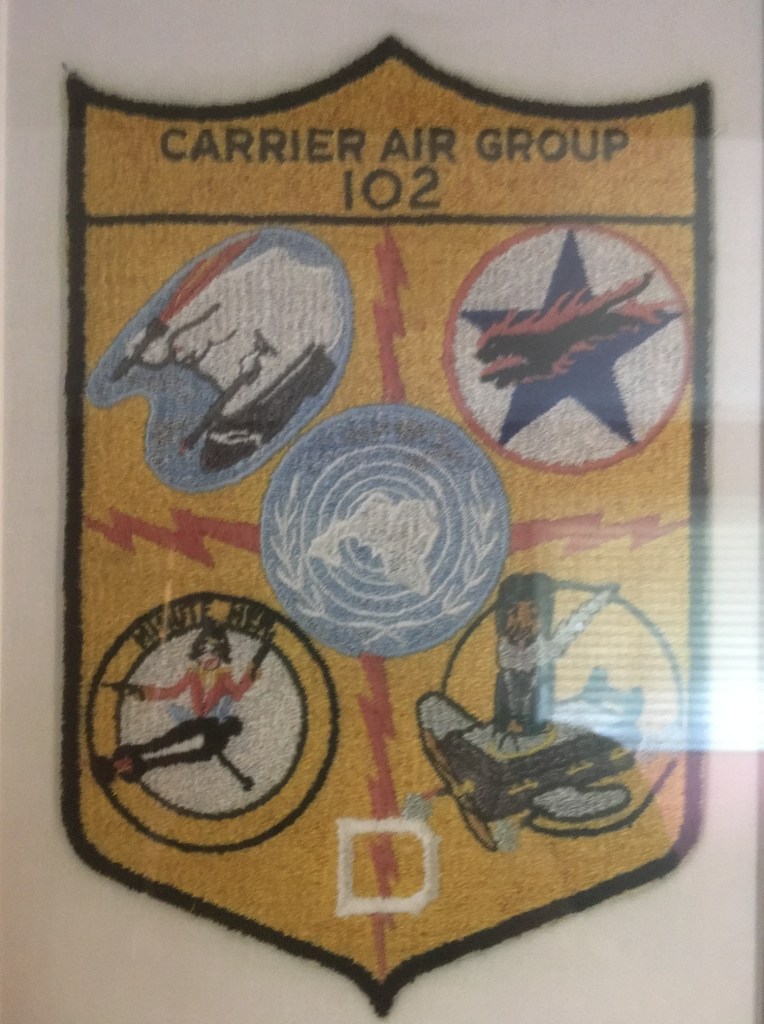
VF-874 earned accolades under Watts’ capable leadership. The squadron served five line periods over the course of 1951. Its pilots regularly came under intense anti-aircraft fire as they sought to destroy infrastructure and provide support for UN troops on the ground. On one occasion, Watts was even shot down off of Wonsan. He was able to get “feet wet” and ditch by a British destroyer. Upon his return to Bon Homme Richard, Watts was greeted with “Ode to the Colonel,” a ditty written in his honor by his young pilots, and a celebratory cake (see slideshow above).
On November 10, 1951, Admiral Martin, in command of 7th Fleet, Admiral Clark, in command of Task Force 77, and General Ridgway, who took over after MacArthur was relieved as commander of all United Nations forces in Korea, observed carrier operations aboard the “Bonny Dick.” The next day, Admiral Martin sent out the following:
The whole task force should be very proud of the show it put on for General Ridgway X In particular the Bon Homme Richard deserves a well done for as fine a demonstration of carrier operations as I’ve ever seen.
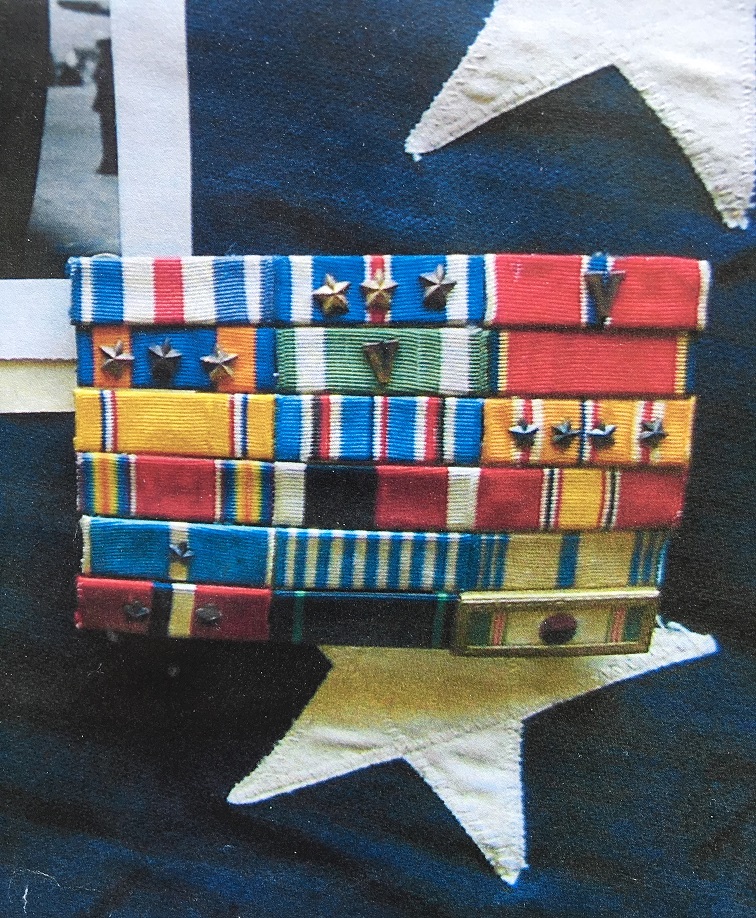
For his service in the Korean War, Donald Watts earned the Bronze Star with Combat V, additional Distinguished Flying Crosses and Air Medals, and the respect and affection of the men he led. Watts may have been glad to return stateside to start his family, but there is no doubt he would miss the thrill of flying and the camaraderie of carrier life.
Watts served in the Navy Reserve for a total of 22 years, and even after he was released on the 20-year rule in 1960, he continued to be associated “on non-pay status” with his beloved “Weekend Warrior” unit for years to come. Not only did he reach the rank of Captain, he ultimately assumed command of the 250-member NARTU Alameda Air Wing Staff, making him the top drilling reservist among the Bay Area’s 3,000 members.
Donald Watts was one of Fighting 18’s most highly-decorated, longest-serving military men—Reserve or otherwise. On the 76th anniversary of the Battle of Leyte Gulf, an event he played a pivotal and overlooked role in, let us honor his memory and the many sacrifices he made in defense of his country.
Special thanks go out to Paul Watts, caretaker of his father’s collection and legacy, without whom this article would have been impossible. Read on if you are interested in the evidence concerning the search efforts undertaken on the morning of October 24, 1944.
October 24: The Evidence
The account that follows is derived from action reports, communications logs and other primary source materials including the citation Watts received for his actions on the morning of October 24, 1944. It is hoped this will serve as a corrective to the prevailing narrative.
On the morning of October 24, Admiral Bogan, Commander Task Group 38.2, had fleet carrier Intrepid and light carrier Cabot in his group. These were the only flattops available to him. According to the report of air operations covering this period, “As a result of reports that major units of the enemy fleet had been sighted approaching the western Philippines a six sector search was ordered to be launched at dawn…Two VF and 1 VB were allocated to each sector and 2 VF for relaying messages. In addition a special search of four fighters was sent to cover the west coast of northern Palawan…”
Intrepid’s War Diary for October 1944 contains a detailed list of aerial activity for each day, including launch and recovery times and the character of each flight. The entry for October 24 shows the following:
| Launched | Recovered | Designation | VF | VB |
| From 0600 | By 1103 | Geographical Search | 12 | 6 |
| 0600 | 1103 | Recco. | 4 | |
| 0600 | 1103 | Communication Relays | 2 |
The above numbers cover the full aircraft roster for six sector searches, the special 4-plane search, and communication relays. Cabot’s War Diary, meanwhile, describes morning flight operations this way: “0600 launched CAP and ASP of 12 VF’s and 4 VT’s…0825 Reports received of a Japanese naval force…sighted south of Mindoro…0855 launched 8 VF’s and 5 VT’s to strike previously reported units.” In 212 pages of aircraft action reports from Cabot’s Air Group 29, there are none with reference to searches flown this day—all specify CAP/ASP flights and strikes. Further, VF-29’s War History, which would certainly mention such a momentous occasion, instead states: “The 24th dawned with two splashes by our CAP and the arrival of news of the approaching Jap Fleet in the Central Philippines.”
Documents related to Intrepid’s Air Group 18 on the other hand provide granular detail concerning the searches. From the VF-18 War History:
On 24 October at 0600 the search group took off. Bill Millar and Herpich stayed half-way between the ship and the searchers in order to relay messages. At about 0730 Max Adams rearseatman picked up a radar blip. Max and Watts of VF went over to investigate. At 0815 Millar relayed the following from FIVE FOX LUCKY, Watts, “13DD, 4BB, 8CA off the south tip of Mindoro, course 050, speed 10 to 12 knots. No train or transports.”
The aircraft action report from Air Group 18 is equally explicit:
This important search was organized as follows: Six teams, each consisting of 2VF and 1VB, were to search six 10 degree–300 mile sectors from 230 to 290 degrees true, and were numbered clockwise one through six. A special search of 4VF was to investigate the northwest coast of Palawan…Two VF were to station between base and perimeter of search to act as relays for contact reports. All sectors were fully covered.
In fact, all six teams and the special search are mentioned in the report:
- Special search to Palawan was negative
- Sector 1 observed two destroyers on its return leg
- Sector 2 had already run into these destroyers along with the Franklin group
- Sector 3 (Max Adams, Donald Watts and Charles Amerman) spotted the battleships
- Sector 4 observed Coron Bay area with negative results
- Sector 5 was negative outbound but later spotted the same force as Sector 3
- Sector 6 located a CL and DD between Corregidor and Bataan
Why then is there any mention of Cabot in the historical record? It appears to be a mistake in the communications logs. Per the Commander 3rd Fleet War Diary:
0810 Item A search plane of the CABOT in Task Group THIRTY EIGHT POINT TWO in sector 3V11 reported contact with 4 battleships, 8 cruisers and 13 destroyers off the southern tip of Mindoro Island, course 050, speed 10 to 12 knots. The original contact report was intercepted by Commander THIRD Fleet on VHF channel “Charlie”.
And the original communication log:
| Message | TOR | |
| 232320 | 232320 | Channel A |
| From CABOT 3V11 | Major force sighted 3 BB, many other units. 300 | |
| speed 15 Vincennes 130 speed 15 — CABOT |
The communications log for Com 3rd Fleet was cobbled together from TBS (talk between ships), VHF, and other communications channels into a single chronological account of communications between Halsey and his subordinates. We already know this record contains typographical errors. One glaring example is a communique from Bogan to Halsey stating that Air Group 18 commander William Ellis was at the target site and reported two battleships damaged. The 232220 timestamp for this TBS report would have put it at 0720 Item (Japan’s local time, GMT +9) on October 24, almost an hour before Sector 3 spotted this force. A handwritten note on the digitized copy of this document at NARA echoes these suspicions.
There are other glaring problems with these accounts. For one, the War Diary indicates Halsey received the contact report on VHF channel “Charlie,” and the report was delivered with a full breakdown of Japanese forces. The supposed Cabot transmission is indicated as channel “Able” (in the WWII-era spelling alphabet) and refers only to 3 BB and “many other units.” However, the next message in the communications log, which was reportedly sent two minutes later, is as follows:
| Message | TOR | |
| 232322 | 232322 | Channel C |
| From 5F INTREPID | The force consists of 4 BB, 8 CA, 13 DD, location | |
| is south of southern tip of Mindoro, course 050, speed | ||
| 10-12 knots. No transports in the group and in all a | ||
| total of 25 warships. |
Multiple sources agree—even if they are not willing to commit to the non-existence of the Cabot aircraft—that the transmission which ultimately reached Halsey and had the largest impact on his decision making was that of 5F, or Five Fox Lucky, Donald Watts. The prior transmission attributed to Cabot by Solberg et al. is given less significance due to its generality. It is typically construed as Cabot planes getting the first look at Japan’s massive battleship force and Intrepid planes arriving on the scene on their heels.
But how could a plane from another carrier be within a two minute flight of a search sector covering a 10-degree, 300 mile plot of ocean? Why does that ship and that ship’s air group’s historical documentation lack any and all reference to participation in searches? Why is the name of the pilot Solberg mentions nowhere to be found in Air Group 29 materials?
A simpler explanation exists. From the same Air Group 18 action report cited above:
While on the first leg of their sector and when approximately 30 miles south of the southern tip of Mindoro Island, ADAMS reported that his radioman had a radar contact bearing 090 degrees distance 25 miles. They were then flying at 9,000’. Course was altered and the wakes of six ships observed at 0746. (all times in this report are Item). An emergency contact report was sent by WATTS to the relay team stating many Jap ships observed 9 miles south of Mindoro, course 030 speed 10-12 knots. This report was relayed and acknowledged. All three search pilots now had the entire disposition in view and after quickly checking the number and classes of warships observed, amplifying reports were sent to the relay plane and promptly transmitted to base. (emphasis mine)
The sighting report credited to Cabot in Solberg’s, and subsequently Evans’ and Toll’s books, is just Watts’ original emergency sighting report being relayed. Somewhere along the line its source was mistaken or a typographical error crept into the transcription. This is far more plausible and has much more support than attempts to square the record with Solberg’s account.
 Two-a-Day 18