War correspondents on Navy ships were tasked with transporting their readers to an alien environment: a land of low ceilings and low lights, of well-regimented hustle and bustle through a maze of winding corridors that would put any ant colony to shame. At the same time, reporters needed to imbue these machines with a sense of purpose and familiarity to ensure that morale on the home-front stayed high. Stories of hometown heroes and their success in combat helped motivate civilians in war industries and justified the sacrifices everyone was making for the cause of victory.
USS Intrepid saw its fair share of newsmen coming and going throughout the course of the war. Tim Leimert of CBS was aboard during the Battle of Leyte Gulf. At its conclusion, he went to USS New Jersey to interview Admiral Halsey directly. Correspondents from Newsweek and TIME were also aboard Intrepid in the fall of 1944. Even reporters from foreign papers, like Denis Warner of Australia’s Sydney Sun, spent some time on the ship.
I want to focus on two reporters who wrote extensively about their time aboard Intrepid: Philip Heisler of the Baltimore Sun, and Ray Coll, Jr., of the Honolulu Star-Advertiser. Their interviews with Fighting 18 pilots shed light on some of the lesser-known members of the squadron, and bring to life the day-to-day experience of young men at war.
Philip Heisler
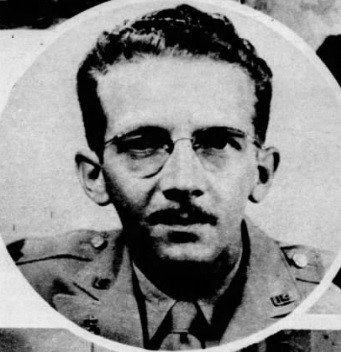
Philip Heisler came aboard Intrepid on October 2, 1944, and departed November 30, 1944—a long stay compared to most of the other correspondents bouncing from ship to ship. As a Baltimore newspaper reporter, he made sure to seek out local flyboys for feature pieces. There were a couple Marylanders he could interview from the bombing squadrons, but Heisler was looking for something with more glitz and glamour. His big break arrived on October 27, almost a month into his stay aboard Intrepid. The newcomer’s name was John T. Williss and he was the full package: handsome, a fighter pilot, and even better, a Baltimorean. It only took Williss a couple days to give Heisler a juicy story for the folks back home.
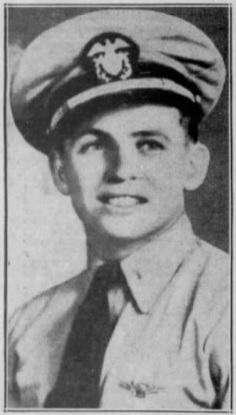
John Williss enlisted in the Navy in 1938 as a Fireman. By early 1942 he had worked his way up to Machinist’s Mate and was serving in neutrality patrols in the Canal Zone. The next year he went full “mustang,” jumping from enlisted man to officer and graduating from NAS Corpus Christi in August 1943. Ensign Williss was originally assigned to Fighting Squadron 11 aboard USS Hornet. However, in the wake of losses suffered during the Formosa Air Battle and Leyte Gulf, Fighting 18 was in desperate need of replacement pilots. Almost a dozen men from the “Sundowners” squadron were thus transferred from Hornet to Intrepid—pure serendipity for the story-hungry reporter.
On the afternoon of October 29, Philip Heisler was perched above the flight deck on “vulture’s row” watching planes coming into the groove for landing. Clear, sunny skies made it easy to see the little specks on the horizon coalescing into the familiar outlines of Hellcats, Avengers and Helldivers. The big blue birds typically queued up for landing with practiced discipline, but today the planes were in disarray. Something was definitely wrong.
One of the struggling Hellcats thumped solidly down on Intrepid’s wooden deck. It was a good, clean landing. As the plane bounced to a stop, Heisler could see Ensign John Williss grinning ear-to-ear in the cockpit. Deck crew rushed to unhook his plane from the arrestor cable and taxi him forward on the flat top. Heisler couldn’t understand why Williss was smiling or how he’d landed so easily. “You could see the sky through two big ragged holes in the tail of his plane…” They were the telltale traces of Japanese 20mm cannon fire.

Williss actually got off easy compared to some of the other men on the strike. Nine Hellcats were mauled and three men had shrapnel wounds. Kenneth Crusoe (a former VF-11 pilot like Williss) pulled his tailhook out on landing and slammed into the crash barrier. The impact banged up his back and caused him to cut his head open. Intrepid’s action report notes: “Wound cleansed and irrigated with normal saline, bleeders tied off with No. 0 plain catgut…Retained on sick list.”
Charlie Mallory, Crusoe’s section leader, had the hydraulics shot out of his plane. He flew all the way back to the ship with his landing gear whooshing in the wind. Mallory later recalled, “I had no flaps, but the LSO (landing signal officer)…brought me in a little faster and higher than normal, and somehow I got the hook—flat tires and all. My plane never flew again. It had 67 holes in it.”
Here’s the action as Heisler reported it:
While the fighter pilots climbed out of the seats in sweat-soaked flying suits they told a tale of one of the strangest aerial dogfights in the Pacific War.
Williss was in a group of six United States planes jumped by ten Jap Zeros in the air over the Philippines. For a few frantic seconds the planes milled around in a wild scramble before the pilots realized a giant merry-go-round had been formed.
Every United States plane had managed to get on the tail of a Zero but every Zero was also on the tail of a United States plane. This strange formation of alternating Jap and United States planes—with everyone shooting at the plane directly in front of him—whirled into a giant endless circle.
Williss was flying as wingman to the division leader and when a Jap began firing on the leader he sent a burst into the Jap. The Zero burst into flames and went down.
At the same time bullets began whizzing past him from a Jap on his tail, but another United States fighter following that Jap plane shot it down before it had done more than put holes in Williss’ tail.
With two Japs shot down, the Jap formation broke up and started heading for home, but not before Williss bagged his second Jap plane. A total of six Jap planes was shot down.
“I was so excited—and scared, I guess—after I got my first plane I hardly realized I had shot down a second plane until it was all over,” Williss said.
Williss was awarded the Air Medal and Distinguished Flying Cross for his service in the fall of 1944. Upon returning home, he was again profiled by the Baltimore Sun. Despite the intense combat he’d seen aboard Intrepid, Williss only had positive things to say about the experience.
“On the carrier on which he was stationed, Lieutenant Williss said he enjoyed better food than he has been able to find in Baltimore, he did not have to make his own bed and there was hot water available any hour of the day or night. “It was like a hotel,” the lieutenant said with a happy smile.”
Ray Coll, Jr.

Ray Coll, Jr. stayed aboard Intrepid from October 19 to November 12, 1944. He was an experienced war correspondent who had spent time on land and at sea, in the European and Pacific Theaters, and with virtually every branch of the Armed Forces. Though foxholes were no picnic, Coll found that weathering storms aboard Intrepid was even worse. “Why didn’t I stay on Guam or Saipan? Dengue was as a bed of roses compared with this…I’d hate to go through a real typhoon. Nope, send us more Japs instead.” He even took a tumble while coming back aboard the ship in November. Coll, “…suffered lacerations of the scalp when he slipped and fell into the water…Prognosis: good.”
In spite of these challenges, he was able to find solid footing with Air Group 18 and produced more than a dozen articles chronicling their exploits. Coll captured the excitement of carrier life by writing gripping narratives instead of merely reporting the news. His columns ooze with the smell of fuel-oil and the salty tang of sea air. What’s more, his relationship with the pilots of Fighting 18 allowed him to be a fly-on-the-wall in their ready room, the center of their social universe aboard ship. Personal details, emotions, routines: as the men talked, Ray Coll listened and wrote it all down.
On October 19, when Coll first came aboard Intrepid, he made a beeline for Ensign Arthur “Moe” Mollenhauer. The young fighter ace was at that moment appearing in newspapers around the United States thanks to an article by Philip Heisler. Coll was determined to profile Moe, too. Though it took until November 8 to finally see publication in the Honolulu Star-Advertiser, Ray Coll’s column on Moe represents the best contemporary insight into the life, character and combat experience of Fighting 18’s youngest pilot. It is reprinted below.
With Vice admiral Marc A. Mitscher’s Fast Carrier Task Force—Your correspondent came aboard a carrier in this force too late to get in on the big aerial battles over the Philippines and Formosa between Oct. 9–15, but the boys are still talking about it: a total of 915 Jap planes destroyed by naval air power in that period and 3,080 since this force went into action June 6. Admiral Mitscher himself is authority for the statement that enemy naval air power has been destroyed while known land-based or army air force has been reduced to scattered remnants.
The hero of the moment aboard this flattop is Ensign Arthur “Moe” Mollenhauer, 21, of Santa Barbara. On Oct. 12, during a strike on Formosa, Moe shot down five Jap planes—a bomber and four fighters. That’s a good score in any league but in Moe’s case it shows that you don’t need a college education to rate the pilot’s seat in a carrier based fighter. Moe was in high school when the war began and after he graduated he enlisted in the Navy and following boot training was stationed in Chicago where he was an aviation machinist 2/c, giving gunnery instruction. But he wanted to fly and finally prevailed upon his commanding officer to recommend him for flight training. He was sent to Corpus Christi, Texas, where he graduated and was commissioned in October, 1943—just a year ago. Then he went to Hilo for fighter training and later to Kaneohe to complete the course. His squadron joined this carrier in August.
Moe was a natural from the start. Since joining this carrier he has been on 22 strikes over the Palau Islands, Philippines and Formosa and prior to his one-man victory at Formosa he had destroyed five Jap planes on the ground in the Philippines and with another flier, Lt.(jg) “Poncho” Mallory, destroyed a Jap convoy of 14 small cargo ships off the Philippines.
“That was really fun,” he grinned. “We had been on a recon flight and a storm forced us off our course coming home. By luck we spotted this convoy sneaking down the coast toward Leyte and we swooped down so low we could see the vessels were loaded with trucks, tractors, etc. Boy, did we let ‘em have it with our 50’s. Those bullets really ripped ‘em apart. We were flying so low we barely skimmed the water. I’ll never forget the speed boat that was leading the procession. I let him have it and literally cut the boat in two. It was a great show. There was a lot of valuable Jap material that went down that day. When I cut that speed boat in half I was thinking of my brother-in-law Gary Wiedner [sic] of Maywood, Ill., a Seabee who was killed by strafing while going ashore at Saipan.”
Then came Columbus Day—Oct. 12—when Moe really went to town. His squadron was scheduled to hit the barracks and hangars near Shinchiku on Formosa while planes from other carriers were pounding bases elsewhere on the island.
“We were all carrying bombs that day,” Mollenhauer said, “and crossed over the mountain range of Formosa (some of the peaks are 14,000 feet) through a heavy overcast. We headed for Shinchiku on the west coast and seeing it through a rift in the clouds we went on out to sea and turned to come in over the target out of the sun. The AA [anti-aircraft fire] was really coming up but we made a successful run and then headed out to sea to rendezvous for another target. But we never got there. Passing over Koro someone saw a group of bombers starting to take off. I spotted one that had just turned out over the water and went down pumping lead into him. He started smoking and went right in. I pulled up 200 feet from the water and started to climb back to rejoin my section.”
“By this time the sky was filled with enemy fighters as well as our own and there was a general melee over the area. I got into it and saw a Jap on the tail of one of our planes. I got him right through the meat-ball (Jap insignia) and he went down. Another pulled up in front of me and did a slow roll. I gave him a burst and he fell in flames. Another came at me and I soon had him smoking. He rolled over and went down. I followed to make sure he hit and this time another Jap got on my tail. I was in a bad spot and my heart was in my mouth but a plane from another carrier spotted him and knocked him off. I finally found my section leader and we saw a Jap sneaking out of the clouds. We boxed him in and forced him out to sea. Then I maneuvered and poured lead into his cockpit. He went into the water without burning, but boy, did he make a splash!”
“Our gas was low as well as ammunition so we started home. Then the reaction came. I was scared to death and my hand was shaking so I could hardly hold it on the stick, I got heated up so during the fight and when I saw one of our planes go down I was so mad I didn’t give a damn for myself and waded in. But when it was over, gosh, was I scared.”
Postscript: A couple of days ago Moe came in for a night landing. He had just made the deck when another plane also came in. Its wing scraped over his cockpit, smashing the windshield and knocking Mollenhauer out. They took four stitches in his head. But he’s up and around again and the doctor says he can fly again tomorrow. He’s glad because there is a strike scheduled against Leyte in support of ground operations there.
The Navy knew what it was doing when they made Aviation Machinist 2/c, Arthur “Moe Mollenhauer” a pilot.

Moe’s injury didn’t prevent him from flying. He was right back out there on subsequent strikes. Ray Coll wrote about him again on December 4, but this time the tone of the article was drastically different. By combining a few of Coll’s pieces together, we can get a sense of how Moe’s mission on October 29 played out from the point of view of his fellow pilots waiting in the ready room.
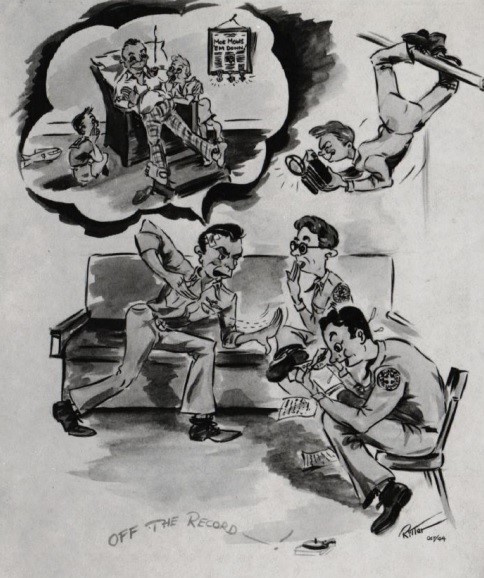
“In the ready room are a number of pilots who didn’t go out this morning. They will get their chance later in the day. Right now they are sweating it out for their buddies. Someone puts on a record and the phonograph grinds out a catchy something about San Fernando. Over in the corner an acey-ducey [sic] game is under way. A pilot comes in with a cup of coffee. Others are reading. There is very little conversation but plenty of cigarettes are glowing.”
“Suddenly a metallic voice rose high and clear above the bedlam, “Hey, Rube! Hey, Rube.” Jap fighters were ganging up on him and he wanted his buddies to come to the rescue. Then the tragic voice calling, “They got me, fellows, I’m going in; go get ‘em and good luck!” That was all.”
“You could cut the gloom with a butter knife…On the walls of the ready room, sweaty flight gear hung limp and inanimate. From the squawkbox on the wall came up the word “Send up the names of the missing pilots and men.” There was a stir among the men slumped in their chairs. Someone said, “Bud would have to go in before we finished that last gin rummy game; he already owed me two dollars. I’ll sure miss him.” …There were similar remarks about missing buddies. You could tell it was forced gruffness to cover their real feelings. They were going to miss those guys like hell.”
“It was with profound sorrow that I learned about one chap who was reported missing in action…Ensign Arthur “Moe” Mollenhauer was the name.” “A veteran pilot was talking about it. “That’s the one thing you’ve got to look out for,” he said. “Never let ‘em on your tail. I guess Moe didn’t seen [sic] him. He was a great kid and as eager as a beaver. It’s tough.”
 Two-a-Day 18