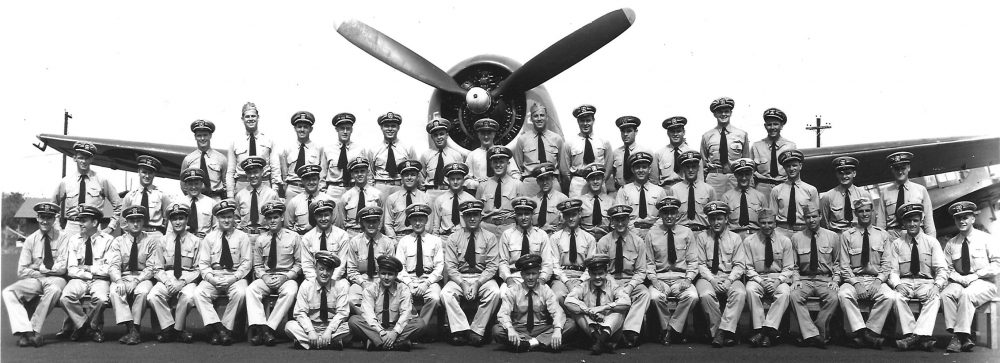
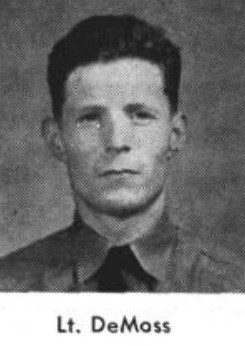
It is an incredible privilege to hear about world-changing historical events from the people who lived through them. Thanks to the Intrepid Museum’s Oral History Project, approximately 200 interviews have been conducted with Intrepid and Growler crew members, providing glimpses into the lives of World War II and Cold War servicemen. In August 2017, Intrepid staff members flew out to California to interview Charles W. “Chuck” deMoss, one of the few surviving members of Fighting Squadron 18. His first-hand account of “Two-a-Day 18” is one of only a handful in existence today.
At almost 96 years of age, Chuck could still recall some of his adventures—and misadventures—in vivid detail. The following narrative is going to let Chuck do the talking. Where possible, I will quote directly from the transcript produced by the excellent team at Intrepid. Without further ado…
Charles William deMoss was born Nov 10, 1921 in Fullerton, CA. The Navy definitely left an impression upon him at an early age. “I would see the Navy down at, I guess it was L.A. Harbor or Long Beach, essentially. And that is particularly what made me want to go flying.” While enrolled in junior college, Chuck entered the Civilian Pilot Training Program (CPTP) for two summer courses. “…Primary was in the Piper Cub; a little 50- or 60-horsepower bird. Rather flimsy, but it was a good little airplane. And then in the second summer…I trained in a bi-plane, it had several-hundred horsepower…” That was enough to get Chuck hooked.
“I wanted to become a naval aviator…but they would say, ‘No, you’ve got to come back when you’re 20.’ So, by gosh, on my 20th birthday I went down to the naval reserve station and signed up for naval aviation.” Chuck had no problem with the early phases of training thanks to his prior CPTP flight experience. Soon he was off to Naval Air Station (NAS) Corpus Christi for intermediate and advanced training. “By that time it was, I think it was very early January of ’42.”
Training was fast and furious. As reported in Collier’s Magazine soon after the base opened, “The Navy needs pilots and isn’t dawdling about getting them. Down in Texas it has built a factory that is turning them out, ready for anything, in 6 months.” Chuck received his naval aviator’s certificate right on time, in mid-July 1942. His dream was coming true.
In terms of assignment, Chuck said, “I really wanted fighter, but they gave me dive bomber.” “I had some dive bomber training right at Corpus, in a Curtiss-built biplane if you can imagine a biplane headed straight down at ever-increasing speed.” Of course, no front-line carrier squadrons were still using bi-planes in 1942. Chuck’s next step was advanced carrier training in Norfolk, VA, where he’d gain experience in faster, heavier, more modern aircraft before completing carrier qualification and receiving assignment to an active squadron.
At Norfolk, Chuck was in for a surprise. “Wade McClusky,” one of the foremost heroes of the Battle of Midway, “was our instructor.” He had commanded a whole carrier air group, won the Navy Cross and no doubt had high expectations of young ensigns like Chuck. One day while out on a training flight, Chuck couldn’t resist “flat-hatting” in his monoplane SBN bomber. He started buzzing the ground, flying as low as possible. Everything was going fine right up until he barreled headlong into a haystack. “Hay, stuff everywhere. So I came back to the field at Norfolk, and I had all this stuff all stuffed up in the, behind the propeller in the cowling…I thought I was going to catch holy heck, you know.”
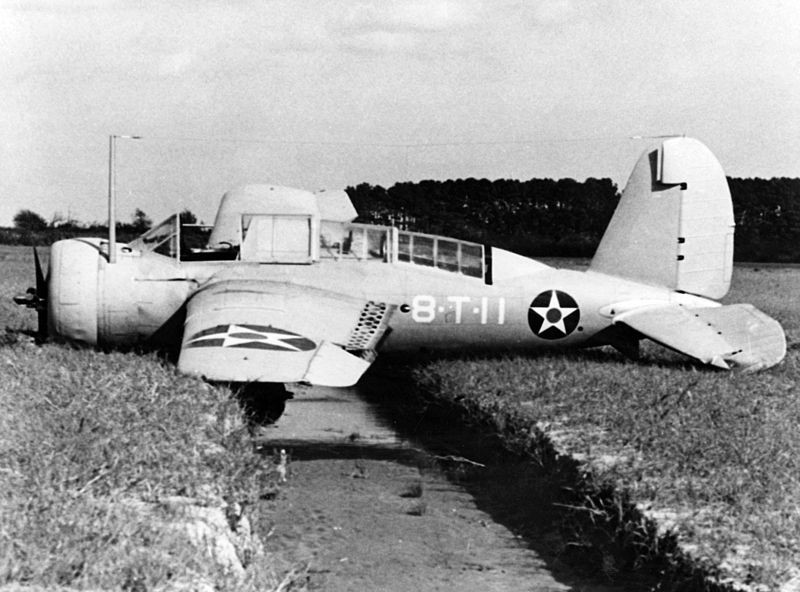
McClusky’s response upon seeing the hay-stuffed plane? “Chuck, next time, fly a couple of feet higher.”
Chuck completed training and had no problem acing carrier qualification on the Wolverine. He reported to Dive Bombing Squadron 11 (VB-11) in Hawaii in early fall 1942. Even after joining the squadron, Chuck knew he still had a lot to learn. One day, he heard the more experienced men in the squadron talking about advanced maneuvers like ‘snap pull-outs.’ Chuck remembered, “I’d never really wanted to pony up to them and ask them, “What are you talking about?” But I surmised. So I got in the SBD [Douglas Dauntless] one day…I got it up to 12,000’ probably; put her in a good full flat vertical dive. Down I came. And I got about as low as I dare, and I braced both feet on the rudder pedals…came back on that stick…”
His plane hurtled straight up into a stall. Fortunately for Chuck, he had enough time and altitude to regain control of the aircraft. He landed safely, though perhaps a bit shaken. Given the stress he put on that poor SBD Chuck half-expected to see paint peeling around the rivets or signs of stress in the metal. “It had not any damage to it…that SBD was one, pardon the expression—hell of an aircraft.”
After squadron training, VB-11 was all set to embark on a carrier bound for the Pacific. It was a big moment, the culmination of about a year of rigorous flight instruction. One slight problem: there weren’t enough carriers to go around in the fall of ‘42. In the course of fighting the Japanese to a standstill, the U.S. Navy had lost most of its flat tops. As a result, VB-11 didn’t ship out until February 16, 1943, and when they headed out they were assigned to land-based duty.
“…We were stationed in Nadi, Nadi in the Fiji Islands for about maybe a month and a half before we flew…on up to Guadalcanal.” The two islands were as different as night and day. According to one of the Air Group 11 squadron war histories, on Fiji, “Baseball diamonds and movie facilities were set up for both officers and enlisted men. Repair and maintenance facilities were inadequate.” On Guadalcanal, “Recreational facilities were very poor due to the fact there was no demand for them. Repair and maintenance facilities were adequate…” Fiji was a backwater training facility free from Japanese harassment; Guadalcanal—though the Japanese had been successful beaten back—was still a warzone.
Being stationed on Guadalcanal was considerably less glamorous than carrier duty. Carriers had washing machines. Guadalcanal had ‘Washing Machine Charlie.’ “He was given that name, [because of] the way he sounded. I think it was a twin-engine aircraft from the Japs. He’d come almost every night…” The sound may as well have been an air raid siren. “… [W]e had to dig our own dugout, if you will.” “It was big…maybe 10, 12 people, we could get into it. And we got some coconut logs from somewhere…and covered over the top.” “We were never hit real close. Although there was one little scare, yeah. But the bomb was quite far away.”
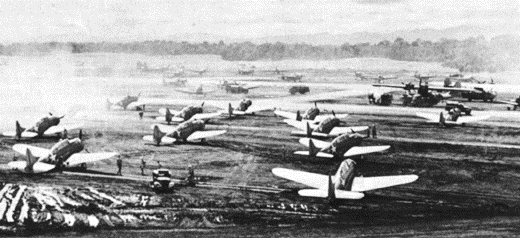
Chuck was flying every 2 – 3 days while stationed at Henderson Field on Guadalcanal. There was the occasional Japanese ship to attack, but opportunities were few and far between, and enemy aircraft were rarely encountered on the scout-bomber missions Chuck was flying. “It wasn’t all too dangerous.” The one time he recalled a major Japanese strike, Chuck was on the ground watching fighter planes swirling overhead in wild combat. “I was a bomber pilot, I couldn’t go up and shoot aircraft down.”
A few men in VB-11 followed the action, sprinting through palm trees out to the beach to watch the fight unfold. “And we were getting a great view of, a pretty good view of what was going on. Down the damn water, down the beach, came a Zero… And we both dove for the sand; the best you could do. And then immediately he went over…there was a P-40 shooting at him. His shells were coming into the sand too.”
“That really convinced me I wanted to be a fighter pilot for sure.”
He didn’t have to wait long for an opportunity to make the change. In late June 1943, the squadron packed up and headed back to the U.S. to bring in replacement pilots, re-train and re-form in anticipation of a second deployment. Chuck had a couple friends in VB-11 who also had the fighter bug, and one of the guys knew someone who could help. “We flew down to San Diego and to Com[mander], Fleet Air, West Coast, as it was; and talked to the detailer and he, instead of re-assigning us back into Bombing 11…he put us into Fighting 11. And so we became instant fighter pilots.”
If Chuck was slotted into VF-11, how did he wind up aboard Intrepid with VF-18? It came down to pure happenstance. Ships were being commissioned faster and faster between 1943 and 1944. One striking example is in the number of escort carriers (CVEs) launched by Kaiser Shipbuilding Company in these years. Between April 5, 1943 and May 27, 1944, Kaiser launched a whopping 50 CVEs— a rate of almost one carrier per week. This new arsenal of “jeep” carriers needed aircraft as quickly as possible, so trainees awaiting deployment were often given temporary duty ferrying planes out to their new homes. This is how Chuck recalls being chosen for ferry duty: “You, you, you. Go.” He went aboard the escort carrier Nehenta Bay in March 1944, and when his temporary assigned duty was complete, Chuck was dropped off in Hawaii. VF-18 was one of the squadrons training there, awaiting a carrier. They needed to fill out their roster and Chuck was in the right place at the right time.
While serving aboard Intrepid, Chuck got to pilot another remarkable aircraft: The F6F-5 Hellcat. The newest iteration of Grumman’s top-of-the-line fighter came complete with water injection, which boosted the plane’s performance for short periods of time. Those precious seconds of added speed could make all the difference. On one mission, Chuck recalled, “…we [had] just left Clark Field. And way out ahead of us…was the whole strike force of ours heading back to the carrier.” “And we were lollygagging along, saving fuel…all of a sudden here come a bunch of tracers right by us. That got our attention in a hurry…so we went into water injection.”
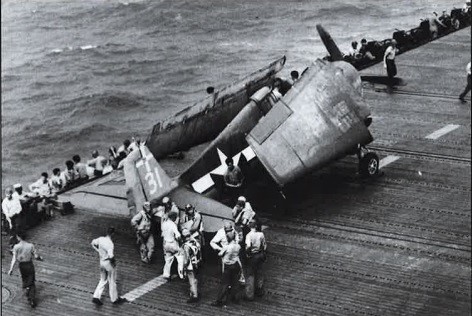
If the Japanese pilots chasing Chuck and his wingman thought they were about to pick up some easy kills, they were sorely mistaken. “I don’t think I’d ever been in water before…we just—pfffwwwt, like that! Look back, these guys… they turned around and gone home. They had been right back there on our tail, by gosh sake!”
Chuck participated in many of the actions previously written about in this column. He was part of the initial fighter sweep over Formosa on October 12, 1944. “…I really got into it…it turned into immediately, a real dogfight. And I was lucky; I got two. I saw several others get shot down…in fire, smoke, whatever. Parachutes in the sky… It was something you’ll never—a scene you never forget.”
On the morning of October 24, 1944, he was assigned to help search for Japan’s main battleship force as it steamed towards San Bernadino Strait. Chuck’s route was yielding nothing but placid water as he headed further and further west. He was running low on fuel and ready to turn around when he heard one of his squadron mates excitedly transmitting a sighting report. Chuck was close enough to fly out for a quick peek at the parade of ships on the horizon before returning to Intrepid, making him one of the first witnesses to the unfolding Battle of Leyte Gulf.
Two days later, Chuck put his dive bombing experience to good use against some of these same ships as they attempted to escape Japan’s disastrous rout at Leyte. He scored a crippling hit on the fantail of a wildly maneuvering battleship, a feat which earned him the Navy Cross.
Perhaps his most memorable run-in with the Japanese came a couple weeks later, on November 5, 1944. This mission was nothing like Formosa or Leyte Gulf. The goal was to hit some planes on the ground at Legaspi airfield in southern Luzon, Philippines. There were no enemy planes in the air and no targets of vital importance. Nevertheless, Chuck had a mission to perform, so he went out with the air group to engage in the thankless—and dangerous—job of strafing targets on the ground.
There were no heavy antiaircraft guns booming below, but the chattering of Japanese light artillery was constant as Intrepid aircraft roared overhead. Bombers dropped fragmentation and incendiary bombs, burning and blasting parked aircraft; fighters flew low time and again to use their .50cal guns, hoping that in the call-and-response of gunfire, no unlucky bullet had their name inscribed on it.
Then it happened. A noise. A shudder. Chuck’s wingman broke the bad news: Chuck’s Hellcat was “pouring oil out, copiously.” There was no way he was making it back to Intrepid, but he could at least get ‘feet wet,’ out over water, to await rescue from a submarine or a ‘dumbo’ seaplane.
Landing a multi-ton carrier plane on an active body of water is an impressive feat in the best of circumstances. Water landing, however, is typically reserved for the worst of circumstances. Chuck kept his cool. He undid his chute and double-locked the cockpit hatch in the open position to keep it from slamming shut during landing. He was ready when his engine started to quit on him. “—plunked her in [the water]. No problem…I got out, stepped on the wing, jumped in the water, pulled my Mae West, and pulled my boat out from under me…I was lucky.”
Unfortunately for Chuck, his luck ran out as soon as he hit the water. He got into his raft, turned the air valve, and… “Nothing happened. Turned it, turned it, and turned it—nothing happened. Turned it back the other way; well, maybe it’s supposed to be…nope, nothing.” At this point his backpack was soaking up water. It was beginning to drag him down. Shrugging the pack off allowed Chuck to stay afloat in his Mae West, but it also meant he had to watch virtually all of his survival equipment slowly sink from sight.
The biting cold of the water seeped right through his thin flight suit, stinging his skin. “I was the coldest I’ve ever been, before or after.” The one mercy granted Chuck was that his division leader, “Bob” Brownell, escorted him out over the water and circled above protectively. When Brownell noticed that his friend was floundering in the water, he rolled back his canopy and threw down his plane’s raft. “Made a beautiful drop! I mean…I thought it was going to hit me on the head. Beautiful.” Fortunately, Bob’s raft worked. Chuck hauled his tired, soaked body inside and awaited rescue.
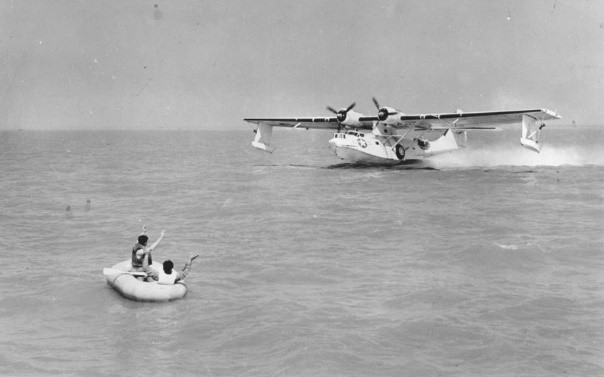
And he waited. And waited. “We had a dawn launch, real early. “Come afternoon—why aren’t they coming to get me?” Any chance of being rescued evaporated when a storm front rolled in. Chuck spent the night being pitched about in the unstable, cold raft; he may have slept, or he may have just lost consciousness from cold, shock and exertion. Either way, when he came to the next morning, he couldn’t believe what he saw: land! When he put his plane down he figured he was at least 8 miles from shore. It was a miracle. “…the raft wasn’t 50 feet from the beach.” Chuck’s luck was back, and this time it was here to stay.
Filipino fisherman in a small boat saw Chuck coming ashore. They approached him in a hurry. “Get in the boat quick. There’s a Jap outfit, it’s just up the beach here, on the island.” Chuck remembered, “Well…I lost no time getting in.” “…I’m laying in the bottom of the boat, and they take me to their village.” When Chuck got off the boat, he was asked to hand over his pistol. Troubling thoughts began to cross his mind, but what choice did he have? “Well, if they’re going to hurt me, they’re going to do it whether I got my pistol or not, you know.” He quickly handed over his gun. In short order it was returned to him, carefully cleaned and properly oiled. That moment defined Chuck’s experience with the Filipino people. “Thank God for them…I think they saved our bacon, really.”
The villagers contacted a nearby guerilla group to help get Chuck back to American military forces on Leyte. It was going to be easier said than done. As the crow flies, it’s about 160 miles from Legaspi, where Chuck went down, to Tacloban, the first city in the Philippines liberated by MacArthur’s men. The longer Chuck stayed in any one village, the more likely it was that the Japanese would catch up with him. It also exposed the locals to the wrath of occupying forces. Every time a Filipino helped get Chuck another mile down the proverbial road, they put their lives in jeopardy.
Chuck’s slog through the jungle, meetings with other American airmen and gun-point standoffs with rival guerilla factions lasted 30 days. As he moved from village to village, townsfolk “…always knew where the Japs were. It was amazing.” “One stop we made in a village, they gave us something to eat. I had a little chicken leg…and that’s all they had to give, you know.” Shortly after Chuck finished his meal, a boy came running into the camp. “‘The Nipponese, Nipponese.’ …he’d been sent up ahead…an early warning for us.” “…we dashed for the boat…got in and paddled…I hope they didn’t take it out on the villagers…” The moral of the story: “If we just stopped there, and they hadn’t had the sense to send that little kid up the trail…we wouldn’t have gotten out of there in one piece. It was, that’s the whole story.”
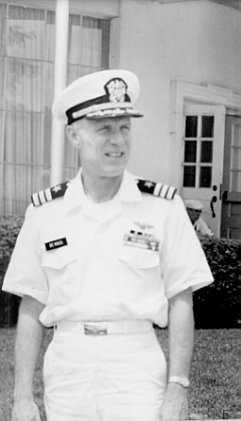
At the end of the war, Chuck decided to pursue a career in the Navy. He pivoted off aviation and towards intelligence. It was a good fit. Chuck served a total of 25 years in all manner of positions at the Office of Naval Intelligence, the Pentagon, CINCPAC staff and as XO of a training unit before retiring with the rank of Commander. As a civilian, Chuck continued to work in intelligence during the Cold War as a CIA and DIA analyst. His specialty was Soviet strategic weapons systems.
The men of Fighting Squadron 18 accomplished remarkable things during their lifetimes. Some of their stories survive in written form and photographs, which allow us to try to imagine what they must have been like, or tease out aspects of their personalities. Fewer stories survive in the reminiscences of their loved ones, which capture personal but fragmentary aspects of these men that may not make it into the written record. Oral histories—evidence of mannerisms, voice and personality—are rarer still. They represent an integral source of information for understanding how individuals responded to the world-historical events of World War II.
 Two-a-Day 18