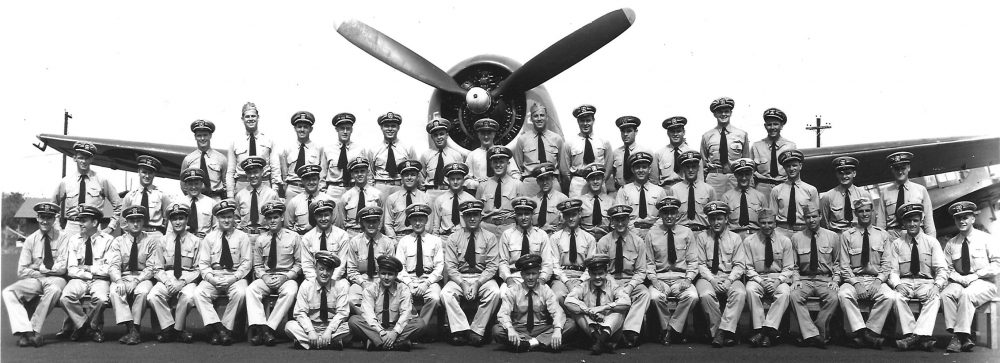
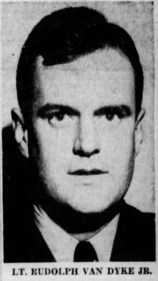
 In the early 1950s, Rudolph Van Dyke’s employer wanted to find out if “Rudy” still retained the air-to-air gunnery skills that made him a World War II fighter ace. To measure him against the best of the best, they sent Rudy to Nellis Air Force Base in Nevada to duke it out with pilots from the 3525th Aircraft Gunnery Squadron. According to the results, Rudy, “…rated above average when compared with experienced U.S. Air Force fighter pilots.” If the Air Force fighter jocks knew who they were flying against, it might have taken away some of the sting of losing to a Navy boy. After all, Rudy Van Dyke was not only one of America’s leading test pilots, he was also one of the fastest men on planet Earth.
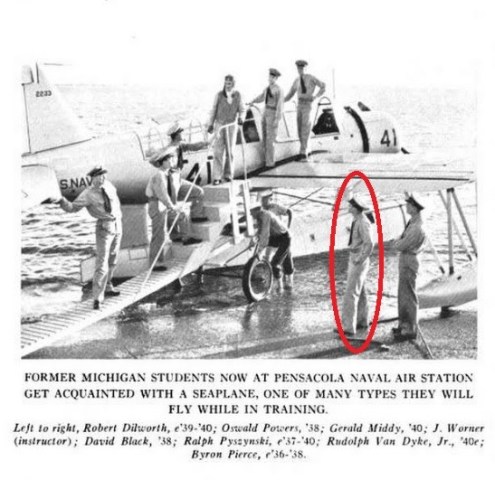
Rudolph Daniel Van Dyke, Jr. was born September 28, 1918 in Berkeley, California, but he grew up in Dayton, Ohio. He built model aircraft as a child and “guessed he always had been interested in flying.” He had a need for speed as well. In 1937, while enrolled at the University of Michigan for aeronautical engineering, Rudy got busted for “speeding 70 miles an hour and reckless driving.” He was fined $20 and his license was suspended for 30 days. However, this incident didn’t prevent Rudy from graduating with the class of 1940, nor did it make a difference when he signed up for the Navy’s aviation cadet program that July. Soon, the idea of “speeding” at 70mph would seem ludicrous.
In training, Rudy flew everything from Stearmans to seaplanes. He earned a place in “the Caterpillar Club” when he was forced to jump from a training plane, but that didn’t stop or even slow him down. He earned his commission as a naval aviator in late June 1941. As his plane-handling skills improved, his natural gunnery proficiency and penchant for speed led him to fighter duty. Rudy bounced around between temporary assignments close to home, at NAS Grosse Ile, Michigan, and as a recruiter in Cincinnati, but these were just pit stops on the way to Intrepid’s VF-18.
Like many other ace pilots in Fighting 18, Rudy scored the majority of his victories over Formosa (Taiwan). His mission on the morning of October 12, 1944, stands out not just because of his success in combat, but because it demonstrates how fiercely fighter pilots protected their bomber brethren.
Rudy was assigned to Strike 2A, the first full carrier strike launched against the island. Intrepid’s contribution was 12 Helldiver dive bombers, 9 Avenger torpedo planes and 5 Hellcat fighters. When the weather closed in on the primary target, Kirun (Keelung) Harbor, the majority of the strike proceeded to the alternate site at Tansui (Tamsui), a nearby seaplane base.
Kirun was bristling with antiaircraft guns and bustled with fighters overhead. Tansui was a different story entirely. Antiaircraft fire was meager and no airborne opposition was encountered. As a result, the Avenger pilots and crew “took their time and made the bombs count.” The dockyard, seaplane ramps, bunkers, a freight yard, freight cars and a gunship were seriously damaged or destroyed. Tansui was in flames in a matter of minutes.
In reality, the Japanese hadn’t abandoned Tansui at all—their pilots were just biding time until they had speed, altitude and the element of surprise on their side. As soon as Intrepid’s spent bombers started heading out of the strike zone, a dozen Japanese Army Air Force fighters streamed out of the overcast with guns blazing. Rudy and his quintet of Hellcats peeled off to engage, luring Japanese pilots away from the bombers and into aerobatic dog fights, but there were only five of them, and as many as fourteen of the enemy.
Rudy was not about to let these interlopers have their way. His first opponent flew a ‘Tony,’ a Kawasaki Ki-61 single-seat fighter. Rudy’s opponent pushed his stick down in an attempt to shake him, but it was too late. The Hellcat’s bullets tore through the engine from above. One down! With superior skill and technology at his disposal, Rudy got on the tail of yet another Tony, raking it from stern to stem as it attempted to dive away. A third followed. It was shaping up to be a banner day. The other Hellcat pilots tallied four between them and a handful more probably destroyed or at least damaged. The first wave was driven off without incident, but the fight was far from over.
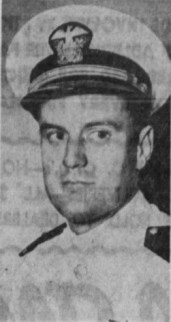
Rudy in the Dayton Daily News circa 1941
An additional group of 10 – 12 Japanese fighters appeared on the scene. Intrepid’s fighter jocks were back in the hot-seat and running low on ammunition. The bombers pushed ahead while the fighters had it out, but in short order another fourteen enemy planes pounced on the now-unescorted planes. The sky was thick with them. Helldiver gunners, the last line of defense, let roar with their twin 20mm guns as Intrepid pilots pushed their planes to the limits. The running fight covered 70 miles, but the determination of pilots and their crew prevented any losses. In fact, a Helldiver gunner was credited with shooting a Japanese fighter off another plane’s tail.
The Avengers were having an equally tough time of it. A separate group of 12 – 16 Japanese fighters attacked while Rudy and company were preoccupied. Like the Helldivers, the Avenger pilots pulled in tight together and let their guns do the talking; .30 and .50 caliber gunfire kept the lightly armored Japanese planes at bay.
On the horizon, Rudy saw the Avengers circled by a couple remaining Japanese fighters carefully testing the formation for an opening. He pushed his plane to catch up as he watched the formation disappear into the clouds, the Japanese in hot pursuit. Two more planes to his name would make Rudy Van Dyke and ace-in-a-day.
He closed the distance swiftly, buzzing between the formation and the enemy aircraft, making run after run on the Japanese planes. The enemy pilots turned tail and ran now that they had a Hellcat to contend with. The pilots of Fighting 18 had done their job: not a single bomber was lost to enemy aircraft.
Rudy may not have made ace-in-a-day, but the back-thumping and outpouring of thanks he received from the ‘Torpeckers’ aboard Intrepid no doubt made up for it. In any event, he couldn’t have shot those planes down no matter how good his aim had been. Rudy’s gun were empty either before he engaged the enemy or shortly thereafter. Even when his ammunition ran out, he kept attacking, determined to protect the Avengers at any cost.
He ended the war an ace after scoring again on October 14 and October 29. In 1946, Lieutenant Commander Van Dyke retired from the Navy after five and a half years of service. He was awarded the Silver Star, Distinguished Flying Cross and three Air Medals.
Returning to civilian life did not mean leaving the cockpit. Rudy signed on with NASA’s forebear, NACA, as one of its premier test pilots at Ames Research Center in California. Though he married Helen Joy Pestell in 1948 and became a father a few years later, he never did slow down. If anything, he sped up.
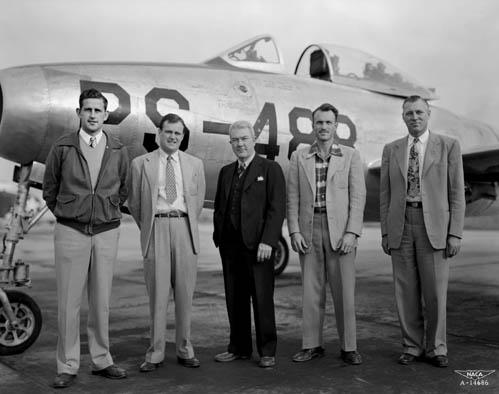
Ames research pilots circa 1949. Rudy Van Dyke pictured second from left.
Rudy Van Dyke became one of the unsung heroes of aeronautical research during his time at Ames. He was one of three principal test pilots for Ames’ first Variable Stability Aircraft. Such aircraft are still used today, such as the NF-16 VISTA operated by the USAF Test Pilot School at Edwards Air Force Base and have contributed to advanced fighter and V/STOL aircraft design. He also served as the primary pilot of an F6F-5 Hellcat from which an SB2C Helldiver was flown remotely, the first demonstration of this kind at Ames.
NASA’s official histories of Ames remembers Rudy for something much more fitting, though: speed. Specifically, his pioneering efforts pushing the sound barrier. It is worth quoting one of these histories in full to give Rudy his fair shake:
“George Cooper and Rudy Van Dyke began flight tests of the Air Force’s new F-86A Sabre in 1949. They made prolonged dives, starting from 46,000 feet, in which the F-86A reached very high speeds. These flights opened up the aircraft’s supersonic envelope and preceded North American and Air Force tests of the aircraft at these speeds. At about the same time, people in the general area began to hear explosions that occurred without any apparent reason. Eventually, these “explosions were correlated with the dive tests of the F-86 Sabre; they occurred when the aircraft reached supersonic speeds. This was the first time the “sonic boom” phenomenon had been associated with the supersonic flight of an aircraft. It is also noteworthy that these two pilots were routinely breaking the sound barrier at a time when only a small number of others, based primarily at Muroc Dry Lake, had done the same thing.”
These were dangerous pursuits to be sure, but any test flight could be dangerous. On June 1, 1953, Rudy climbed into the cockpit of an F8F Bearcat—a piston-engine propeller plane nowhere near as fast as a Sabre—and rolled down the runway into California skies. As he climbed upward, he put his plane through maneuvers, testing its response until he gradually leveled off. Nobody knows exactly why, but from that point on Rudy’s plane went into a steep dive until it slammed directly into San Francisco Bay. He did not survive the crash.
Rudy was just 35 years old at the time of his death. He was an accomplished pilot and a father of two infant children. Rudy’s bravery and sacrifice advancing the science of aviation came from somewhere deep inside of him; from the same wellspring that made him fight unarmed against two enemy planes in order to protect his fellow pilots.
As a fitting end note, I want to point out that Rudy’s contribution to aviation science and his pioneering spirit are alive and well at NASA’s Ames Research Center, Rudy’s old employer. Ames is currently responsible for configuration and systems engineering for the X-59, a low-boom flight demonstration aircraft that’s paving the way for the next generation of commercial supersonic planes. They’re working off a legacy that’s over 70 years old, one which traces its roots back to Rudy Van Dyke.
 Two-a-Day 18