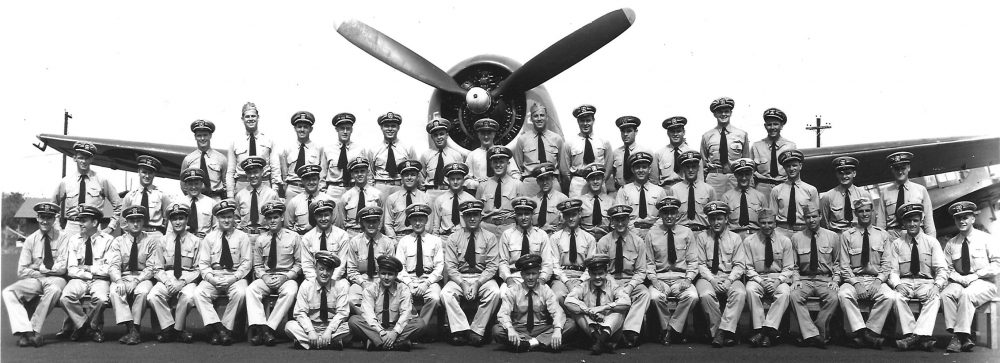
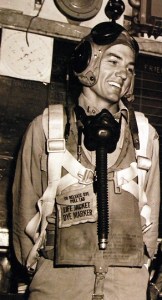
Charles Mitchell Mallory (1920-2013) was a dyed-in-the-wool West Virginian. He was born and raised in Kanawha County, a veritable outdoorsman’s paradise whose manifold waterways and verdant woods Charles came to know like the back of his hand. There was absolutely no place he’d rather be—at least not on earth.
The skies were a different matter. Like so many combat airmen in World War II, “Charlie” caught the flying bug through his university’s Civilian Pilot Training Program. When war came, this “Flying Mountaineer” left West Virginia University to do his part in the Pacific.
He did it well. Mallory was one of Fighting 18’s photo reconnaissance specialists. Throughout September 1944, he, along with his squad mates “Red” Beatley and Harvey Picken, took aerial photographs of the Philippines. Included among their targets: Leyte, the site of future allied landings, whose gulf would lend its name to one of the largest naval battles in world history.
September 21st 1944 was a milestone for the Third Fleet and for Intrepid’s air group. For the first time since the Philippines fell to Japan in 1942, the carriers were going to strike Luzon, the largest and most populous island in the archipelago. Charles Mallory was assigned photo duty that day alongside Picken, with Beatley and George Eckel flying as escorts. These photographic missions were deemed so important that Mallory and company had orders not to engage enemy aircraft unless directly attacked themselves. The orders purportedly came from Admiral William “Bull” Halsey himself. Charlie’s CO—his Commanding Officer—made sure this point was crystal clear before takeoff. Any deviation from this directive would result in serious military discipline up to and including court-martial.
The photo team left Intrepid around 0910 with the second strike of the day. While the rest of the formation continued on to Subic Bay, the four pilots of the photo unit split off to reconnoiter Clark Field, a former U.S. Army Air Corps base the Japanese were using as a hub in the region.
Japanese planes were already swarming over Luzon. They’d been caught on the ground by the morning’s first strike, which had taken off only an hour prior. Now they were up and spoiling for a fight. The first enemies Charlie encountered were six “Betty” bombers, twin engine, land-based attack aircraft used by the Imperial Japanese Navy. They were flying low and in loose formation; they didn’t appear to notice the photo planes.
Despite earlier admonitions, this opportunity was too good to pass up. As the fighters bore down, Mallory pounced on the first bomber to break formation. His machine guns sent it careening out of control to be finished off by Beatley. While those two headed below the clouds, Picken and his wingman Eckel easily dispatched the remaining bombers. What was the harm in engaging the enemy if the results were total victory?
All four pilots reconvened shortly thereafter over Clark Field, snapping pictures and scouting the terrain below. They were the only U.S. planes over an airdrome buzzing with enemy activity and bristling with anti-aircraft guns.
Beatley spotted another Betty escorted by a single fighter. He rolled in after the slow bomber and squeezed the trigger until his quarry exploded. Mallory, keeping a watchful eye from above, saw the day’s first real threat: a number of “Tony” fighters scrambling up on an intercept course. He alerted his division that enemies were incoming. Eckel heard the call and scanned his horizon for enemy aircraft. A formation of eight Betty bombers caught his eye. Were these Mallory’s bogeys?
Eckel engaged immediately. He was so eager, in fact, that he repeatedly overshot the lumbering bombers, chasing them low across the airfield. After finally landing hits and sending a plane spinning down to the ground below, he pulled up—just in time to see the Tonys lining up a gunnery run on him. Fortunately, his F6F Hellcat had more than enough power to pull him up and away from the Japanese pilots.
The Tonys went after Beatley next. Looking over his shoulder, Red realized they were only 100-or-so feet behind him and closing fast. Before the four Japanese fighters could seal the deal, however, Mallory cut in, putting .50cal rounds in and around the cockpit of the lead plane. The next Tony in line swerved onto Mallory’s tail, riddling his plane Tony may have had a tighter turning radius, but the Hellcat easily outclimbed them. The Japanese pilots fled as soon as they lost the altitude advantage.
This story would be remarkable enough if it ended here. But photo missions were absolutely crucial. Mallory, Beatley and Picken took off again on the very next strike only an hour and a half after they’d landed aboard Intrepid. They returned to Clark to take more pictures, and almost immediately spotted more Tonys above and below. In the ensuing fight, Charlie downed another two enemy fighters to bring his total for the day to five. He had accomplished a rare feat, making “ace” in a single day. He also disobeyed orders on two separate occasions.
When Charlie landed back aboard his ship for the second time, his CO was waiting. Not only would he not receive the Navy Cross for his heroism, he was told, he would be lucky to walk away from this incident without a court-martial. Earlier, he’d flown his plane back with 67 bullet holes in it. Then, on his second flight, he’d interrupted his picture taking to chase enemy aircraft in protracted aerial battles down almost to the mountaintops. Imagine trying to explain that!
Though he never received the Navy Cross, during his service with Fighting 18 Charles Mallory was credited with shooting down 11 enemy aircraft, making him one of the squadron’s hottest pilots.
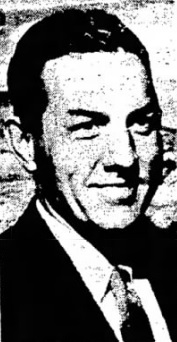
C.M. Mallory in 1965
After the war, Charles went back to school to get his degree in Real Estate. He settled back in Kanawha County where he successfully owned and operated both a department store and real estate firm. His employees loved him. In 1969 he was crowned Boss of the Year by the local chapter of the American Business Women’s Association. He even ran for local office, though his platform, “make the word integrity mean something in our state government,” likely rendered him ineligible.
He was always drawn back to the rivers of his youth and back into the air. When he wasn’t hard at work, Charlie could often be found in a canoe or plane. He was a founding member of the West Virginia Wildwater Association and flew all over, from Alaska to the Bahamas. Both river running and flying were lifelong pursuits. Indeed, “the Flying Realtor,” as he was nicknamed by a local newspaper columnist, wielded paddle and yoke into his late 80s. Charles Mallory passed away at age 92 in Kanawha County, leaving behind the patch of earth he loved best in favor of those irresistible skies.
 Two-a-Day 18